Connect with us

Security

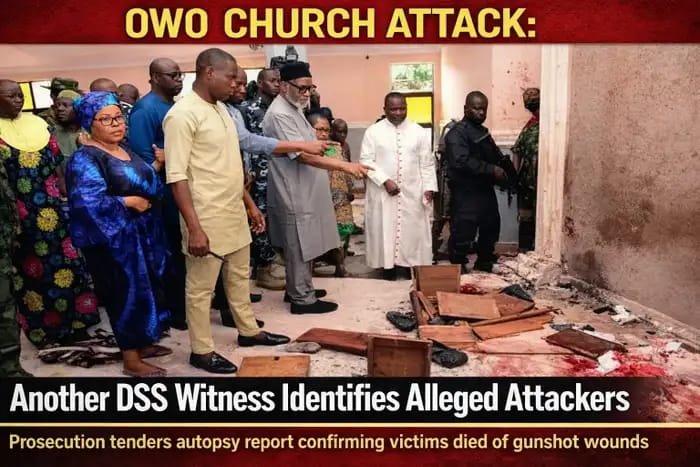
I SAW HIM CLEARLY ”: DSS WITNESS IDENTIFIES ALLEGED OWO CHURCH ATTACKER

Published

on

A Department of State Services (DSS) witness on Tuesday identified one of the defendants’ standing trial over the June 5, 2022 attack on St. Francis Xavier Catholic Church in Owo, Ondo State, is one of the gunmen involved in the deadly assault.

Testifying before the Federal High Court in Abuja, the witness, identified as PW7 and codenamed SSG, told the court that he recognised the second defendant, Al Qasim Idris, during a close-range exchange of gunfire on the day of the attack.

SSG, an Assistant Commander with the Ondo State Security Network Agency, Amotekun, said he was deployed to the church shortly after receiving an emergency alert from his commander.

According to him, he arrived to find scenes of mass casualties with the bodies of men, women, and children scattered within and around the church premises.

“I saw about 35 corpses,” he told the court.

The witness said eyewitnesses informed him that the attackers had escaped in a blue Nissan Sunny vehicle heading towards the Achievers University axis along Ute Road.

He said he and his team pursued the vehicle and tracked it to Ijegunman Village, where the suspects abandoned the car by the roadside and fled into the bush.

“They were four in number. They abandoned the vehicle and ran into the bush. When I searched the vehicle, I found packs of sachet water inside,” SSG said.

He identified the vehicle as a blue Nissan Sunny with registration number AKR 895 AG, adding that two operatives later drove it to the Amotekun office in Owo.

SSG further told the court that he and a hunter attached to his team pursued the suspects into the bush, where they later encountered them.

“They opened fire on us with AK-47 rifles. I responded with my pump-action rifle,” he said.

According to the witness, three of the attackers escaped deeper into the bush, while one hid behind a tree and shot the hunter, killing him instantly.

“I saw him clearly at close range,” SSG said, adding that he could still identify the shooter despite the incident occurring nearly four years ago.

Following an application by the prosecution, led by Ayodeji Adedipe (SAN), and with no objection from defence counsel Abdullahi Mohammad, the court allowed the witness to move closer to the dock to identify the suspect.

SSG stepped forward and pointed at Al Qasim Idris as the man who shot and killed the hunter. He repeated the identification during cross-examination, explaining that he could not arrest the suspect at the time because the defendant was armed with an AK-47 rifle, which he said outmatched his own weapon.

He added that the defendant was later arrested through a joint operation involving security agencies in Ondo State.

Earlier in the proceedings, the sixth prosecution witness (PW6), a pathologist codenamed SSF, tendered a certified true copy of the autopsy report on victims of the attack.

The report, which was admitted without objection, confirmed that the victims died from gunshot wounds that caused severe organ damage, skeletal injuries, and massive bleeding.

“Generally, all the bodies bore marks of gunshot injuries fired from varying distances, leading to fatal internal damage and exsanguination,” the pathologist testified.

The DSS is prosecuting Idris Abdulmalik Omeiza, Al Qasim Idris, Jamiu Abdulmalik, Abdulhaleem Idris, and Momoh Otuho Abubakar over the attack, which claimed dozens of lives.

This marks the second time a prosecution witness has directly identified some of the defendants as participants in the Owo church massacre.

Continue Reading
Click to comment

Leave a Reply

Your email address will not be published. Required fields are marked *

Legislature

WORO KILLINGS: SENATE DEMANDS IMMEDIATE RESCUE OF ABDUCTEES 

Published

on


The Senate has urged the Federal Government, through the Service Chiefs and the Office of the National Security Adviser, to intensify efforts toward the safe rescue and release of women and children abducted from Woro Community in Kaiama Local Government Area of Kwara State.

The upper chamber also called on the Federal Government to comprehensively clear and redesign the Kainji Forest Reserve to flush out criminal elements operating within the area. It further urged the strategic establishment of security formations where necessary to prevent future attacks.

The resolutions followed a motion of urgent national importance raised by Senator Sadiq Suleiman Umar (Kwara North), who informed the Senate that communities located in remote and forest-bordering areas remain highly vulnerable to attacks and require enhanced protection to prevent further loss of lives.

Contributing to the debate, other senators described the incident as tragic, noting that insecurity, armed banditry, kidnapping and abductions have become recurring challenges across the country. They called for urgent and decisive action to address the worsening security situation.

Among those who spoke were Senators Abba Moro, Adamu Aliero, Ahmed Lawan and Abdul Ningi, who stressed the need for improved intelligence gathering, security coordination and sustained military presence in affected regions.

In his remarks, the Deputy Senate President, Senator Jibrin Barau, urged both the Federal and Kwara State governments to provide comprehensive support, adequate resources and well-structured intervention programmes for displaced families and residents of Woro Community and other affected areas.

The Senate also called on the Federal Government to fully fund and expedite the completion of the already awarded Wawa–Kaiama and Kaiama–Kishi road projects. Lawmakers noted that the poor state of the roads has made access to the communities difficult and has further worsened security challenges in the region.


Continue Reading

General News

“FIRST LADY REMI TINUBU CALLS U.S. MILITARY AIRSTRIKES IN NORTHERN NIGERIA A ‘BLESSING ’ AMID DEBATE OVER CHRISTIANS KILLINGS ”

Published

on

First Lady Oluremi Tinubu

Nigeria’s First Lady, Senator Oluremi Tinubu, is facing growing criticism following remarks made during her official visit to the United States, where she described U.S. military intervention in Nigeria as a “blessing” and dismissed claims that Christians are being targeted for genocide in the country’s troubled northern region.


Speaking during media engagements and high-level meetings in Washington, D.C., Tinubu pushed back strongly against narratives circulating in parts of the U.S. and international advocacy space that Nigeria is witnessing systematic religious extermination. She characterised such claims as exaggerated and politically motivated, insisting that Nigeria’s security crisis is complex and not driven by religion.


Her comments, however, have landed at a particularly sensitive moment.


Within days of her statements, reports emerged from parts of Plateau, Benue, and Southern Kaduna of fresh attacks on rural communities, with dozens killed. While casualty figures vary depending on sources and remain difficult to independently verify in real time, local leaders, church groups, and humanitarian organisations have confirmed renewed violence affecting farming communities already displaced by years of conflict.


Tinubu’s remarks echo the long-held position of the Nigerian government: that violence in the North and Middle Belt is rooted primarily in banditry, terrorism, land disputes and criminality, not religious cleansing.


Government officials have repeatedly warned that framing the conflict as a Christian-Muslim war risks inflaming tensions and inviting foreign misinterpretation.


But critics argue that the First Lady’s Washington messaging focused heavily on military solutions while downplaying civilian suffering and the failure of governance in affected regions.


Judd Saul, Executive Director of the U.S.-based advocacy group Equipping the Persecuted, accused Nigerian authorities of misrepresenting realities on the ground. In a widely circulated statement, Saul claimed that while Nigerian officials were assuring U.S. audiences that no genocide exists, hundreds of Christians had been killed in recent attacks allegedly carried out by armed Fulani militias.


The Nigerian government has consistently rejected such ethnic or religious characterisations, stating that criminal groups operating in the region are not representative of any ethnic group and that security forces are actively responding.


Another source of controversy is the perception that Tinubu’s U.S. visit prioritised security cooperation, particularly airstrikes and intelligence sharing over discussions on development aid, education, healthcare, or humanitarian relief for conflict-affected communities.


During her engagements, Tinubu welcomed stronger U.S. security collaboration, describing it as vital to Nigeria’s fight against terrorism and insurgency. Yet critics say the emphasis on “bombs over bread” reflects a deeper failure to address the socio-economic drivers of violence: poverty, youth unemployment, climate pressure, and weak local governance.


Analysts note that military action alone has not ended Nigeria’s insecurity after more than a decade of counter-insurgency operations.


Photos and reports of the First Lady attending high-profile meetings and official dinners in Washington have further fuelled public anger back home, particularly on social media, where Nigerians questioned the optics of diplomatic reassurance abroad amid bloodshed at home.


For many affected communities, the issue is not whether the word “genocide” is technically accurate but whether their deaths are being minimised in global conversations.


As Nigeria seeks continued international support, the controversy highlights a growing disconnect between official diplomacy and local pain, raising uncomfortable questions about whose stories are told, whose are denied, and what solutions truly lie ahead.

Continue Reading

Security

BANDITS STORM CHURCH DURING NIGHT VIGIL, KIDNAP NINE WORSHIPPERS IN BENUE

Published

on


Suspected bandits have abducted nine worshippers during a night vigil at St. John’s Catholic Church in Ojije, Utonkon, Ado Local Government Area of Benue State.

The incident was confirmed on Monday by the Benue State Police Public Relations Officer, DSP Edet Udeme, who said the attack occurred while worshippers were observing a night vigil at the church.

According to Udeme, the assailants stormed the church under the cover of darkness and whisked away nine members of the congregation to an unknown location.

The police spokesperson disclosed that following the incident, the Benue State Police Command has deployed all its tactical teams across the state to the affected area to track the perpetrators and ensure the safe rescue of the abducted worshippers.

He assured residents that the police, in collaboration with other security agencies, are intensifying efforts to secure the release of the victims and restore calm to the community.

The abduction adds to growing concerns over insecurity in parts of Benue State, particularly attacks on rural communities and places of worship.

Police authorities urged members of the public to remain vigilant and to provide credible information that could aid ongoing rescue operations and the arrest of the suspects.

Continue Reading