Featured
Kemi Badenoch: Some thoughts and a prayer, By Matthew Hassan Kukah.
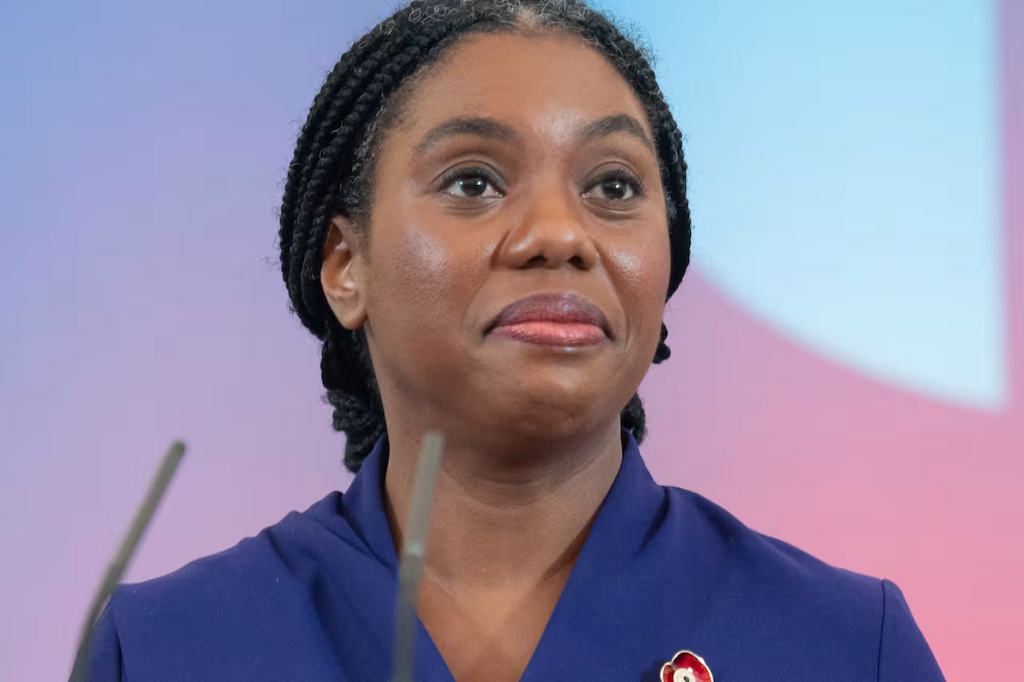
I was quite ecstatic about Kemi Badenoch’s miraculous slaying of the Goliath of the British establishment and emerging as the head of the Conservative Party and is now leader of the Opposition. I felt disappointed by the rather lukewarm reception of this great news especially in Nigeria and Africa. I drafted this opinion piece and I decided to seek the opinion of my good friend, Dipo Salimomu who has lived in England and understands the issues. I felt his criticisms would be useful. Nothing prepared me for the response I got from him.
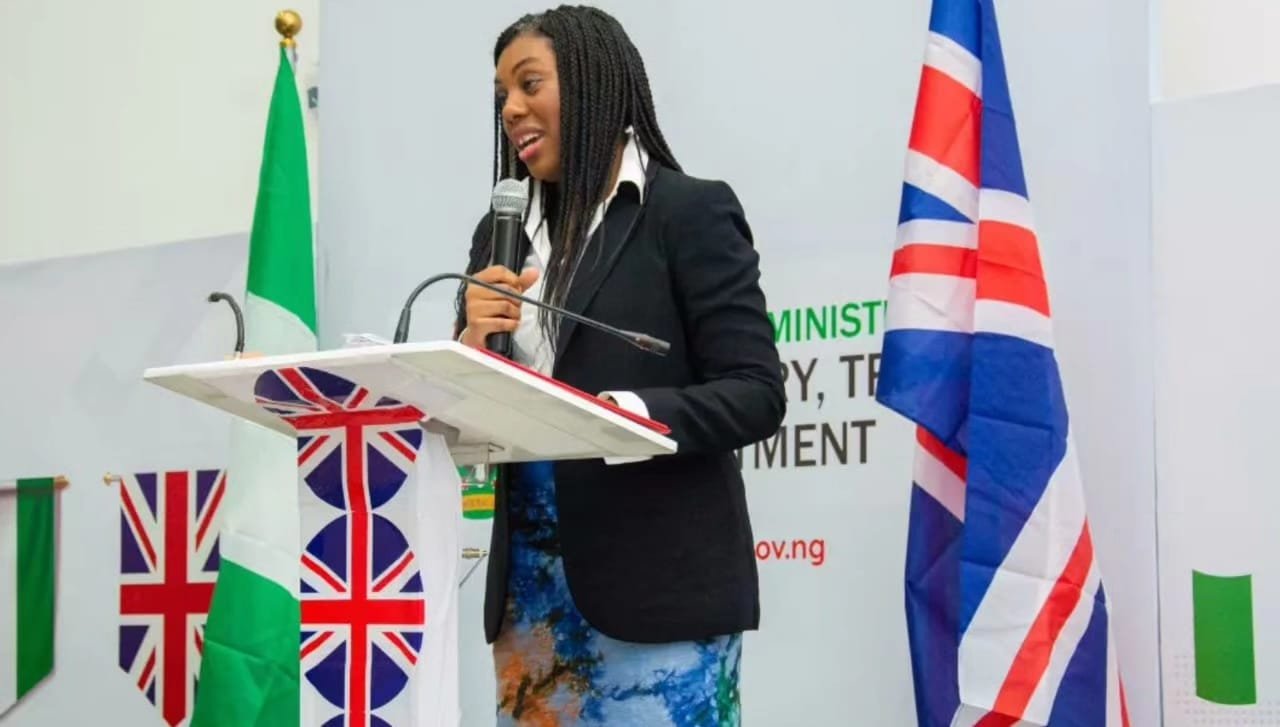
After reading the draft, he called to say he did not have much to add but could I take a look at a short video he had just sent to my Whatsapp page? I opened and played the video and could not believe my eyes. There, right before me was a young lady, Kemi Adegoke with whom I had shared a Tedex-Euston platform in 2017. Pat Utomi had been at the same event too. I had been struck by her eloquence and clarity of thought but that was it.
At that event, at only 30 years old, she had spoken about her journey into politics barely 15 years after returning to the UK at the age of 16. She spoke of her experience with white British teachers who had discouraged her from contemplating going to Oxford because she would be boxing well above her weight. She said that when she informed a white female Member of the Labour Party of her plan to join the Conservative Party, the lady had considered it a sign of ingratitude and a lack of appreciation of what the Labour Party had done for people of her kind. In the end, she said, she had joined the Conservative Party because, its ideology aligned with her personal beliefs. Barely seven years later, Kemi now sits at the highest pedestal of a Party she joined barely ten years ago. This is a feat that is moment defining and will remain a major marker in the future of British politics.
Truth be told, at the beginning, when I heard that one Kemi Badenoch, a British woman of Nigerian descent had thrown her headgear into the ring to contest for the position of Leader of the Conservative Party in July this year, I must confess that I sneered. ‘What kind of gra-gra is this’, I said to myself. I imagine that millions of people of African descent living in the United Kingdom and beyond felt the same. I was convinced that perhaps she simply wanted her name on the list for history. I recalled the story of the tortoise who was to be carried away on exile. As he was lifted up by, he had pleaded to be put down for just a few minutes. ‘I am not quarreling with my exile’, he said, ‘but just put me down, please’. When his captors reluctantly did, he scratched the ground with his paws and turned, saying, ‘Ok, I am ready for the exile. You can carry me’. Asked why he had wasted their time, he replied: ‘I want my descendants to know that their forefather did not go on exile without a fight’.
How Kemi pulled this great feat off, definitely requires far more attention than we are prepared to concede to her. On personal reflection, I scratched my head, pause and reflected: Kemi was born a year after I arrived the University of Bradford for a post graduate degree. The landscape of British public life from where I stood, was almost totally denuded of black presence in either academia, economics or politics. Bradford itself then was a sleepy environment with a very high Asian population running corner shops. There were hardly any black heroes or heroines not to talk of British citizens of Nigerian descent. In Long Tennis, Mr. David Imonite had made a brief appearance in Wimbledon in 1979. I had begun to support Nottingham Forest Football Club because of Viv Anderson, the first black person I saw playing football at that level. Later, John Barnes followed, with Liverpool later. Then came the greatest decathlete of all time, Daley Thompson, followed by the sprinter, Linford Christie, the heavy weight boxer, Frank Bruno and Lennox Lewis along with others. Sports and to some extent music (Sade Adu) would remain the main theatre of action for many British citizens of colour.
The walls of British politics, hitherto seeming impregnable, cracked open slightly when the 1987 elections saw Diane Abbot, Paul Boateng and Bernie Grant emerge as Members of Parliament under the flag of the Labour Party. Then, a lull followed, until 2017, where was a surge in black representation in the Parliament. Six British citizens of Nigerian descent won six seats (Chi Onwurah, Bayo Alaba, Kemi Badenoch, Taiwo Owatemi, Florence Eshalomi, Kate Osamor). Nigerians still blew muted trumpets.
It is from this Class of 2017 that Kemi forged her way through to become an insider in just about five years. Her speed of progress is phenomenal by any measure. She had no visible name recognition, experience, age or even resources. Like Oscar Wilde, the controversial Irish writer, who was asked by Immigration what he had to declare, Kemi can only declare genius! Against the run of play, she is today the Leader of the Conservative Party of the United Kingdom, and Leader of the Opposition. Coming from a background where patriarchy holds supreme, many men are still holding their breathe. After over a hundred years of presence, no black person has accomplished anything close to this. The drums ought to roll out.
There is need to pause and remember. This is the Conservative Party of Margaret Thatcher. This is the party that celebrates its 190th anniversary this year. To ascend to the top of this Party at the age of 44, is by any measure, an historic achievement. To do so as a woman and a black woman at that, the daughter of immigrants, and a wife and a mother, is worthy of celebration. Kemi’s ascendance is special. It points at the possibilities and challenges that lie ahead for those who dare. It is often the case that some doors are closed but not locked. When that right moment comes, you need boldness, courage, character and self-belief and of course, the grace of God.
Kemi’s selection by her peers has elicited comments and controversy, and rightly so. Some people have accused her of throwing her country, Nigeria ‘under the bus’ at the slightest opportunity. This is no doubt an exaggeration by her opponents. But let’s face it. To be thrown under a stationary bus should not be a matter of concern at all. Should we not be worried about the corruption that has become a swamp out of which we have been unable to swim? Should we not be worried that in our own country, we are still raising roadblocks against gifted men and women because of their faith or ethnicity? I am surprised that even some of her critics who have cases with the Economic and Financial Crimes Commission have found it convenient to condemn her for calling out Nigeria’s cancer of corruption. Nigeria’s dirty laundry will not be cleaned by outsiders or by self-deceit. From where she stands today, as a former Secretary of State for International Trade, Kemi likely knows more about the state of our sleaze than even we are prepared to admit. There are of course, other critics who seem to be driven by envy.
Join the Premium Times WhatsApp Community For Quick Access To News and Happenings Around You.
Open in WhatsApp
Having said this, Ms. Badenoch must also know that she should not stray too far from her natural constituency, as every politician soon learns. She has shown that her identity does not define her, but she cannot either ignore that she is black and the daughter of immigrants. Not only because it would smack of self-hatred, but it would rob her of the authenticity and largeness of spirit required of all transformative leaders. Good diplomacy must ensure a smooth relationship between her and Nigeria. She needs Nigeria and Nigeria needs her very much.
And, it must be mentioned, the revolving doors in established hegemonies often run out of oil, become creaky or stop revolving for certain people after some time. How she handles this great opportunity and challenge, will determine how others like her get a chance to enter the door. As she fights her way within the establishment, she must ensure that her doors are open to women and other immigrants who are seeking a life in politics. She would do well to adequately acquaint herself with the history of the black struggle in British public life, and especially in politics. Despite the ideological differences which may exist, advancing the cause of those who consider themselves outsiders to the British society should be taken seriously. She has some experience from her time as a former Minister for Women and Equalities. Her criticisms of existing populism must be constructive and helpful to all. She needs to be patient with those who have come from a long history of painful history of racism. It will not be wise to assume that the system has opened all her doors. This is the responsibility of leadership, to inspire and have empathy. She should not be tempted to ignore that the reinforced concrete that holds the structural injustice against those who feel left behind is still deep-seated in British society. She should resist the temptation to think that there are opportunities everywhere, it is just that the poor do not see them. It more than that.
Looking through a wider lens, African immigrants are poised to play a very significant role in global politics well beyond Africa. Nigeria needs to strategically position herself and take the lead in establishing and nurturing relationships with her sons and daughters in diaspora. Often, immigrants hold the rough end of the stick and are endurers of structural injustices in the societies in which they find themselves. Nigeria need not see them as simply ‘remittances donors’. In my view, the organization ‘Nigerians in Diaspora’ should be restructured, and headed by a former Ambassador or a Nigerian who has an international Rolodex and can operate at the highest levels of global soft diplomacy. The commission could serve as a lighthouse, identifying and pointing out Nigerians of great achievement in whom the country should believe and invest. Such a head could help Nigeria identify where and how to seek (I nearly said, steal) technological assistance and collaboration whether in Russia, China, the United States of America, Canada, the United Kingdom. It was patriotism that enabled Dr. Abdul Qadeer Khan to steal nuclear technology secrets from the Dutch company where he worked to enable Pakistan, Iran and North Korea have nuclear weapons today. Developing nations with ambition must deliberately invest in their citizens in diaspora. I hope that Nigeria takes Kemi quite seriously for its own interest.
The world is in a tensive flux now. As white populations reduce in Europe and other parts of the world, we are witnessing an upsurge of hate in both fringe and mainstream politics. Populist mobsters weaponize identity and deploy the scare mongering rhetoric of hatred, especially against immigrants, both on the streets and on the pages of social media. Kemi’s victory suggests that along with rejecting the soft bigotry of low expectaions, black people must not allow one single identity to define them, no matter the structural architecture of racism. Skin colour is surface thin, but it can be devastating as a weapon of exclusion. Kemi has shown that these walls are not static. They may be tough but they can be overcome.
That said, the modern world is very complex and no matter how noble the black agenda might be, it cannot succeed on its own. The challenge is to move away from blind and reductionist ideologies, and the suffocating nihilism which arises from self-pity or even self-hate. This is the lesson that great men like Mahatma Gandhi, Rev. Martin Luther King and Nelson Mandela have taught us. They tried to take their people away from self- consuming single-story narratives of oppression and prying open their worldviews and the lens through which their experiences are filtered and interpreted, despite the objection of a huge segment of their own people. Often, they paid the price with their lives.
Wimbledon needs a very special recognition as a sacred spot for Africans. It in Wimbledon that Arthur Ashe became the first black man to win the Men’s Tennis title in 1975. It is there that our own David Imonite became the first black African to compete in Wimbledon in 1979. It is with the Wimbledon Football Club that John Fashanu became the highest signing in 1984 and went on to play for that Club for nearly ten years. It is in Wimbledon that the William Sisters held the world spell bound as they both competed against one another and shared the prestigious titles between themselves in 2002, 2003, 2008, and 2009. It is not an accident that it is Kemi’s place of birth!
So, Kemi, accept our congratulations and prayers as you make history. Please work hard but conserve your energy. Wear the shoes of a long-distance runner. And be mindful of presumed allies. Remember that some night, you do not know when, the long knives may come out. All you need to do is just look at the shelf life of other women who have come after you. The work of a woman is never ended. Look back at the fate of your predecessors who are still around with you. Stay in touch with, compare notes or head-ties with big aunties like Ngozi Iweala, Amina Mohammed and others. You never know. Never forget, whatever you may believe today, God brought you where you are and for a purpose. The race ahead is not for the swift or for the faint of heart. Please remember with God on your side, ‘You will run, but you will not get weary, the Lord will renew your strength’ (Is. 40: 31). Well done, and Godspeed. We await the coronation.
Matthew Hassan Kukah is Bishop of the Catholic Diocese of Sokoto and founder of the Kukah Centre, Abuja, Nigeria.
Featured
THE UNCOMMON FEAT: WHY TINUBU’S STATE POLICE REFORM IS THE ANTIDOTE TO DECADES OF INSECURITY
By Oto’ Drama, PhD.
FOR decades, the discourse on Nigeria’s security architecture has been trapped in a centralized bottleneck—a stranger-policing model where officers are often deployed to terrains they do not understand and cultures they do not share.
Today, that cycle is breaking. By activating the transition to State Police, President Bola Ahmed Tinubu is not merely fulfilling a campaign promise; he is steering the nation toward a techno-sovereign reality where security is as local as the threats it seeks to eliminate.

This uncommon feat by the President and the Inspector General of Police (IGP), Tunji Disu, deserves more than just applause—it requires a rigorous intellectual and technological blueprint to ensure it becomes the cornerstone of a new Nigerian regionalism.
The Logic of the Local: Why State Police is the Only Way Forward
The fundamental maxim of modern governance is that all politics is local, but security is even more so. In every hamlet, village, and urban ward, the residents know the visitors, the anomalies, and the shadows. A federal officer from a thousand miles away cannot navigate the intricate social fabric of a community as effectively as a son or daughter of that soil.
While critics fear the political manipulation of state police by governors, this concern—though valid—is outweighed by the catastrophic cost of the status quo. Centralization has not prevented abuse; it has only facilitated inefficiency. By shifting to a subnational model, we introduce proximity as a deterrent. When the police are part of the community, the social contract is renewed, and the wall of silence that often protects bandits and kidnappers begins to crumble.
To transition from a “force” to a “service,” Nigeria must adopt the tactics of the world’s most efficiently policed nations. These countries balance local autonomy with high-technology integration. For President Tinubu and IGP Disu to truly “reclaim the killing fields,” the new state police must not just be “men in uniforms” but nodes in a digital security grid.
Here are three world-class tactics to curtail insecurity.
Nigeria’s forests have become “blind spots.” State police should be equipped with long-range thermal drones integrated with geotagging software. This allows local units to map “heat signatures” in dense foliage, identifying kidnappers’ camps with surgical precision before a single boot hits the ground.
Secondly, is Bio-Digital Border & Community DNA.
Instead of static checkpoints, state police should utilize biometric mobile units. By enrolling local populations into a decentralized database, “strangers” or “infiltrators” in a locality are immediately flagged during routine community patrols. This is the ultimate Bio-Digital Bastion.
Thirdly, is Professional Neutrality via Federal Oversight. To prevent the feared “governor’s militia” syndrome, Nigeria should adopt the German Model:
State Operational Autonomy: States control recruitment, localized patrolling, and community intelligence. A “National Police Service Commission” (NPSC) must set the bar for training, weapon handling, and forensic standards, with the power to decertify any state unit that violates human rights or democratic norms.
The inauguration of the 8-member steering committee by IGP Disu is the first step in a marathon. We must encourage this administration to remain indomitable. The transition to state police is not just a return to regionalism; it is a return to common sense.
By empowering the states to secure their own lands, President Tinubu is providing the antidote to insecurity. It is time to move past the fear of abuse and embrace the power of localized, intelligent, and technologically-driven protection. Nigeria’s sovereignty starts at the grassroots.
Dr. Drama, PhD Counterterrorism contributed this piece via: Nigeriandrama@gmail.com
Featured
DANIEL BWALA’S AL JAZEERA HUMILIATION +(VIDEO)
By Farooq A. Kperogi
I barely know Daniel Bwala. He came to the forefront of national media attention in 2022 because of his impassioned opposition to the choice of Kashim Shettima as Bola Ahmed Tinubu’s running mate. But beyond his public break from the APC, he came across to me as a voluble, ignorant and opportunistic careerist, not because of his stance on Tinubu’s choice of a Muslim running mate, but because of what struck me as his facileness and self-seeking obsessions.
His dramatic volte-face from being a virulent Tinubu critic to a fawning, vicious Tinubu battering ram has proven that my hunch about him was accurate.
Yet I felt sorry watching him eaten alive by Mehdi Hassan on Al Jazeera on Friday, March 6. He willingly participated in the detonation of what remained of his credibility before the world. In the process, he did incalculable reputational damage to the Tinubu government he is paid to protect.
What viewers saw on Mehdi Hasan’s Head to Head was the spectacle of a presidential spokesman arriving unarmed to a firefight he should have anticipated, then trying to fight back with nervous laughter, evasions, amnesia and the old Nigerian official fallback of whataboutery.
His evasiveness and prevarications were so unnervingly apparent that Hasan was compelled to say, “At the weekend, you put out a video to music of you and your team researching and prepping for this show and…now every time I ask you say you are not aware of that….what were you researching in that video…?”
The most striking thing about Bwala’s performance was not that he was challenged hard. Anyone who agrees to sit opposite Mehdi Hasan knows the interview will not be a tea party. The disgrace was that Bwala looked startled by facts he should have mastered before stepping into the studio.
On insecurity, on corruption, on Tinubu’s own words and even on his own prior statements, he oscillated between denial, deflection and the sort of desperate verbal stalling that makes a government look smaller than its critics claim it is.
The problem was not that Daniel Bwala appeared lazy or obviously unprepared. In fact, he looked prepared, even thoroughly rehearsed and robotic. He had the posture, the confidence and the choreographed mannerisms of a man who believed he had done his homework. But his carefully planned performances collapsed pitifully when they collided with Hasan’s hard, cold, indisputable facts.
Political wordplay can sometimes survive on friendly platforms or on Nigeria’s tame media spaces where assertion is mistaken for argument. It cannot survive a fact-driven, scorched-earthed, bare-knuckle, no-holds-barred interrogation.
Facts are facts. And Mehdi Hasan is a man of facts. He has the rare gift of making heavy, devastating facts sound almost light in conversation. That quality made Bwala’s evasions even more painful to watch.
The exchange over “context” illustrated this perfectly. When confronted with evidence that insecurity had worsened under the current administration, Bwala retreated to the mantra that “context matters.” Yet the context he invoked was little more than semantic fog and intentional, self-impressed verbal obfuscation.
Hasan, by contrast, used numbers and reports that any government spokesman worth the title should already know. The moment became absurd when Bwala insisted that the context of worsening statistics was that things were not getting worse. The dialogue is worth reproducing:
Hasan: You are failing. Amnesty International says you are failing at security. The numbers don’t lie.
Bwala: It’s unfortunate and as a government working day and night that situation. I don’t agree to [sic] the fact that it’s getting worse.
Hasan: How can it not get worse if more people die in one year than the previous year?
Bwala: Context matters.
Hasan: What’s the context?
Bwala: The context is not getting worse.
Hasan: What!
Bwala: Yes.
Hasan: The context is not getting worse?
Bwala: The context is that it is not getting worse, because you, you see this is a water [sic], right?….
Forget, for now, Bwala’s inexcusably horrible grammar, especially for a lawyer, his tortured logic and his buffoonish articulation. That was some cringeworthy self-own.
The numbers he tried to wave away are not inventions of hostile foreigners with an anti-Nigerian agenda. Nigeria’s own National Human Rights Commission reported that at least 2,266 people were killed by bandits or insurgents in the first half of 2025 alone.
Conflict monitoring groups have recorded even higher totals for the full year. Amnesty International has repeatedly warned that violence has intensified since Tinubu assumed office. In other words, Hasan’s central point was merely a summary of documented reality.
This is what made Bwala’s performance so damaging. He was not merely disputing interpretations. He was disputing arithmetic. When a spokesman tells the world that things are not getting worse while credible datasets show that they are, he is insulting the intelligence of everyone listening, especially Nigerians who bury the dead, pay ransoms, withdraw their children from schools and avoid highways after dark.
But the interview’s most morally satisfying feature was Hasan’s methodical dismantling of Bwala’s denials about his own past words. Bwala tried the trite and tired Nigerian political trick of pretending that statements made in opposition exist in a separate moral universe from statements made in office. Hasan did not let him get away with it.

Bwala denied on air having said Tinubu and his camp created a militia and threatened him. Yet those remarks were widely reported during the 2023 campaign. He also denied saying that bullion vans seen at Tinubu’s Bourdillon residence were ostensibly for vote buying, despite the fact that the comments were carried by multiple Nigerian outlets at the time. So, when Bwala asked who said such things, the answer was brutally simple. Daniel Bwala said them.
The same pattern appeared on corruption. Tinubu did in fact proclaim at a public event that Nigeria had “no more corruption,” a line that was widely reported and widely mocked and that provoked Omoyele Sowore to call Tinubu a “criminal” for which he is being tried now.
Bwala’s attempt to rescue the statement by retroactively inventing a narrower meaning was not the contextual clarification he wanted it to be. It was out-and-out mendacity.
On the appointment of Abubakar Bagudu as minister of budget and economic planning, Bwala again reached for evasion. Yet the record is clear that Bagudu returned about $163 million linked to the Abacha loot investigations in a settlement with authorities. Whether or not one calls that a conviction, the public controversy around his appointment cannot honestly be dismissed as drunken rumor.

Then there is the overarching irony that electrified the interview. Bwala was confronted with the fossil record of his own mouth. Before joining Tinubu’s camp, he publicly attacked the same man over allegations of corruption, the drug forfeiture case in the United States and the bullion van episode. What Hasan exposed was the speed with which partisan appetite can digest prior conviction and call the indigestion growth.
Bwala’s performance mattered for a reason larger than one man’s embarrassment. It showed in concentrated form the disease afflicting Nigerian political communication.
Too many spokesmen believe their job is not to illuminate but to survive the segment. So, they deny what is documented, nervously laugh when cornered, compare Nigeria with unrelated countries, abuse the word “context” and hope that shamelessness can do the work preparation cannot.
Daniel Bwala went to London to defend the government. Instead, he displayed its worst habits: contempt for evidence, indifference to contradiction and the assumption that public memory is so short that a man can disown his own recorded words without consequence.
Mehdi Hasan did not disgrace him. Bwala did that himself. Hasan merely kept the receipts.
Kperogi holds a Ph.D. in Public Communication from Georgia State University (2011), an M.Sc. in Communication from the University of Louisiana at Lafayette, and a B.A. in Mass Communication from Bayero University, Kano . He began his career as a journalist and news editor for Nigerian newspapers including the Daily Trust and the now-defunct New Nigerian . He also worked as a researcher and speechwriter in President Olusegun Obasanjo’s administration from 2002 to 2004 . Kperogi writes a popular weekly political column, “Notes from Atlanta,” which currently appears in the Nigerian Tribune, and a language column, “Politics of Grammar” . He has authored several academic books, including “Glocal English: The Changing Face and Forms of Nigerian English in a Global World” (2015) and “Nigeria’s Digital Diaspora: Citizen Media, Democracy, and Participation” (2020), which won the 2021 CHOICE Outstanding Academic Title Award
Featured
DSS, THE WALIDA ABDULLAHI EPISODE, AND THE QUIET LEADERSHIP OF DG ADEOLA OLUWATOSIN AJAYI- OLUMIDE BAJULAIYE
The Department of State Services (DSS), also known as the State Security Service (SSS), remains one of the most misunderstood institutions within Nigeria’s security architecture.
For many Nigerians, the agency only comes into public focus during dramatic arrests or when politics dominates the conversation. Yet intelligence work is far deeper and far more complex than the moments that make the headlines.
At its core, the DSS is Nigeria’s primary domestic intelligence service. Its duty is not simply to arrest suspects but to prevent threats before they escalate into national crises. Terror networks, espionage activities, sabotage against government institutions, and plots capable of destabilising the country all fall within its operational radar.
Like many institutions in Nigeria, the DSS has faced its share of criticism. There have been allegations of political interference, controversial arrests and occasional heavy-handed operations. Such scrutiny is normal in a democracy where powerful institutions are expected to remain accountable.

However, the other side of the story—often overlooked—is the critical role intelligence plays in keeping the country stable.
Intelligence successes rarely trend on social media because when intelligence works, crises are prevented before they occur. And “nothing happened today” rarely qualifies as breaking news.
Over the years, the DSS has helped disrupt terror financing networks, track extremist recruiters and intercept plots that could have resulted in major national security incidents. The agency has also provided intelligence support in the fight against insurgent groups such as Boko Haram, assisting security forces in anticipating threats.
Under the leadership of the current Director-General, Adeola Oluwatosin Ajayi, observers say the agency has focused increasingly on preventive intelligence, institutional reforms and improved collaboration with other security agencies.
Ajayi’s tenure has been associated with strengthening intelligence coordination among security institutions and placing greater emphasis on professionalism and lawful operations. Security analysts say the DSS has intensified efforts against kidnapping networks, arms trafficking rings and organised criminal syndicates threatening national security.
Another area where the current leadership has drawn attention is the effort to rebuild public confidence in the agency. In recent years, the DSS has demonstrated a willingness to review controversial cases, comply with court processes and engage more openly with stakeholders, including the media.
The recent episode involving Walida Abdullahi also illustrates the delicate balance intelligence agencies must maintain between national security responsibilities and public perception.
While details surrounding the matter sparked debate in public spaces, it also underscored how intelligence operations—often conducted quietly and based on sensitive information—can quickly become subjects of political or social interpretation once they enter the public domain.
For the DSS leadership, such situations represent the difficult terrain intelligence institutions must navigate: acting decisively when national security concerns arise while ensuring that operations remain within legal and professional boundaries.
Observers argue that the measured handling of such sensitive matters reflects the broader leadership approach of Ajayi—one that prioritises caution, institutional discipline and strategic restraint rather than dramatic publicity.
Beyond operational issues, the DSS under Ajayi has also sought to improve engagement with the media and civil society, a move many believe is necessary in building transparency without compromising intelligence confidentiality.
Ultimately, intelligence work remains one of the most paradoxical professions in public service.
When intelligence agencies succeed, the public rarely notices because crises are prevented before they happen. But when something goes wrong—or even appears controversial—everyone suddenly becomes an expert.
The DSS, like every intelligence service in the world, will continue to face criticism and scrutiny. That is part of democratic accountability.
Yet beyond the noise of politics and public perception, the agency remains a critical pillar in Nigeria’s internal security structure—often working quietly while the public sees only fragments of its work.
And if the current trajectory continues, the story of the DSS under DG Oluwatosin Ajayi may ultimately be defined not by the controversies that occasionally make headlines, but by the threats that never materialise.
Olumide Bajulaiye is the Publisher, Daily Dispatch Newspaper, writes from Abuja.