
Finance
DOLLAR TO NAIRA TODAY: NAIRA HOLDS STEADY AS OFFICIAL AND PARALLEL MARKET RATES CONVERGE

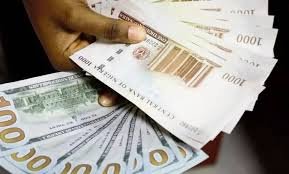
The Nigerian foreign exchange market opened on Wednesday, March 11, 2026, with the naira trading within a narrow range across official and parallel markets. Market analysts say the gap between the official window and the parallel market remains relatively small. However, exchange rates continue to fluctuate based on demand, supply, and liquidity in the forex market.
In the official market, the US dollar is quoted at between ₦1,390 and ₦1,405, while the parallel market sees the dollar trading at ₦1,405 to ₦1,415. The mid-market indicative rate for the dollar stands at ₦1,400. The euro is exchanging at ₦1,520 to ₦1,540 in the official window and between ₦1,630 and ₦1,660 on the parallel market, with a mid-market rate of ₦1,640. The British pound trades at ₦1,800 to ₦1,830 officially and at ₦1,920 to ₦1,950 on the black market, while the mid-market rate is ₦1,935.
The Chinese yuan is quoted at ₦190 to ₦195 in the official market and between ₦200 and ₦205 on the parallel market, with a mid-market rate of ₦202. The Japanese yen exchanges at ₦9.5 to ₦9.9 officially and at ₦10.2 to ₦10.6 on the parallel market, while the mid-market rate stands at ₦10.4. The Canadian dollar trades at ₦1,010 to ₦1,040 in the official window and between ₦1,090 and ₦1,120 on the parallel market, with a mid-market rate of ₦1,105.
The Swiss franc is exchanging at ₦1,560 to ₦1,590 officially and between ₦1,650 and ₦1,680 on the parallel market, while the mid-market rate is ₦1,670. The Saudi riyal trades at ₦370 to ₦375 in the official market and between ₦385 and ₦395 on the parallel market, with a mid-market rate of ₦390. The UAE dirham is quoted at ₦375 to ₦380 officially and between ₦390 and ₦400 on the black market, while the mid-market rate stands at ₦395.
The official rate represents transactions within the Nigerian Foreign Exchange Market regulated by the Central Bank of Nigeria. Meanwhile, the parallel market rate reflects prices quoted by Bureau de Change operators across major cities such as Lagos, Abuja, and Kano. The mid-market rate is the global benchmark rate used by international currency platforms. It does not include transaction charges or local dealer margins.
Exchange rates can change several times during the day. Therefore, traders and travelers should always confirm the current rate before carrying out foreign exchange transactions.


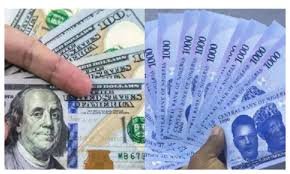
The naira ended the second week in a significant depreciation against the dollar in official and parallel foreign exchange markets.
On Friday, the Central Bank of Nigeria’s data showed that the Naira further slipped to N1,393.26 per dollar, down from N1,387.45. This means that on a day-to-day and week-on-week basis, the Naira dropped by N5.81 and N29.87, respectively, against the dollar. Meanwhile, in the last two weeks, the naira has slumped by N46.94 to the dollar at the official market.
Similarly, at the black market, the Naira dipped by N45 to N1,415 on Friday, down from around N1,370 per dollar on February 23, 2026, according to multiple Bureau de Change operators in Wuse Zone 4, Abuja.
The local currency decline across foreign markets comes after the apex bank mopped up dollars from the market by way of intervention, a move that was confirmed by President Bola Ahmed Tinubu in a recent remark.
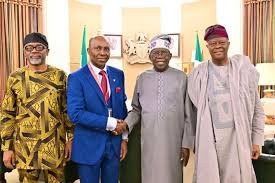
President Bola Ahmed Tinubu has nominated Mr Taiwo Oyedele as the minister of state for finance, replacing Dr Doris Uzoka-Anite. Uzoka-Anite will now move to the Ministry of Budget and National Planning, as the Minister of State, her third portfolio in the administration. President Tinubu has today conveyed the nomination of Oyedele to the Senate for confirmation in a letter to the Senate President, Godswill Akpabio.
The Special Adviser to the President on Information and Strategy, Bayo Onanuga, announced this in a statement on Tuesday. Onanuga revealed that until President Tinubu nominated him as a minister, Oyedele, from Ikaram, Akoko, Ondo State, was the chairman of the Presidential Committee on Fiscal Policy and Tax Reforms, which overhauled Nigeria’s tax system.

Oyedele, 50, is an economist, accountant and public policy expert. He attended Yaba College of Technology, where he obtained a Higher National Diploma in accountancy and finance. He attended Oxford Brookes University and earned a BSc in applied accounting. He also completed executive education programmes at the London School of Economics, Yale University, the Gordon Institute of Business Science, and the Harvard Kennedy School.
Onanuga further stated that Oyedele spent 22 years of his working career at PwC, joining in 2001 and rising to become the Fiscal Policy Partner and Africa Tax Leader. According to Onanuga, Oyedele is also a professor at Babcock University in Ogun State and a visiting scholar at the Lagos Business School.
The Central Bank of Nigeria has approved the merger between Unity Bank Plc and Providus Bank Limited, clearing the way for the two banks to begin integration.
The move follows a Court-Ordered Meeting and a joint statement released by the banks on Wednesday, February 18, 2026. The merger has also received the backing of shareholders, and all remaining steps are mainly procedural.
Once the court gives its final approval, the combined bank will join other institutions that have met the CBN’s new N200 billion capital requirement for national banking operations. The merger ensures the enlarged bank will maintain the necessary capital levels under the apex bank’s recapitalisation framework.

This merger comes as part of the CBN’s wider recapitalisation programme, which sets higher capital thresholds for banks depending on their licence type. National banks are required to have a minimum of N200 billion, while international banks must maintain N500 billion.
The programme is designed to strengthen the banking sector, improve financial stability, and ensure institutions can withstand challenges such as inflation, exchange rate swings, and tighter liquidity conditions.
Analysts say the combined bank will have a stronger balance sheet and greater resilience in Nigeria’s unpredictable economy. Providus Bank contributes digital banking and corporate services expertise, while Unity Bank brings an established retail and SME banking network.
Together, the merger is expected to increase market reach, deepen customer engagement, and improve service across both retail and SME segments.