General News
HURIWA CALLS FOR PEACEFUL PROTESTS AS SENATE DROPS REAL-TIME RESULT UPLOAD
The Human Rights Writers Association of Nigeria (HURIWA) has expressed strong opposition to the Senate’s passage of the Electoral Bill 2026 without a provision mandating the real-time electronic transmission of election results, describing the decision as a setback to electoral transparency and democratic accountability.
In a statement issued on Monday, HURIWA said it was “shocked and deeply concerned” that the Senate rejected amendments compelling the Independent National Electoral Commission (INEC) to upload polling unit results in real time, a reform the group considers critical to preventing electoral manipulation.
The rights group declared its support for peaceful mass protests demanding the immediate inclusion of real-time electronic transmission of results in the amended law. It also urged security agencies not to disrupt demonstrators, stressing that peaceful protest is a constitutionally guaranteed right.
“HURIWA calls on Nigerians participating in these protests to remain peaceful and law-abiding, while urging the police and other security agencies to respect citizens’ rights to peaceful assembly,” the group said.
HURIWA further cautioned Senate President Godswill Akpabio against viewing public opposition to the bill as intimidation of the National Assembly, arguing instead that it reflects legitimate advocacy for electoral reforms capable of strengthening democracy and public trust in elections.
According to the organisation, citizens and civil society groups, including HURIWA, have converged on Abuja for the “Occupy National Assembly” protest to challenge the Senate’s rejection of compulsory real-time result transmission.
The group also raised concerns over what it described as heavy deployment of security personnel drawn from the Nigeria Police Force, the Nigerian Army, and the Nigeria Security and Civil Defence Corps at protest venues. It questioned why security agencies, already stretched by counterterrorism and internal security challenges, were being deployed to monitor peaceful demonstrations.
HURIWA warned against the use of force on protesters, citing past incidents of violent crackdowns, and called on the federal government to ensure that demonstrations remain peaceful and unhindered.
The protests follow the Senate’s decision last Wednesday to reject an amendment to Clause 60 of the Electoral Act Amendment Bill, which sought to compel presiding officers to transmit polling unit results electronically to INEC’s Result Viewing (IReV) portal in real time.
Instead, lawmakers retained provisions from the 2022 Electoral Act, which allow results to be transmitted electronically after votes are counted and announced at polling units.
HURIWA argued that retaining the existing framework fails to address long-standing flaws in Nigeria’s electoral process, including result manipulation and falsification, which it said were evident in previous elections, particularly2023 general polls.
The group dismissed arguments that poor telecommunications infrastructure justified the rejection of real-time transmission, describing them as “untenable” and warning that the decision could worsen voter apathy and undermine confidence in future elections.
It recalled that the ongoing electoral amendment process began with joint public hearings by the Senate and House of Representatives Committees on Electoral Matters in October 2025, during which lawmakers and stakeholders pledged to introduce reforms to enhance transparency, accountability, and voter participation.
While acknowledging that the Senate approved some amendments such as: reducing election timelines, increasing fines for unlawful possession of voter cards, and formally adopting the Bimodal Voter Accreditation System (BVAS). HURIWA said these changes fall short without compulsory real-time result transmission.
The Senate also rejected proposals allowing electronically generated voter identification with QR codes, opting to retain the Permanent Voter’s Card (PVC) as the sole accreditation document.
At the centre of the controversy is Section 60 of the bill, which governs result transmission. Senators voted down a recommendation that would have required presiding officers to upload signed result forms to the IReV portal immediately after collation at polling units.
HURIWA warned that if the bill is signed into law without mandating real-time electronic transmission, the 2027 general elections could be marred by irregularities, post-election litigation, and potential unrest.
“Free and fair elections are the foundation of democracy,” the group said, adding that credible elections require transparent voting, accurate counting, and timely publication of results.
The statement was signed by Comrade Emmanuel Nnadozie Onwubiko, National Coordinator of the Human Rights Writers Association of Nigeria.
General News
FG ALLOCATES ₦10.49BN TO MARINE, BLUE ECONOMY MINISTRY FOR 2026; OYETOLA FLAGS FUNDING GAPS
The Federal Ministry of Marine and Blue Economy has proposed a ₦10.49 billion budget for the 2026 fiscal year, but the Minister, Dr. Adegboyega Oyetola, CON, has warned that the allocation is insufficient to meet the ministry’s critical mandate.
Oyetola presented the budget on Tuesday before a joint session of the Senate Committee on Marine Transport and the House of Representatives committees on Ports and Harbours, Maritime Safety, Education and Administration, Shipping Services, Inland Waterways, and Ocean and Fisheries.
The proposed ₦10,499,984,667.10 budget comprises ₦8.24 billion for capital expenditure, ₦453.86 million for overhead costs, and ₦1.81 billion for personnel. The minister noted that while the funding could sustain basic operations, it falls short of supporting sectoral reforms or driving significant growth.
He explained that the ministry oversees multiple interconnected subsectors — including ports, shipping, inland waterways, fisheries, and aquaculture — which collectively account for over 90 per cent of Nigeria’s international trade by volume, contribute to food and nutrition security, and underpin national economic competitiveness.
Oyetola highlighted operational challenges faced by agencies under the ministry, such as the Nigerian Ports Authority (NPA), Nigerian Maritime Administration and Safety Agency (NIMASA), and Nigerian Shippers’ Council. While largely self-funding and contributing substantial remittances to the Consolidated Revenue Fund, these agencies are constrained by “excessive deductions at source” by the Office of the Accountant-General of the Federation, he said. The minister warned that these deductions have led to port congestion, rising logistics costs, delayed cargo movement, revenue losses, and inflationary pressures, describing the issue as a national economic concern.
He also flagged an apparent misplacement in the 2026 budget, where the Council for the Regulation of Freight Forwarding in Nigeria (CRFFN) was listed under the Federal Ministry of Transportation instead of the Ministry of Marine and Blue Economy, complicating oversight and policy coordination.
On inland waterways, Oyetola called for increased funding to improve safety and efficiency, noting that water transport is globally cheaper than road haulage. He said Nigeria’s reliance on road transport for over 80 per cent of freight has accelerated road deterioration and raised logistics costs.
Turning to fisheries and aquaculture, the minister said Nigeria’s annual fish demand exceeds 3.6 million metric tonnes, while domestic production is around 1.4 million metric tonnes, resulting in over $1 billion in annual imports. He added that post-harvest losses of up to 30 per cent worsen supply shortages, stressing that boosting local production could reduce import dependency and provide affordable protein to households.
Oyetola further disclosed that in 2025, the ministry’s revised capital budget of ₦3.53 billion received only ₦202.47 million, about 1.7 per cent, while overhead releases stood at 35 per cent. He said ongoing engagements with the Ministry of Budget and Economic Planning aim to address these funding gaps in line with the Federal Government’s agenda to diversify the economy through the marine and blue economy.
Senator Wasiu Eshilokun, Chairman of the Senate Committee on Marine Transport, assured that the National Assembly would carefully review the proposals, emphasizing the strategic importance of the marine and blue economy to Nigeria’s development and economic resilience.
General News
NIMET’S 2026 SCP PREDICTS LONGER-THAN-NORMAL RAINFALL, WARNS FARMERS AGAINST EARLY CULTIVATION
The Minister of Aviation and Aerospace Development, Festus Keyamo, SAN, has said that normal annual rainfall amounts are expected in most parts of Nigeria in 2026 when compared to the long-term average.

Keyamo stated this in a keynote address at the Nigerian Meteorological Agency (NiMet) 2026 Seasonal Climate Prediction (SCP) presentation held in Abuja on Tuesday, February 10, 2026.
The Seasonal Climate Prediction provides comprehensive climate forecasts designed to guide agricultural planning, water resource management, and disaster preparedness across critical sectors of the Nigerian economy. It also offers projections on key climate variables, including rainfall distribution and temperature patterns for the year.

The 2026 SCP, themed “Climate Science for Sustainable Development,” outlines variations in rainfall onset, cessation, duration, and intensity across different parts of the country.
According to the forecast, early rainfall onset is expected in Bayelsa, Rivers, Akwa Ibom, Cross River, Benue, Kogi, Nasarawa, Oyo, and parts of Kebbi, Niger, Jigawa, Katsina, Kano, Adamawa, and Taraba States. Conversely, a late onset of rainfall is predicted for Borno State.
Rainfall cessation is expected to occur earlier than normal in parts of Ogun, Osun, Ondo, Imo, Rivers, Akwa Ibom, Kogi, and Niger States. However, a delayed end to the rainy season is anticipated in Lagos, Ogun, Anambra, Enugu, Cross River, Benue, Nasarawa, and Kaduna States.

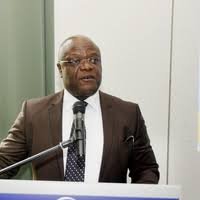
Dr. Anosike
A longer-than-normal rainy season is projected for Lagos, Benue, Enugu, Ebonyi, Ogun, Oyo, Nasarawa, Anambra, Kwara, Kebbi, Kaduna, Gombe, and Taraba States. In contrast, parts of Borno, Yobe, and Niger States are expected to experience a shorter-than-normal rainy season.
NiMet further forecasts above-normal rainfall in Borno, Sokoto, Kebbi, Kaduna, Enugu, Cross River, Abia, Ebonyi, Akwa Ibom States, and the Federal Capital Territory. Below-normal rainfall is, however, expected in parts of Katsina, Zamfara, Kwara, Oyo, and Ogun States.
During the March to May period, severe dry spells lasting more than 15 days are likely in parts of Oyo and Ogun States. Moderate dry spells are predicted across Ekiti, Kogi, Osun, Ondo, Ogun, Edo, Ebonyi, Abia, Cross River, Delta States, as well as parts of Kogi and Kwara States.
For the June–July–August season, severe dry spells of up to 21 days are expected in parts of Bauchi, Borno, Gombe, Jigawa, Katsina, Kano, Kebbi, Kwara, Nasarawa, Niger, Oyo, Plateau, Sokoto, Yobe, and Zamfara States.
The Little Dry Season (LDS), popularly known as the “August Break,” is forecast to begin by late July and is expected to be severe and prolonged over Lagos, Ogun, Ekiti, and parts of Oyo States.
The number of days with little or no rainfall during this period is projected to range between 28 and 40 days. A moderate LDS effect is expected over Ondo and parts of Kwara and Edo States.
NiMet also predicts that both daytime and nighttime temperatures will be warmer than the long-term average across most parts of the country in January, February, March, and May 2026.
The Minister advised farmers and stakeholders engaged in rain-fed agriculture and other rainfall-dependent activities to rely on the predicted onset dates outlined in the SCP or consult NiMet for appropriate guidance to avoid losses associated with premature cultivation.
Goodwill messages were delivered by the Permanent Secretary of the Federal Ministry of Aviation and Aerospace Development and NiMet’s international partners, including the Secretary-General of the World Meteorological Organization (WMO), Prof. Celeste Saulo.
Members of the All Farmers Association of Nigeria also shared testimonials in various Nigerian languages, recounting the effectiveness of NiMet’s SCP in improving agricultural decision-making.
As NiMet marked 140 years of service to Nigeria, past Directors-General of the agency were recognised for their contributions.
The event’s highlights included the official launch of the 2026 SCP report by the Minister of Aviation and Aerospace Development, with support from the Director-General of NiMet, Prof. Charles Anosike, and other key stakeholders.
General News
SENATE REVERSES EARLIER STANCE, APPROVES ELECTRONIC TRANSMISSION OF ELECTION RESULTS
The Nigerian Senate on Tuesday approved the Electronic Transmission of Results Bill, reversing its earlier position following intense pressure from civil society organisations and public criticism.
The bill was passed after a motion was raised under a point of order to rescind and amend a contentious provision in the earlier version. The amendment replaced the phrase “transfer of results” with “transmission of results,” a change advocates say is crucial for safeguarding the integrity of elections.
The motion was moved by the Senate Chief Whip, Senator Tahir Monguno.
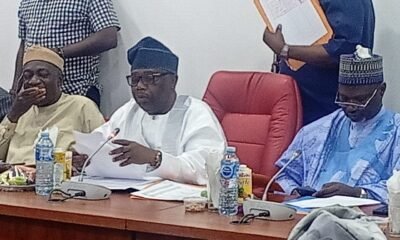
The amendment, however, triggered a rowdy plenary session, as several senators openly opposed the motion, leading to heated exchanges on the Senate floor.
During the debate, Senator Enyinnaya Abaribe (Abia South) invoked Order 72 of the Senate Standing Rules, calling for individual voting on the motion. He later withdrew the request, allowing proceedings to continue.
Subsequently, Senator Diket Plang moved a motion that the earlier votes and proceedings be adopted and approved as amended. The motion was seconded by Senator Seriake Dickson.
After the motion was put to a voice vote, Senate President Godswill Akpabio declared it passed.
Akpabio also announced that the membership of the conference committee on the bill had been expanded from nine to twelve members. He named Senator Simon Lalong as chairman of the committee, along with other members.
The Senate President expressed optimism that all outstanding issues would be resolved promptly, adding that President Bola Ahmed Tinubu is expected to assent to the bill before the end of the month.
In a related development, Akpabio read a letter from President Tinubu seeking Senate confirmation of non-career ambassadors.
The request was referred to the Senate Committee on Foreign Affairs, which is expected to report back to the Senate within one week.