
Education
Only the Best Made It – DELSU VC Tells 9,498 New Students

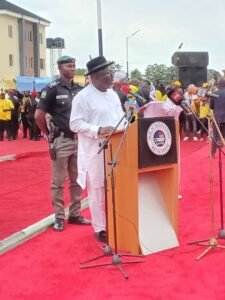
Delta State University (DELSU), Abraka, has formally welcomed 9,498 newly admitted students into its academic community for the 2025/2026 session.
The matriculation ceremony was held on Saturday at the Convocation Arena, Site III, on the university’s main campus in Abraka, drawing faculty members, parents, and well-wishers.
Speaking at the event, Vice Chancellor, Professor Samuel Asagba, congratulated the students for successfully navigating the Unified Tertiary Matriculation Examination (UTME) and the university’s Post-UTME screening exercise. He described their admission as a significant achievement, noting that thousands applied but only 9,498 secured places.
Giving a breakdown of admissions across faculties, he said the Faculty of Science recorded the highest number with 1,736 students, followed by Education with 1,385 and Management Sciences with 1,100. Other faculties admitted include Arts (952), Allied Health Sciences (804), Social Sciences (660), Communication and Media Studies (633), Engineering (592), Computing (340), Law (118), Pharmacy (114), Dentistry (10), Environmental Sciences (21), Basic Clinical Sciences (five), and Agriculture (171).
Professor Asagba urged the new students to recognise the privilege of gaining admission into the institution and to make the most of the opportunity.
Highlighting the university’s growing reputation, he referenced the 2026 Times Higher Education rankings, which placed DELSU as the fourth-best state university in Nigeria and 12th overall in the country. According to him, the institution also emerged as the leading state university in both the South-South and South-East regions.
He attributed the progress to consistent academic standards, strong engagement with host communities, and continued support from the Delta State Government.
The Vice Chancellor disclosed that the university currently runs 17 faculties offering 109 academic programmes, alongside an Institute of Education and a Business School located in Asaba. He assured that all programmes have full accreditation and that new, industry-driven courses are being introduced to align with global trends.
Addressing the matriculants, Professor Asagba stressed the importance of discipline and focus. He warned against excessive use of social media and cautioned students to steer clear of cultism, cybercrime, examination malpractice, indecent dressing, and any behaviour capable of disrupting peace on campus.
The National Universities Commission (NUC) has approved 33 new universities across Nigeria in 2025, bringing the total number of universities in the country to 309.
Data obtained from the commission shows that 20 private universities were granted operational licences within the year, while the Federal Government established seven new institutions. State governments account for 67 universities nationwide.
The newly established federal universities are located in Rivers, Kaduna, Ogun, Osun, Ekiti, Oyo, and Zamfara states.
Among them are:
Federal University of Environment and Technology, Tai Town, Rivers State
Federal University of Applied Sciences, Kachia, Kaduna State
Federal University of Agriculture and Developmental Studies, Iragbiji, Osun State
Federal University of Technology and Environmental Studies, Iyin-Ekiti, Ekiti State
Federal University of Agriculture and Technology, Okeho, Oyo State.
At the state level, Niger, Benue, Cross River, and Imo state each established one new university, while Ebonyi State set up two.
Some of the newly created state universities include:
Abdulsalam Abubakar University of Agriculture and Climate Action, Mokwa, Niger State
Ebonyi State University of ICT, Science and Technology, Oferekpe
Cross River University of Education and Entrepreneurship, Akamkpa
Benue State University of Agriculture, Science and Technology, Ihugh
With 168 institutions, private universities remain the largest category within Nigeria’s university system, followed by 74 federal universities and 67 state-owned institutions.
Among the newly licensed private universities are:
Leadership University, Abuja
Jimoh Babalola University, Ilorin, Kwara State
Bridget University, Mbaise, Imo State
Greenland University, Jalingo, Taraba State
JEFAP University, Suleja, Niger State
Azione Verde University, Amaigbo, Imo State
Unique Open University, Ojo, Lagos State
Six of the new private universities are located across Lagos, the Federal Capital Territory, and Imo State, with two institutions each. Ogun and Kwara states host three each, while others are spread across Ondo, Osun, Akwa Ibom, Edo, Enugu, Kaduna, and Taraba states.
879 New Programmes Introduced Under CCMAS
In January 2026, the Executive Secretary of the NUC, Abdullahi Ribadu, disclosed that more than 879 new academic programmes were introduced in Nigerian universities in 2025.
The development follows the implementation of the Core Curriculum and Minimum Academic Standards (CCMAS), a framework designed to reform and modernise the Nigerian University System.
According to Ribadu, the CCMAS framework allocates 70 per cent to core academic content and 30 per cent to university-specific content, allowing institutions greater flexibility in curriculum development.
He explained that the new programmes incorporate 21st-century competencies such as digital literacy, entrepreneurship, and problem-solving skills, with emphasis varying across disciplines.
The reform, he said, is aimed at repositioning Nigerian universities to produce globally competitive graduates and strengthen the country’s higher education system.

The Federal Ministry of Education has debunked claims that the History textbook Living History has been approved for use in Nigerian schools.The Ministry also dismissed allegations that the book excludes Igbo content, describing such claims as misleading.
In a statement issued on Tuesday, the Ministry, through its Director of Press and Public Relations, Boriowo Folasade, clarified that Living History is not an approved instructional material and has never been recommended by the Federal Ministry of Education or the National Educational Research and Development Council (NERDC).
NERDC is the statutory body responsible for reviewing and approving textbooks and other instructional materials in line with the national curriculum.
“The book was never submitted to NERDC for evaluation and does not appear on the official list of approved History textbooks,” Folasade stated.
According to the Ministry, consultations with NERDC further confirmed that Living History is not among the instructional materials endorsed for nationwide use in schools.
The Ministry urged parents, teachers, school proprietors and the general public to disregard misinformation and refrain from using unapproved educational materials, warning that such practices could undermine teaching quality, learning outcomes and national curriculum standards.
“All approved textbooks strictly comply with the national curriculum and reflect Nigeria’s rich cultural diversity, shared history and core national values, promoting inclusivity, balance and unity,” the statement added.
Stakeholders were advised to verify the approval status of textbooks and learning materials through official NERDC channels before adoption.

Delta State Governor, Rt. Hon. Sheriff Oborevwori, will on Monday, February 2, 2026, inaugurate the newly completed Omadino Model Technical College in Warri South Local Government Area of the state.
The inauguration ceremony is scheduled to hold at the college premises by 10:00 a.m., with invited guests expected to be seated by 9:30 a.m., according to a statement issued by the Governor’s Chief Press Secretary, Sir Festus Ahon.
The Omadino Model Technical College is one of the legacy projects inherited by the Oborevwori administration and has now been fully completed and equipped to deliver modern technical and vocational education.
The institution is designed to provide students with practical, industry-relevant skills aimed at promoting self-reliance, enhancing employability and supporting national productivity goals.
Facilities at the college include purpose-built workshops, modern classrooms, laboratories and specialised training centres tailored to contemporary technical education standards.
The college is expected to serve as a hub for training skilled technicians, artisans and innovators capable of meeting the demands of a rapidly evolving economy.
According to the statement, Governor Oborevwori considers technical and vocational education a key pillar of his MORE Agenda, particularly in creating opportunities for young people to acquire marketable skills, reduce unemployment and contribute meaningfully to socio-economic development.
Education stakeholders, community leaders and other invited guests are expected to attend the ceremony, which marks another milestone in the administration’s efforts to strengthen human capital development and expand access to quality, functional education across Delta State.