Religion
RARE 1847 ANTI-SLAVERY DOCUMENT REVEALS AMERICAN BAPTISTS’ COMMITMENT TO ABOLITION
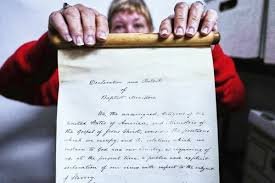
A remarkable piece of American history has been uncovered in the American Baptist archive in Groton, Massachusetts. Jennifer Cromack, a retired teacher and archive volunteer, stumbled upon a 5-foot-long handwritten document titled “A Resolution and Protest Against Slavery,” signed by 116 New England ministers in Boston and adopted on March 2, 1847. The document, which was thought to be lost forever, offers a glimpse into the emerging debate over slavery in the 18th century in the Northeast.
The document’s discovery is significant, as it sheds light on a critical moment in the history of the Baptist church. It was signed two years after the issue of slavery prompted southern Baptists to split from northern Baptists and form the Southern Baptist Convention. The northern Baptists eventually became American Baptist Churches USA.

Rev. Mary Day Hamel, the executive minister of the American Baptist Churches of Massachusetts, said, “It comes from such a critical era in American history, you know, right prior to the Civil War. It was a unique moment in history when Baptists in Massachusetts stepped up and took a strong position and stood for justice in the shaping of this country. That’s become part of our heritage to this day, to be people who stand for justice, for American Baptists to embrace diversity.”
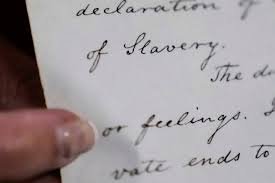
The document shows that the ministers had hoped for a “reformatory movement” led by those involved in slavery, but felt compelled to act after witnessing a growing disposition to justify and perpetuate the system. “Under these circumstances, we can no longer be silent,” the document states. “We owe something to the oppressed as well as to the oppressor, and justice demands the fulfillment of that obligation.”
Rev. Diane Badger, the administrator of the American Baptist Church of Massachusetts, has been working to identify the signers of the document, including Nathaniel Colver of Tremont Temple in Boston and Baron Stow, who belonged to the state’s anti-slavery society. Badger is also estimating the document’s value and planning for its protection, with potential plans to share a digital copy with Massachusetts’ 230 American Baptist churches.
The discovery has been met with inspiration from Rev. Kenneth Young, whose predominantly Black Calvary Baptist Church in Haverhill, Massachusetts, was created by freed Blacks in 1871. “I thought it was awesome that we had over hundred signers to this, that they would project that freedom for our people is just,” Young said. “It follows through on the line of the abolitionist movement and fighting for those who may not have had the strength to fight for themselves against a system of racism”.
International
Pope Leo Condemns ‘Atrocious Violence’ in Iran War, Calls for Immediate Ceasefire
Pope Leo XIV has strongly condemned the escalating war involving Iran, describing the ongoing conflict as “atrocious violence” and calling on all parties to immediately halt hostilities.
Speaking during his weekly Angelus prayer at St. Peter’s Square in Vatican City on Sunday, the pontiff appealed to leaders involved in the conflict to declare a ceasefire and pursue dialogue instead of continued military confrontation.
The appeal comes as the war widely reported to involve strikes by the United States and Israel against Iranian targets, entering its third week, leaving thousands of civilians dead or displaced across the Middle East.
“For two weeks, the peoples of the Middle East have been suffering the atrocious violence of war,” the Pope said, warning that violence can not bring justice, stability, or lasting peace to the region.
The Catholic leader expressed solidarity with victims of the conflict, particularly civilians who have lost loved ones or been forced to flee their homes. He emphasized the urgent need for humanitarian support for affected communities.
The Pope also raised concerns about the growing instability in Lebanon, where clashes between Israel and the Iran-backed group Hezbollah have worsened the humanitarian situation.
Calling for a diplomatic solution, the pontiff urged global leaders to pursue dialogue that could lead to lasting peace and stability in the Middle East.
Despite maintaining the Vatican’s traditional diplomatic neutrality, the Pope’s comments are seen as one of his strongest appeals yet for an end to the expanding regional conflict.
International
Vatican Removes San Diego Bishop Over $250,000 Church Fraud
The Vatican has accepted the resignation of Bishop Emanuel Hana Shaleta of the Chaldean Catholic Diocese of St. Peter the Apostle in San Diego following his arrest on allegations of embezzling $250,000 from his congregation.
Bishop Shaleta, who had served the Chaldean Catholic community since 2017, pleaded not guilty to 16 counts of embezzlement and money laundering during a court hearing on Monday. According to San Diego Deputy District Attorney Joel Madero, the alleged offenses occurred in 2024 and were discovered after a church employee reported missing funds, local broadcaster KGTV reported.
Authorities detained Shaleta on March 5 at San Diego International Airport while he was attempting to leave the United States. His lawyer stated that the bishop had planned to travel to Germany.
Chaldean Catholics, while recognizing the authority of the Pope, follow an Eastern Christian liturgical tradition. Vatican statistics estimate approximately 71,000 Chaldean Catholics reside in the San Diego area.
The arrest and resignation have sent shockwaves through the local religious community, prompting calls for greater transparency and accountability in church financial management.
International
Security Breach in Vatican Conclave: Cardinal Found With Cellphone, Book Reveals
A shocking breach of protocol occurred during the secret conclave that elected Pope Leo XIV last May, a new book by veteran Vatican reporters reveals.
As 133 cardinals gathered in the Sistine Chapel for their first vote, which is typically safeguarded by signal-jamming equipment to prevent outside communications, security officials detected an active mobile phone signal inside the chapel.
In a scene the authors describe as “unimaginable even for a film,” one of the older cardinals discovered a cellphone in his pocket and handed it over to security. The book, The Election of Pope Leo XIV, does not identify the cardinal or suggests he had any motive for carrying the phone but notes he was “disoriented and distressed” by the incident.
The incident is unprecedented in the history of modern papal conclaves, which require cardinals to relinquish all communication devices to ensure the election process remains secret.
Pope Leo XIV, elected on the fourth ballot with 108 votes, became the first pope from the United States. The revelation of this security lapse provides a rare behind-the-scenes glimpse into one of the world’s most secretive religious events.