Interview
A Prayer From the Gutter


Türkçe’si için, buraya tıkla.
Nobody should know my name.
The fact that you’re reading this is proof of God’s grace.
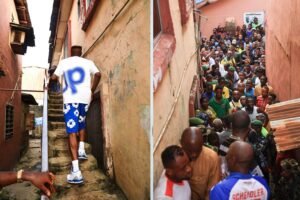
My mother died when I was 2 or 3. Too young to remember anything except her holding me. Me and my 6 siblings lived in a one-room apartment in a shanty town in Lagos. It’s called Olusosun. You may have heard of it. It’s next to the biggest landfill in Africa. People say they drop off 10,000 tons of garbage a day there. Chemical waste. Broken TVs. Anything you can imagine.

That was my backyard.
When I started playing football and I wanted boots, I’d just go out into the dump with my friends and search.
“Hey, I found a broken Nike. Left foot! Size 8!”
(An hour later…….)
“Hey, I found a Puma!!!! Right foot!!!! Size 9!!!!!”
That was a lucky day. We had a pair of boots to share between us all.
Most of the families in our neighborhood re-sold scraps from the landfill, but my father was a driver when I was little. After my mom died, he lost his job and started washing dishes in a police department kitchen. It was not enough money to pay our rent. I remember one night when I was about 12, the landlord had enough. He cut off the power to our apartment. We were sitting in the dark in one room — all 7 of us — no TV. Nothing. I went outside and I sat down next to this gutter — literally, a gutter — and I started crying.

I looked up into the sky and I asked God, “What kind of life is this for a child???”
Around that time, I stopped playing football completely. I had to help my family put food on the table, you know? My sisters, they sold oranges. Not at a market, but on the street. In Lagos, there’s a lot of traffic, so you can make money waiting by the side of the road and running between the cars with food. I was really fast, so I was good at selling bottled water. I’d put a box of 12 on my head and wait for someone to beep for me. Then I’d sprint over to the car before the light turned green again.
I thought, “I’m going to be the fastest kid they’ve ever seen.”
I actually took pleasure in it. It was almost like training.
Some days I would come home so tired that I’d ask my sisters, “Can I just sell oranges with you tomorrow?”
My older brother Andrew, he actually had the hardest job. He would get up at 3 o’clock in the morning and sell the sports newspaper on the street. Sometimes he would bring home a paper and I’d see Drogba or Zlatan on the cover, and I would be in awe of them. It felt like they lived in another world. For me, football was just something I did when I was not working. Unfortunately, I was always working.
If there was money to be made, I was there. I even got on a TV show. It was like a family quiz show, and they called up people from the audience at the end. Thanks to God, I got called and I actually did really good. I won like 10,000 naira on live TV.
That was the most money I ever held in my hands before.
It was like €6.
The next day in school, my friends were kind of laughing at me.
“Bro, you were on TV last night! One day you’re in the street selling water. Then you’re on TV. Now you’re here? What the hell?”
But I didn’t care. I was a hustler. For a few years, I got this job working for a pastor in Lagos. A very famous one. He was even on TV. They had a little laptop at the church, and my job was to get people to give me their email for his newsletter. Every 10 emails, I got like the equivalent of 10 cents. Man, I was so good, I probably even got your email.
“Ehh?? What is this?? Victor got me again. Unsubscribe!!”
After a while, they promoted me, and I got to sell the pastor’s bible study books on the street. The one was called “Rhapsody of Realities.” My classmates would pass me on the street and laugh, like, “Now he’s selling Bibles??? What is going on???”
I told you. Hustler.
Everything I earned, I gave to my siblings to buy food and pay the rent. Most nights, I actually slept in the church. Our house barely had a roof. It was starting to cave in, and so the landlord said, “OK, I’ll fix it. Don’t worry.”
He sent some guys over, and they took half the roof off and never came back! (You know, I pray for everybody. I really do. Except for landlords. I always seem to forget them in my prayers.)
If you had a legal job for me, I would do it. My sister used to give me her old phones. You know the cracked, gross one? That was the one that would get passed to me. If you called my phone at 2 a.m. with a job, I’d pick up.
I even used to do soakaway work. You know the soakaway? In Europe, probably not. But in Africa, it’s like a dry well that you dig yourself. You need someone to go way down into the well on a ladder. And another guy stays up at the top. He’s the “safety guy.” He looks down into the hole, yelling, “You OK down there, brother?”
I was not the safety guy.
I was the other guy.
Hahahahah.
Dirty work, bro.
For almost two years, I only played football with the church team. Then when I was 15, I was playing with some friends, and somebody said, “Did you hear the Super Eagles are going to be in Lagos next week?”
I said, “Where? Give me an address.”
It was 90 minutes away on the bus, and I didn’t have any money. So I would hitchhike. In Lagos, we have these yellow vans called a danfo. They’re like a community bus. The drivers are crazy. And if you’re a kid, or you need a break, the drivers will let you just hop on and sit on somebody’s lap. You can fit 20 people in one van if you really try. So I would sit on somebody’s knees for 30 minutes and have them drop me at the next bus stop. Then the next stop. Then the next stop.
Danfo “surfing.”
I finally arrived at the stadium, and there must have been 300 kids there, just trying to get the Under-17 coaches to see them. There were so many kids that they couldn’t use a ball. They just had everybody run, and they would eliminate you if you were slow.
I ran for my life.
At the end of the day, they told me, “Come back tomorrow.”
And I ran for my life again.
It went on like this for months, and we finally got to play with a ball.
I was playing so amazing, too. I really thought that I had made it. After three months, there were about 30 of us left, and they told us, “Come tomorrow for the final trial.”
At the end of the training, they gathered us all together. Out of the 30, they called 27 names.

Only 3 were dropped.
I was one of those 3. Dream dead. I begged the coach for an answer.
He told me, “It’s just technical. I’m sorry.”
I remember riding the bus home on someone’s lap, and I started sobbing.
The guy said, “What’s wrong?”
I said, “It’s a long story.”
“But why are you crying?”
“I’m a footballer. Or I was trying to be.”
Most kids would have quit. But I was so deep in love with football that I couldn’t. I was training on my own, and months went by. Then one day somebody told me, “The national team is coming back to Lagos in two weeks.”
I said, “Whenever they arrive, call me.”
The day came, and I ran from my work, got on the bus, and went straight to the stadium. When I arrived….
600 kids. Everybody begging to get seen.
There were so many kids that Emmanuel Amunike, the coach, got on the microphone and said, “I cannot see all of you today. It’s impossible. We will be in Abuja in two weeks. If you KNOW you are good — REALLY good — then come to Abuja and see me.”
Abuja was 9 hours away by car. And I didn’t have a car. I knew this guy, who I guess you could call an agent. But like a neighborhood agent. I told him, “It’s over.”
Two weeks later, he called me and said, “I borrowed a car. Let’s go.”
I said, “Where are we going to stay?”
He said, “Don’t worry, I have a brother in Abuja.”
The morning before we were supposed to leave, I got so nervous. I had never left my town before. It was comfortable. Four hours went by, and the agent was calling me.
I told him, “Forget it. I’m not going nowhere. I’m cool here.”
And that’s when my father heard what was going on, and he said, “You need to go.”
There was no big speech. He just said, “You need to go.”
And I knew that he was right. I left home with a backpack and two pairs of clothes. The one I was wearing, and a green kit in my bag. Lucky green. We drove to Abuja in the oldest car you can imagine, and we arrived at midnight.
The next morning, the sun came up, and I saw 1 million kids with a dream.
Maybe 1 million is an exaggeration, but not by much. There must have been 900 kids waiting outside this stadium. The first day, I didn’t even get on the pitch. The second day, one of the coaches finally pointed at me.
“Green shirt. Let’s go. You have 15 minutes.”
Just 15 minutes to change my life. I knew that the only way to impress them was to run. So I ran until I was sweating blood.
I ended up scoring 2 goals in 15 minutes.
I thought that maybe I had a chance. But then the coaches got on a microphone, and they addressed the crowd. They called out some names, and I did not hear my name. Everybody started walking to the parking lot.
My dream was dead. I was just about to get in the car when I heard people shouting.
“Hey! Hey! The guy in green!”
Huh???
I turned around, and some kids were waving to me.
I pointed to my chest, like in the movies.
Me???
I looked behind me.
“The guy in green!”
Lucky green.
I ran back over to them, and they said, “Hey, the coach wants to see you. The team doctor told him you were the guy who scored two goals. Are you the guy?”
I said, “I’m the guy!!! I’M THE GUY!!!!”
I went back into the stadium and the doctor was pointing at me and holding up two fingers.
He said, “That’s the kid.”
Two fingers saved me.
If the team doctor didn’t do that, I would not be a footballer today. I would probably be at the bottom of a well.
15 minutes to change my life. I knew that the only way to impress them was to run. So I ran until I was sweating blood.
– Victor Osimhen
Still, the trials went on and on. If you had “made it” then you stayed with the team at a hotel. But I was still staying with my agent’s brother at his house. I was helping take their kids to school and washing up. I remember I was so shy that I didn’t understand that the food that his wife was putting on the table was supposed to be for me. I came home from training, and I saw the food and I thought it was leftovers. I would break off a piece of bread and take it out behind the house and eat it in secret.
One day, his wife was cooking and she said, “What’s wrong? You don’t like my food?”
I said, “It’s for me???”
She said, “What? Yes, of course! You must be starving!”
When I finally made it onto the team for real, and they gave me a bed in the hotel, I told her, “Thank you. You saved me. I will always pray for you. You’re family to me now.”
My life changed so fast. The next year, we went to play in the U-17 World Cup in Chile, and I exploded. I scored 10 goals in 7 games and won the Golden Boot. We were world champions. Nobody expected it. Even I did not expect it. I remember when I came back from the World Cup, they gave me a little bit of money. I was finally a millionaire, but in naira unfortunately. Hahahah. So a few thousand Euros. I called my sisters and said, “I am moving you all from a one-room house to a two-room house. Everything is taken care of. All I ask from you is to include me in your prayers.”
A few years later, I signed for Wolfsburg and I was blessed with more money than I ever saw in my dreams. I remember I was refreshing the bank app on my phone. Refresh. Still poor. Refresh. Still poor. Refresh…… and the number changed. The number got big. It looked fake. I was going nuts. Literally, I was jumping around going nuts.
Two years before that, I was selling water bottles for 10 cents.
On a good day I’d make maybe $2.
Now I saw a million. On my phone.
I wiped my eyes.
Am I dreaming?
Refresh. Refresh. Refresh.
No, it’s real.
I got on my knees and I thanked God.
I called up my father, and I said, “You don’t have to worry about paying the landlord anymore. I am making you the landlord now.”
I even got a driver for my father. He was getting older, and he had heart problems. But he was so proud that he told me, “What do I need this for? I was a driver! Keep your money!”
I said, “But this person needs a job too.”
He said, “OK. Fine. I will keep him close to me, and you can pay him. But I’ll drive myself.”
He would drive around with the driver in the passenger seat, like his sidekick. All he wanted to do was to hang out at the police station with his old buddies.
When I moved from Wolfsburg to Lille a few years later, his health started failing. I was away all the time. Then during the beginning of COVID, he went into the hospital. I was stuck in France, all alone. Football was shut down. The airports were shut down. I was calling my agent, trying to arrange a private flight to Nigeria. I even got clearance from the aviation authority to land. I just needed the club and my agent to say I could leave.
I was waiting, waiting, waiting.
He was getting worse.
So I started panicking. I was calling every hour, begging them.
But that’s when I started to understand the dark side of football. The business. They wanted to sell me, you see? They were discussing a transfer. So my former agent kept telling me, “Well, it’s complicated. Just wait. Just wait.”
I was going crazy. I couldn’t sleep. One morning, I woke up and I left my phone downstairs to take a shower. I’ll never forget, I got out of the shower …. and I had a picture of my mother next to my bed, always. I looked at the picture, and I just got a feeling. I started crying. I thought: Something is wrong. Something is so wrong.
I went downstairs and I had 20 missed calls from my family. I called my brother back on FaceTime, and he said, “He’s gone.”
Then he turned the camera and showed me my father.
“You should say goodbye….”
I remember I threw the phone and I just went crazy. I tore up the entire house. Smashed everything. I was out of my mind. The noise made my neighbors come over to check on me, and I love my neighbors. They were like family to me when I was alone in France. The guy was trying to calm me down, telling me that there’s so much to live for.
For 5 or 6 hours, he stayed with me, and he probably stopped me from doing something stupid.
I just felt so guilty, because all of his children and grandchildren were there with him.
Only one person was not by his side. Me.
I was so angry. I snapped.
I thought, If this is football, then what is the point? I just want to be with my family.
I called my former agent, and I said, “Can I go bury my father?”
He said, “Go ahead. But come back Friday.”
I thought, “Friday? To hell with football.”
When I flew back home, I really thought that maybe I would never play football again. I was so disgusted with everything.
I tell people all the time “I have seen it all, bro. I have really seen it all.”
They don’t understand what I mean when I say this.
I am not talking about just growing up next to a landfill.
I am not talking about growing up with no lights.
I am talking about really losing. It goes very deep.
When I left Lille, I was lost.
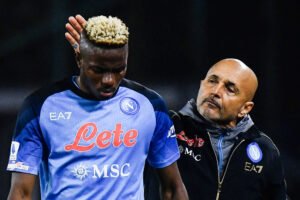
When I came to Napoli, I was found. I really have to thank the city and the fans and my teammates for turning my life around. I remember the first meeting I had when I arrived, I told the coach, Mr. Spalletti, “I am not well. I am very angry right now. Very sad. My head is not straight.”
But he was like a father to me. When I wasn’t doing something right, he came for my neck. But he believed in me deep in his soul, I swear. He thought I could be the best in the world.
I would score 2 goals in a game, he’d come to me in the dressing room and go head-to-head with me. When he wanted to tell you something, he would put his head very close to yours and almost whisper….
“Cazzo!! You could have scored 4 today. I will show you the video tomorrow.”
It’s funny, because after I came in, we had lost the old guard. Koulibaly, Insigne, Mertens all left. But that 2022–2023 season, we had brought in Kvara, Raspa, and Kim Min-jae and everyone thought, “Oh! This is interesting….”
We started the season playing so magnificent that I always tell people that grandmothers started showing up at the training ground. In Napoli, the better you are doing, the older the people you see at the training ground. At first, just the ultras. The young. Then it’s the young and their fathers. Then it’s the son, the father and the grandfather. But then in Napoli, when you’re at the top of the table, all of a sudden the grandmothers start showing up in wheelchairs.
Saying, “I am praying for you, son.”
“Thank you.”
“You don’t have to play like Maradona. Because no one can play like him. We just want you to run and sweat for the badge.”
I remember we were 8 points up in the league, and we started thinking “OK, we got it.”
It’s only natural. We never joked around in training because Mr. Spalletti doesn’t allow it. But this one day we were feeling cocky, and we were playing a small-sided game, and guys were falling down, exaggerating, screaming, “Free kick! Ref! Hey!” Just to make everybody laugh.
Spalletti stopped the game and told the assistants, “Take away the goal posts!”
They’re looking at him like, “What?”
“Take them away!!!!”
We ran for 30 minutes with no ball.
The next day at training, we’re laughing in the dressing room again.
We went to the pitch …. no balls.
“Run.”
“But mister….”
“Run until I say stop!!!!!”
“Mister, please….”
“Run!!!!!”
We all go to the captain, Di Lorenzo, and he says, “Guys, what can I tell you?”
So we apologize to the manager, and we are practically on our knees, and he says nothing.
“Cazzo!!!!!! Run!!!!!”
We did not see a ball for two days.
When we saw that beautiful football again, we could have cried tears of happiness.
Nobody ever told a joke again.
We couldn’t even complain, because Mr. Spalletti was sleeping in his office during that time. He had a little bed set up. Like in the army. He had a wife at home, but for five months, he slept there.
I remember before big matches he would tell us, “You guys don’t understand what will happen if you win the title. Me? They might speak about me for 2 or 3 years. But you players, they will speak about you until you are old men.”
Everybody always asks me about the goal that I scored on the final day, to secure the Scudetto. Well, it was a goal. It was incredible. But we were playing away. It did not sink in what happened, and what we had achieved until we went back to the city, and we saw the emotion of the people. It cannot be put into words. The closest I can tell you is this…….
Right before we won the Scudetto, there was a crowd of fans outside our training ground. I stopped my car to shake their hands, and a guy was there with his son holding up his phone. He wanted to show me a video. It was a video from when Maradona was there in the ’80s. The guy didn’t speak any English. He had tears in his eyes.
I said, “What is he saying?”
Someone else came over to translate.
He said, “For 1,000 years they will remember you. When we are all dust, they will remember you.”
This is why I play football, for this feeling.
To win a title is one thing. But to win a Scudetto for Napoli for the first time in 33 years is true history.
This is why I choose the teams that I choose.
When I left Napoli, do you know how many people told me, “Do not go to Turkey. Are you crazy?”
A former agent even told me, “No, no, no. Don’t go there. It’s not a smart move.”
But I think with my heart. I wanted to play for Galatasaray. How can I go from the emotion of NHow can I go from the emotion of Napoli to just any club? Impossible. Boring.
I wanted to go to a top 3 club in the world in terms of passion. Those are the kind of people who really understand me. The ones who live football in a different way.
When I spoke to Okan Buruk on the phone, before I signed, he told me, “I’m here to tell you that I personally, as a person and as a coach and as a father, I want you in my club. And I know these fans will love you a lot. Even when you’re going through a hard time, this club is the one that is going to back you.”
Before stepping on the plane to Turkey, I put everything in the hands of God.
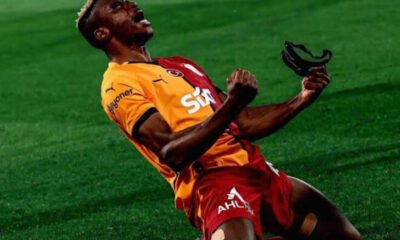
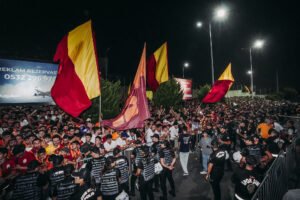
When the flight landed, there were 3,000 Gala fans waiting for me in the middle of the night. At a private airport. They were tracking my flight! The people welcomed me with open arms. That feeling is worth more than money.
If you don’t believe me, just ask van Dijk. I was speaking to him after our Champions League match against Liverpool and he said, “Man, what kind of atmosphere is this!?”
I said, “Brother, to be honest, if I never came here and someone just told me about it, I wouldn’t believe it.”
Prayers From the Gutter
When I came here, everyone said, “What is he doing? Why does he want Galatasaray?”
Well, if you know my story, you already know the answer to that question. When I won the Golden Boot at the U-17 World Cup, some reporter asked me, “You have come from nowhere. Now everybody knows your name. What do you want to achieve?”
My answer now is the same as it was 15 years ago, when I was in the trenches.
Greatness.
I want to be an inspiration for the kids who grew up like me. There are millions of us. The kids who have to work for their next meal. Selling water in traffic. Digging through the landfill for something to scrap. Hustling. Dreaming. Praying…..
What gives me happiness is not money. Definitely not fame — it’s actually really boring, to be honest.
What gives me bliss is going back home to Nigeria, or walking on the street in Istanbul, and I am just wearing my hoodie like normal, and I am still ME.
I can talk to all the kids and say “Hey, I was you. A kid with one Nike and one Puma. A size 8 and a size 9.”
By the grace of God, I made it.
Let my story be proof to those kids.
You can start out in the gutter, and still……………. and still…..
Your name can be on their lips for 1,000 year
s.
Culled from The Players’ Tribune