
Connect with us

World News

US SENATORS URGE TRUMP TO STEP DOWN AS CONSTITUTIONAL ACCOUNTABILITY MEASURES INTENSIFY ON CAPITOL HILL

Published

on

Share

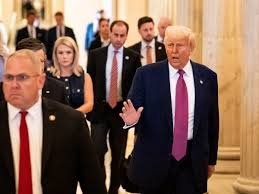
The atmosphere on Capitol Hill intensified as members of the United States Senate publicly urged Donald Trump to consider stepping down, placing him back under an intense national spotlight. A cluster of congressional actions invoking some of the Constitution’s most severe accountability mechanisms has intensified scrutiny of President Donald J. Trump, underscoring a widening rift between the executive branch and segments of the legislative branch.

In recent days, lawmakers have introduced or advanced resolutions that cite the 14th Amendment’s disqualification clause, pursue formal censure and call attention to the 25th Amendment’s provisions regarding presidential capacity. While none of the measures currently carries the votes required to remove the president from office, their simultaneous emergence reflects an unusual convergence of institutional pressure.

At the center of the debate is Section 3 of the 14th Amendment, the so-called insurrection clause adopted after the Civil War to bar individuals who had sworn an oath to support the Constitution and then engaged in rebellion from holding federal office. A Senate resolution introduced this session expresses the chamber’s view that Trump’s conduct surrounding the events of January 6, 2021, warrants scrutiny under that provision.

Constitutional scholars have long debated whether Section 3 is self-executing or requires congressional enforcement. In recent years, courts including the Supreme Court have weighed in on related ballot eligibility questions, shaping but not fully settling the broader constitutional landscape. The current resolution, however, is nonbinding and represents the sense of the Senate, not a direct legal disqualification.
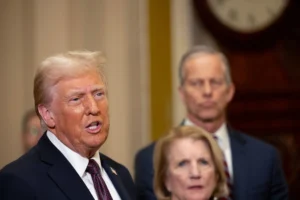
Separately, members of the House have introduced a censure resolution formally condemning the president’s conduct. Censure does not remove a president from office or impose legal penalties. Instead, it serves as an institutional rebuke, a formal expression of congressional disapproval placed into the historical record. Supporters of the measure argue that documented statements and executive actions have, in their view, undermined democratic norms and judicial independence. Opponents characterize the resolution as politically motivated and warn against normalizing what they describe as escalating partisan conflict.

See also  TRUMP GRANTS TIKTOK 90-DAY EXTENSION, DELAYING SALE-OR-BAN LAW

In addition to these legislative efforts, some senators have publicly raised the prospect of invoking the 25th Amendment, which provides a process for declaring a president unable to discharge the powers and duties of the office. Section 4 of that amendment requires the vice president and a majority of the Cabinet to initiate the process, followed by potential congressional review. Historically, it has been understood primarily as a safeguard against medical incapacity rather than a tool for resolving political disputes. There is no indication that the vice president or Cabinet members are preparing to take such action. Nonetheless, the public discussion itself signals the depth of concern among certain lawmakers.

Political analysts note that the simultaneous pursuit of multiple constitutional pathways, including disqualification, censure and capacity review, is rare. One constitutional law professor observed that it is unusual to see these mechanisms discussed in parallel, noting that each was designed for extraordinary circumstances.

At present, the practical barriers to removal remain high. Impeachment would require a majority vote in the House and a two-thirds vote in the Senate for conviction. Disqualification under the 14th Amendment would almost certainly require judicial adjudication. The 25th Amendment demands executive branch participation that appears unlikely. Still, the introduction of these measures contributes to a formal institutional record. Congressional resolutions, even when symbolic, articulate findings and interpretations that may shape future legal and historical assessments. Lawmakers backing the efforts say documentation matters and that establishing a clear legislative position is part of Congress’s constitutional responsibility.

White House officials have dismissed the initiatives as partisan maneuvers lacking sufficient support. They emphasize that the president was duly elected and continues to exercise the full powers of the office. For now, the immediate balance of power remains unchanged. The president retains executive authority, and none of the measures has advanced to a decisive vote capable of altering that reality. Yet the episode highlights a period of heightened constitutional tension, with lawmakers reaching for provisions historically reserved for moments of profound institutional strain.

See also  SAUDI ARABIA INTRODUCES NEW VISA REGULATIONS FOR 14 COUNTRIES, INCLUDING NIGERIA

Whether these efforts gain momentum or recede will depend on political calculations, legal interpretations and public response in the weeks ahead. What is clear is that the debate unfolding on Capitol Hill is less about a single vote than about the boundaries of presidential power and the tools Congress is willing to consider when it believes those boundaries have been tested.

Continue Reading
Click to comment

Leave a Reply

Your email address will not be published. Required fields are marked *

World News

Mexico Deploys 2,000 Troops to Jalisco After El Mencho’s Fall

Published

on

Share


Mexican authorities have deployed an additional 2,000 military troops to the western state of Jalisco following renewed violence after the reported capture and death of cartel kingpin Nemesio Oseguera, widely known as “El Mencho.”


Security forces moved swiftly into the region as tensions escalated in the aftermath of the operation that brought down one of the most feared drug lords in the country. The reinforcement is aimed at preventing retaliatory attacks, dismantling remaining criminal cells, and restoring public order.


Oseguera was the leader of the powerful Jalisco New Generation Cartel (CJNG), a group long considered one of the most violent and influential drug trafficking organizations in Mexico. Under his command, the cartel expanded its operations across multiple states and was linked to high-profile attacks on security forces.


The western state of Jalisco has historically served as the stronghold of the cartel, making it a flashpoint for clashes between criminal groups and federal forces. Following news of Oseguera’s capture and death, reports emerged of road blockades, vehicle burnings, and sporadic gunfire in parts of the state.


Authorities say the military deployment is part of a broader stabilization effort designed to deter further unrest and prevent power struggles within the cartel’s ranks. Security analysts warn that the fall of a major crime boss often creates a temporary vacuum, sometimes triggering violent infighting as rival factions compete for control.


For residents of Jalisco, the heavy military presence brings both reassurance and anxiety. While many hope it signals a turning point in the fight against organized crime, others fear potential reprisals in the coming days.

See also  TRUMP GRANTS TIKTOK 90-DAY EXTENSION, DELAYING SALE-OR-BAN LAW


The federal government has yet to release detailed information on the operation that led to Oseguera’s capture and death, but officials insist that security operations will remain active in the region to ensure stability.

Continue Reading

World News

Billions at Stake as U.S. Stops Illegal Tariff Collections

Published

on

Share


The U.S. Customs and Border Protection (CBP) has announced it will stop collecting tariffs imposed under the International Emergency Economic Powers Act (IEEPA), following last week’s ruling by the Supreme Court of the United States declaring the duties unlawful.


According to a notice issued to shippers through CBP’s Cargo Systems Messaging Service, all tariff codes linked to former President Donald Trump’s IEEPA-based orders will be deactivated effective 12:01 a.m. EST (0501 GMT) on Tuesday.


The suspension comes more than three days after the Supreme Court struck down the measures. The agency did not explain the delay in halting collections at U.S. ports, nor did it provide guidance on whether importers will receive refunds for duties already paid.


The pause in IEEPA-related collections coincides with the introduction of a fresh 15% global tariff announced by Trump under a separate legal authority. That move effectively replaces the invalidated measures but keeps overall tariff pressure in place.


CBP clarified that the suspension applies only to tariffs imposed under the emergency powers law. Other trade measures; including those enacted under Section 232 on national security grounds and Section 301 addressing unfair trade practices remain in force.


The agency said further updates would be communicated to the trade community as necessary.


The Supreme Court decision has significant financial implications. Economists at the Penn-Wharton Budget Model estimate that more than $175 billion in revenue collected under the IEEPA tariffs could now be subject to potential refund claims. Their analysis suggests the duties had been generating over $500 million per day in gross revenue for the U.S. Treasury.

See also  DEADLY TORNADOES AND WILDFIRES WREAK HAVOC ACROSS US, LEAVING AT LEAST 32 DEAD


The development adds another layer of uncertainty for businesses navigating shifting U.S. trade policies.

Continue Reading

World News

EU Demands Clarity from U.S. After Supreme Court Strikes Down Trump Tariffs

Published

on

Share


The European Commission has urged the United States to honour the terms of last year’s EU-U.S. trade agreement following a fresh wave of tariff uncertainty triggered by a U.S. Supreme Court ruling.


After the Supreme Court of the United States invalidated  President Donald Trump’s sweeping global tariffs, Trump responded by announcing new across-the-board levies. Brussels said Washington must now provide “full clarity” on how it intends to proceed and whether the new measures are consistent with the existing bilateral deal.


“The current situation is not conducive to delivering fair, balanced, and mutually beneficial transatlantic trade,” the Commission said, stressing that the agreement reached last year remains binding. “A deal is a deal.”


The statement marked a sharper tone compared to the Commission’s earlier reaction when it said it was still assessing the court’s ruling.


Under the 2025 EU-U.S. trade arrangement, most EU exports to the U.S. face a 15% tariff ceiling, with exemptions for certain goods such as aircraft and spare parts. In return, the EU reduced duties on a range of American products and shelved plans for retaliatory tariffs.


However, uncertainty now surrounds whether Trump’s newly announced 15% tariffs override the agreed framework. If so, existing exemptions could be scrapped, and new duties might be layered on top of standard U.S. “most-favoured-nation” rates, something the deal was designed to prevent.


Analysts warn that the EU’s competitive edge under the 15% cap could also erode, as countries without specific agreements may now face similar rates.


Trade monitor Global Trade Alert estimates the EU economy could be 0.8 percentage points worse off under the new tariff regime, with Italy potentially hit harder at 1.7 percentage points.

See also  PHILIPPINE LAWMAKERS SHUT DOWN IMPEACHMENT BID AGAINST MARCOS


The Commission warned that unpredictable tariff changes risk undermining investor confidence and destabilizing global markets. EU Trade Commissioner Maros Sefcovic has already held talks with the U.S. Trade Representative Jamieson Greer and Commerce Secretary Howard Lutnick in a bid to clarify Washington’s position.


Brussels insists that EU exports must continue to receive the “most competitive treatment” under the agreed ceiling, warning that any deviation could strain transatlantic trade relations.

Continue Reading