World News
TRUMP DELIVERS LONGEST STATE OF THE UNION ADDRESS IN US HISTORY, HAILS ‘GOLDEN AGE OF AMERICA’
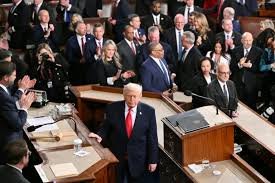
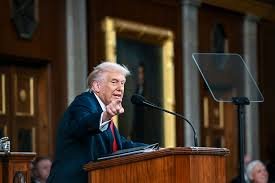
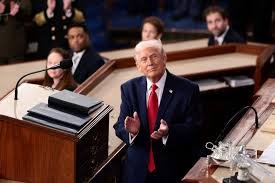
Donald Trump delivered the longest State of the Union address in American history on Tuesday night, speaking for one hour and 47 minutes in a closely watched appearance before United States Congress.
In the marathon speech, Trump declared what he described as a “golden age of America,” pointing to his administration’s economic record as proof of national resurgence. He cited gains in the stock market, progress on inflation, tax cuts, and lower prescription drug prices as evidence of success.
The president claimed that the stock market had reached 53 record highs since his second-term victory, arguing that Americans’ retirement savings had grown substantially. He also unveiled a proposal for the federal government to match up to $1,000 in 401(k) contributions for certain workers who lack employer-sponsored retirement plans, though he provided limited details on how the initiative would operate.
The address came amid political headwinds. Public opinion surveys have reflected frustration over rising living costs, while Trump’s signature tariff agenda suffered a setback after the U.S. Supreme Court struck down much of his import tax framework. Despite ongoing market uncertainty, Trump offered little new information about the future direction of his global trade policy.
Foreign policy received comparatively brief attention. Although the administration has overseen an expanded military presence in the Middle East, Trump did not mention Iran until more than an hour into the speech, reiterating that Tehran must never acquire a nuclear weapon. References to Russia and Ukraine were limited, and Venezuela was mentioned only briefly.

On immigration, Trump renewed assertions that undocumented migrants are contributing to violent crime, claims that numerous studies have disputed. During that portion of the speech, Democratic Representative Ilhan Omar interrupted from the chamber floor, shouting, “You have killed Americans!”
The evening included other moments of protest. Representative Al Green, who was removed during a Trump address for the second consecutive year, later said he had brought a sign reading “BLACK PEOPLE AREN’T APES!” to condemn a social media post that had shared and later deleted imagery depicting former President Barack Obama and former First Lady Michelle Obama as apes.
Delivering the Democratic response, Virginia Governor Abigail Spanberger painted a sharply contrasting picture of the nation’s economic outlook. She argued that American families remain burdened by tariffs and high consumer prices, accusing the administration of prioritizing corporate interests over working households.
Labor leaders echoed that criticism. Liz Shuler, president of the AFL-CIO, dismissed the address as a “fever dream,” contending that it failed to address the economic pressures confronting workers.
Throughout the speech, Trump made direct political appeals, labeling Democrats “crazy” for opposing his legislative agenda and accusing them of seeking to “cheat” in elections — a reference to Republican-backed proposals requiring proof of citizenship for federal voting.
Despite the charged atmosphere, the president largely adhered to prepared remarks, even shaking hands with Supreme Court justices days after publicly criticizing the court’s tariff ruling.
By the conclusion of the night, Trump had surpassed his own previous record for the longest presidential address to Congress. Supporters described the performance as a confident defense of his agenda, while critics argued it offered more rhetoric than concrete solutions to voters’ day-to-day concerns.
World News
PAKISTANI MAN TELLS US COURT IRAN PRESSURED HIM TO ASSASSINATE TRUMP, BIDEN AND HALEY
Asif Raza Merchant, a 47-year-old Pakistani, has revealed to the court the reason he made the move to assassinate President Donald Trump, former president Joe Biden and the former United Nations ambassador Nikki Haley, alleging that he was pressured by Iran’s Islamic Revolutionary Guard Corps to carry out the plan.
Merchant told a US court on Wednesday that he became involved in the scheme because members of the Iranian security force threatened his family who were living in Tehran. Merchant had earlier been charged in September 2024 for allegedly trying to hire a hitman to kill unnamed US political figures.

Testifying during the trial, Merchant said he feared for the safety of his wife and adopted daughter and believed the threats against them were serious. He insisted he never intended for anyone to actually be killed and thought the operation would collapse before reaching that stage.
“My family was under threat, and I had to do this,” Merchant told the court through an Urdu interpreter. “I was not wanting to do this so willingly.”

According to reports presented in court, Merchant claimed his Iranian contact mentioned three possible targets during their conversations: Donald Trump, former US President Joe Biden and former United Nations ambassador Nikki Haley.
Investigators say Merchant attempted to hire hitmen to carry out the killings, but the individuals he contacted were undercover FBI agents, leading to his arrest before the alleged plot could move forward.
World News
UKRAINE AND US HOLD FRESH TALKS IN GENEVA FOCUSED ON ECONOMIC RECOVERY AND PEACE PROCESS
Ukrainian and United States delegations began a fresh round of bilateral talks in Geneva on Thursday, shifting focus toward economic reconstruction and investment frameworks as part of broader efforts to end the nearly four-year war with Russia.
Ukraine’s chief negotiator, National Security and Defense Council Secretary Rustem Umerov, confirmed on social media that the meeting had commenced with US presidential envoys Steve Witkoff and Jared Kushner. The Ukrainian delegation also includes lawmaker Davyd Arakhamia, Economy Minister Oleksii Sobolev, and Deputy Economy Minister Daryna Marchak.
“Together with the Government’s economic team, we will thoroughly work through the prosperity package: mechanisms for economic support and recovery of Ukraine, instruments for attracting investment, and frameworks for long-term cooperation,” Umerov wrote on X.

The discussions come as Kyiv seeks to attract approximately $800 billion in public and private funds over the next decade to rebuild the country following widespread destruction from Russian aerial strikes and frontline combat. A World Bank assessment released this week estimated Ukraine’s reconstruction needs at $588 billion based on data through December 2025.
Ukrainian President Volodymyr Zelensky said he spoke with US President Donald Trump on Wednesday to coordinate ahead of Thursday’s meeting. “We expect this meeting to create an opportunity to move talks to the leaders’ level. President Trump supports this sequence of steps,” Zelensky wrote on X.
The Ukrainian leader previously indicated that territorial issues remain a major challenge and expressed doubt that clear progress on borders would emerge from the February 26 talks, saying such matters ultimately require decisions at the leaders’ level. “I am not sure that tomorrow we will have a clear result regarding land or territory, for example, because these issues, I will repeat again and again, in my opinion should be raised to the level of leaders,” Zelensky said during a press briefing earlier this week.
Umerov noted that along with economic discussions, the delegation would address preparations for the next round of trilateral negotiations involving Russia, expected in early March. “An important issue is the humanitarian track and the issue of possible exchanges. We expect concrete results regarding the return of our citizens,” he said.
The talks follow three rounds of US-mediated negotiations this year, including meetings in Abu Dhabi during January and February, and a trilateral round in Geneva on February 17-18 that yielded no breakthrough on key sticking points, particularly territorial control . Ukrainian and Russian positions remain far apart, with Moscow demanding Kyiv cede territory in the eastern Donetsk region and Ukraine refusing to relinquish land its forces have defended.
Thursday’s discussions coincide with continued Russian aerial attacks on Ukrainian infrastructure. Zelensky reported that Russia launched 420 drones and 39 missiles in overnight strikes, injuring dozens and causing damage across eight regions.
Also in Geneva on Thursday, Witkoff and Kushner were scheduled to hold a third round of indirect talks over Iran’s nuclear program with Iranian Foreign Minister Abbas Araqchi, mediated by Oman
World News
Mexico Deploys 2,000 Troops to Jalisco After El Mencho’s Fall
Mexican authorities have deployed an additional 2,000 military troops to the western state of Jalisco following renewed violence after the reported capture and death of cartel kingpin Nemesio Oseguera, widely known as “El Mencho.”
Security forces moved swiftly into the region as tensions escalated in the aftermath of the operation that brought down one of the most feared drug lords in the country. The reinforcement is aimed at preventing retaliatory attacks, dismantling remaining criminal cells, and restoring public order.
Oseguera was the leader of the powerful Jalisco New Generation Cartel (CJNG), a group long considered one of the most violent and influential drug trafficking organizations in Mexico. Under his command, the cartel expanded its operations across multiple states and was linked to high-profile attacks on security forces.
The western state of Jalisco has historically served as the stronghold of the cartel, making it a flashpoint for clashes between criminal groups and federal forces. Following news of Oseguera’s capture and death, reports emerged of road blockades, vehicle burnings, and sporadic gunfire in parts of the state.
Authorities say the military deployment is part of a broader stabilization effort designed to deter further unrest and prevent power struggles within the cartel’s ranks. Security analysts warn that the fall of a major crime boss often creates a temporary vacuum, sometimes triggering violent infighting as rival factions compete for control.
For residents of Jalisco, the heavy military presence brings both reassurance and anxiety. While many hope it signals a turning point in the fight against organized crime, others fear potential reprisals in the coming days.
The federal government has yet to release detailed information on the operation that led to Oseguera’s capture and death, but officials insist that security operations will remain active in the region to ensure stability.