Politics
ADC Accuses Akpabio of Encouraging Certificate Forgery, Says It Reflects APC Legacy
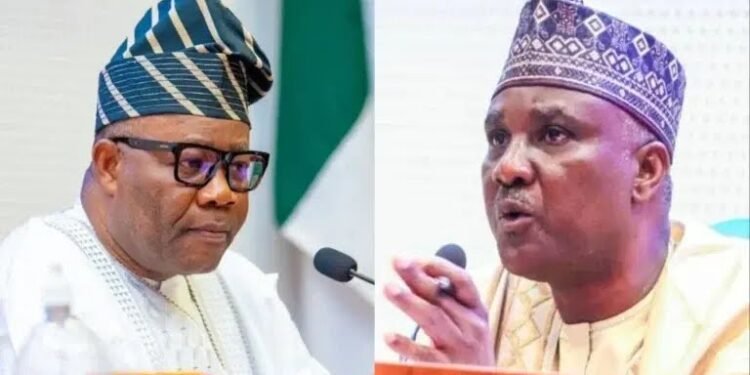
The African Democratic Congress (ADC) has criticised Senate President Godswill Akpabio over comments it claims appeared to justify certificate forgery, warning that such a stance could become the lasting legacy of the ruling All Progressives Congress (APC).
In a statement issued by the party’s national publicity leadership, the ADC accused the Senate President of trivialising a serious criminal offence by allegedly making remarks that appeared to defend or excuse individuals accused of presenting forged academic credentials.
The opposition party said the comments were troubling, especially coming from the head of the National Assembly, adding that public officials should instead uphold integrity and accountability in public service.
According to the ADC, certificate forgery undermines merit, damages public institutions, and discourages honest citizens who have worked hard to obtain legitimate qualifications.
“The suggestion that certificate forgery can be defended or rationalised sends a dangerous message to young Nigerians,” the party said, adding that such attitudes weaken public trust in governance and leadership.
The party further argued that normalising academic fraud reflects poorly on the ruling party and could define its political legacy if not strongly condemned.
ADC also called on political leaders to promote transparency and ethical conduct in public office, stressing that the fight against corruption must include zero tolerance for falsification of educational credentials.
The criticism follows ongoing public debate surrounding academic certificate controversies in Nigerian politics, which have periodically generated legal battles and political disputes.
As of the time of filing this report, neither the Senate President nor the APC had issued an official response to the ADC’s statement.
Politics
Arenyeka Warns Against Factionalism at APC Inaugural Meeting
A chieftain of the All Progressives Congress (APC), Arenyeka, has warned party leaders and executives against engaging in factional politics, urging them to remain loyal to the party’s leadership and ideals.
Speaking during an inaugural meeting of party executives, Arenyeka stressed that unity within the party structure is essential for strengthening the APC and maintaining its political dominance.
According to him, internal divisions and factional interests have historically weakened political parties, noting that the APC must avoid such pitfalls if it hopes to remain cohesive and effective.
He called on newly inaugurated executives to place the party’s collective interest above personal ambitions, emphasizing that loyalty, discipline, and cooperation are critical for achieving the party’s objectives.
Arenyeka also urged party leaders at different levels to work together to promote harmony among members, warning that disunity could undermine the party’s progress and public confidence.
The APC stalwart further encouraged the executives to focus on grassroots mobilization and engagement with party supporters, describing them as the backbone of the party’s strength.
He concluded by reminding party officials that their leadership positions come with responsibility and accountability, urging them to serve with integrity while promoting unity within the party.
The meeting brought together key stakeholders and newly appointed executives of the party, who pledged their commitment to working together to advance the goals of the APC.
Politics
Political Tension Deepens as Rivers Assembly Rejects Four of Fubara’s Commissioner Nominees
The Rivers State House of Assembly has rejected four commissioner nominees submitted by the Governor of Rivers State, Siminalayi Fubara, in a development that underscores the continuing political tension within the state’s leadership.
The lawmakers made the decision after screening the nominees during the plenary, where concerns were reportedly raised regarding the suitability and credentials of some of the candidates presented by the governor.
According to legislative sources, the Assembly resolved not to confirm the four nominees following deliberations by members, although other nominees on the list were cleared for appointment into the state executive council.
The rejection marks another flashpoint in the ongoing political struggle within Rivers State’s political landscape, which has witnessed repeated disagreements between the executive and legislative arms of government in recent months.
Observers say the development could further complicate the governor’s efforts to fully constitute his cabinet and implement his administration’s policy agenda.
However, officials close to the government insist the governor remains committed to working with the assembly and may submit fresh nominees for consideration in line with constitutional provisions.
Under Nigerian law, commissioner nominees must be screened and confirmed by the state House of Assembly before they can be sworn in as members of the State Executive Council.
The Rivers Assembly has not ruled out the possibility of reconsidering new nominees if submitted by the governor.
Political analysts say the outcome of the screening highlights the delicate balance of power in the state’s politics and could shape the working relationship between Governor Fubara and the lawmakers going forward.
Politics
Zamfara Governor Dauda Lawal Defects from PDP to APC
Governor Dauda Lawal of Zamfara State has defected from the Peoples Democratic Party (PDP) to the ruling All Progressives Congress (APC), a development that could further intensify the challenges facing Nigeria’s main opposition party.
The announcement was made by the Deputy Governor, Mani Malam Mummuni, who disclosed that the governor, his political associates and key stakeholders decided to leave the PDP after extensive consultations.
Mummuni made the disclosure in a video circulating on social media while addressing supporters and political stakeholders in the state.
Speaking on behalf of the governor, he explained that the decision followed a careful assessment of the political situation in Zamfara and the country at large.
“I greet you all in the name of Allah, the Most Gracious, the Most Merciful. Peace and blessings be upon the Prophet Muhammad,” he said.
“I am here on behalf of His Excellency, the Executive Governor of Zamfara State, Dr. Dauda Lawal Dare. After wide consultations and consideration of the political situation in our state and the country, and in the best interest of the people of Zamfara State to bring development, peace and progress,” he added.
According to him, the governor and his political team concluded that joining the APC would better position the state to pursue development and strengthen cooperation with the Federal Government.
“We, the governor, his team and I, have decided to officially leave the Peoples Democratic Party and join the All Progressives Congress,” Mummuni stated.
He noted that the move would enable the state to attract greater federal support, tackle security challenges and accelerate development projects.
“This decision is taken to align with the direction that will better serve our people, secure more federal support, address security challenges and accelerate development in Zamfara,” he said.
The deputy governor also appealed to party members and supporters across the state to support the move in the interest of peace and progress.
“We call on all our supporters, party members and the good people of Zamfara to support this decision for the greater good of the state. May Allah guide us all,” he added.
PDP Crisis Deepens
The defection comes amid an ongoing crisis within the PDP, which has been grappling with internal disputes and factional divisions since the aftermath of the 2023 general elections.
The crisis has largely revolved around rival political camps associated with the Minister of the Federal Capital Territory, Nyesom Wike, and the Governor of Oyo State, Seyi Makinde.
Both leaders, once allies in the G5 group of PDP governors, reportedly fell out over disagreements regarding party leadership, control of party structures and the direction of the opposition ahead of the 2027 general elections.
The conflict escalated after rival factions began organising separate meetings and conventions, each claiming legitimacy over the party’s national leadership.
At one point, tensions between the camps led security agencies to seal the PDP national secretariat in Abuja following chaotic meetings by opposing factions.
Political observers say the prolonged leadership struggle has weakened internal cohesion within the PDP and raised fresh concerns about the party’s ability to remain a strong opposition platform in Nigeria.