Oil and Gas
Nnpc doubles crude supply to Dangote refinery to 10 cargoes in March


The Nigerian National Petroleum Company Limited has doubled crude oil deliveries to the Dangote Petroleum Refinery, raising supplies to 10 cargoes in March 2026, up from an average of five cargoes monthly since late 2024. This development comes as Nigeria moves to shore up domestic fuel availability following global supply disruptions triggered by the US-Israel attack on Iran and the ensuing Gulf war.
The President and Chief Executive of Dangote Industries Limited, Aliko Dangote, confirmed the increased supply on Tuesday, April 7, 2026, while hosting the Deputy Secretary-General of the United Nations, Amina Mohammed, at the industrial complex in Ibeju-Lekki, Lagos. According to Dangote, the state-owned oil firm supplied six cargoes paid for in naira and four cargoes paid for in dollars under the crude-for-naira arrangement.
“Last month, they gave us six cargoes for naira and four cargoes for dollars,” Dangote said.
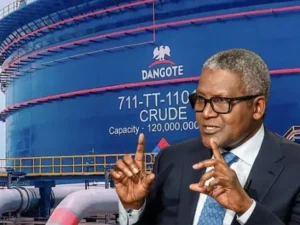
The crude-for-naira deal, signed between NNPC and Dangote Refinery in October 2024, was designed to enhance local refining, conserve foreign exchange, and stabilise fuel prices in Nigeria by allowing crude purchases in local currency, bypassing the dollar shortages that have long plagued the economy.
Despite the significant improvement, Dangote noted that the supply remains below the 19 cargoes required for optimal operations of the 650,000 barrels per day facility, which is Africa’s largest refinery. The company continues to bridge the gap through imports from the United States and other African producers, including Brazil, Equatorial Guinea, Angola, and Algeria.
“We need 19 cargoes to operate at full capacity,” Dangote said.
The refinery has also secured additional allocations for May 2026. Trade sources and a senior refinery official told Reuters that NNPC is allocating seven cargoes for May, up from previous months, as the refinery continues negotiations for more volumes. “NNPC has allocated more cargoes to Dangote for May. While this will not completely meet our demands, it can help. We are also in negotiation with NNPC for more volumes,” the senior Dangote official said.
NNPC cargoes are cheaper for the refinery because of lower shipping costs. Dangote recently had to pay premiums as high as $18 a barrel over the Brent crude benchmark to secure cargoes from the international market, the official added. That would amount to approximately $137 per barrel based on current Brent prices.
However, Dangote expressed concern over the unwillingness of international oil companies operating in Nigeria to sell crude directly to the refinery. He stated that their preference for selling crude to international traders forces the refinery to repurchase Nigerian crude at higher premiums, with broader implications for the economy.
“Some of the international oil companies would rather sell to traders. So, we end up buying our own crude at a premium. The higher we pay, the higher the cost of petroleum products will be, because we have to pass on the cost,” Dangote explained.
An economist and oil and gas industry analyst, Dr. Marcel Okeke, told Daily Trust that the IOCs in Nigeria are subsidiaries of global companies, and with existing product sharing arrangements, it becomes difficult to compel them to cater to local refiners. “The crude oil market is an open market determined by market forces. People should sell where they should get the best price and the government cannot compel them,” he said.
Despite domestic supply challenges, the refinery is experiencing a boom on the export front. Dangote disclosed that the refinery shipped about 17 cargoes of petroleum products to other African nations in March alone, leveraging its massive capacity to stabilise supply across multiple regions affected by the Middle East crisis.
“What I can do is assure Nigerians and most of West Africa, Central Africa, and East Africa, we have the capacity to supply them,” Dangote said.
The company has also ramped up exports of urea fertiliser to support agricultural productivity and ease supply constraints across the continent. “The challenges are many. One is urea, which is fertiliser that we have. I think in the last couple of days we’ve been loading to mostly African countries, which we were not doing before. And then now it’s to do with petroleum products, which we are now sending mainly to African countries,” Dangote said.
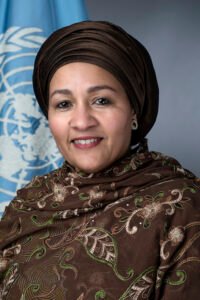
Portrait of Deputy Secretary General Amina J. Mohammed.
Official Portrait
Meanwhile, the Deputy Secretary-General of the United Nations, Amina Mohammed, underscored the strategic importance of Dangote Industries Limited, particularly Dangote Fertiliser Limited, in addressing Africa’s mounting food security challenges. “I think the UN’s job here is to amplify and to put visibility on the possibilities of mitigating a food security crisis, and this is one of them. I hope that when we go back, we can continue to engage partners and countries that should collaborate with Dangote Industries,” she said.
Industry operators have projected potential price relief from the increased crude supply, but warned that Nigerians may not feel the benefit through lower pump prices without government intervention. The Chief Executive Officer of Petroleumprice.ng, Jeremiah Olatide, said the delivery of 10 crude cargoes in March signals improved supply but noted that pricing remains tied to international benchmarks.
“The 10 crude cargoes supply recorded in March is a good development because it indicates more crude supply and, by extension, more fuel availability. But without Federal Government intervention through crude subsidy to the Dangote refinery and other local refineries, Nigerians will continue to experience availability but unaffordability, as petrol and diesel prices are poised to hit N1,500 per litre and N2,000 per litre at the pump,” Olatide said. “The six cargoes paid for in naira are still priced using international benchmarks, so Nigerians should not expect any drop in pump prices.”
The Group Chief Executive Officer of NNPC Limited, Bashir Bayo Ojulari, recently led a delegation to the Dangote Refinery complex for high-level discussions aimed at strengthening collaboration. Ojulari commended Aliko Dangote for delivering the refinery, describing it as a landmark project that positions Nigeria as a major downstream hub in Africa, and stated that the partnership would “unlock synergies across assets, infrastructure, capital, and markets.”