World News
Power Blackouts and Dry Taps: How Cubans are Giving up Beauty and Changing how They Move

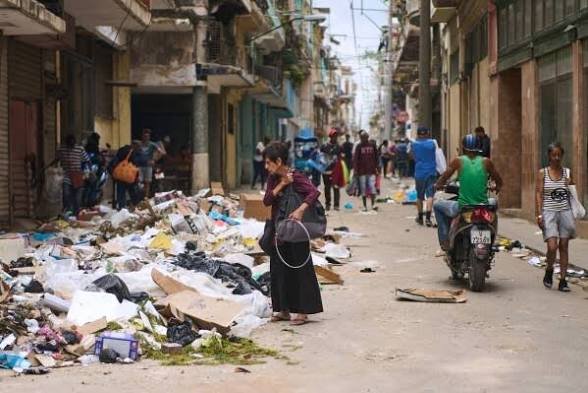
HAVANA — Severe shortages of water, electricity and fuel, compounded by a tightening U.S. energy blockade, have forced Cubans to abandon long-cherished routines, from personal grooming to basic hygiene and commuting, as the island’s economic crisis deepens.
Even those who were once relatively affluent are now eliminating established habits and adapting to increasingly dire realities. The crisis has reshaped everything from how people style their hair to how they wash their clothes and move around the capital.
Eduvirgen Zamora, a 56-year-old cafeteria worker, hides her hands out of embarrassment these days. Her nails are bitten down to the quick, except for her thumbs, which feature inch-long talons covered in fancy silver swirls. Unable to afford a new set of nails, she opted instead to do her lashes, a cheaper alternative she hoped would draw attention upward. “The Cuban woman likes to look beautiful — to do her hair, do her nails, do her feet — and wear perfume,” Zamora said. “I don’t look how I would like to look.”


Melina Colás, a young manicurist working in Havana, recently got long braids for her birthday but quickly realised the style is difficult to maintain given chronic water shortages. She used to wear her hair long and straightened but has now decided to cut it and wear it natural, even though she thinks it does not suit her short stature and round face. “Before, you could do whatever you wanted,” she said of hairstyles when water was readily available. “Not now.”
At the salon where she works, Colás has also had to adapt. She now relies on a mixture of water and vinegar in a spray bottle to offset water shortages, a concoction she said also helps soften clients’ cuticles and stave off a growing number of fungus cases, because the time between manicure appointments is growing longer for many. “Some cases are critical,” Colás said.
She also lamented how the economic crisis and shrinking budgets have led to a drop in customers, a trend that hairstylist Betty Ramírez Aldana, 50, has also noticed. “It really came as a shock to me, because I’ve lost a lot of clients,” he said on a recent afternoon at a makeshift hair salon with bubblegum pink walls. “Normally by now I’d have five, six, eight clients. Look at the hour. And no one has showed up.”
The hair salon where Ramírez works recently spent three weeks without water, since electricity powers many pump stations on the island and severe outages are now commonplace. He can no longer provide certain hair straightening treatments, so he offers clients options including flattering cuts. “A lot of them have opted to embrace their natural curly hair,” he said.
An increasing number of women have also been forced to grow out their roots given a lack of gasoline and public transportation, coupled with withering budgets, Ramírez said. Those who can afford it call him for home visits, with the original customer often joined “by her aunt and the upstairs neighbor. I don’t serve one, I serve two or three,” he said.
Beyond beauty, Cubans are agonising over being forced to cut corners on basic hygiene. Some say they are washing their hair only twice a month, and clothes stay dirtier longer. Antonia Isalgués Barrién, 60, who works for a state-run company running boats from eastern Havana to the heart of the capital, said she hangs her clothes outside every day after working on a boat because she does not have water to wash them. “It’s very hot here in Cuba; you sweat a lot,” she said, recalling how she used to wash clothes nearly daily. “I’ve never been forced to hang clothes in the fresh air… and then put them on again.”
The fuel shortage has also transformed transportation. Isalgués said she has noticed a surge in the number of passengers on the boats as a growing number of gas stations close and only a handful of public buses remain in circulation. Cuba had spent three months without fuel shipments until a Russian tanker arrived in late March with 730,000 barrels of oil, which experts said was expected to last only nine or ten days.
Iván de los Ángeles Arias, a 44-year-old boat pilot, often boards the boat for a five-minute ride across the Bay of Havana, keeping his car at home for emergency use only. “That’s the reality we’re forced to live,” he said. “You deal with it as best you can.”
Cuba’s government has blamed the crisis on a U.S. energy blockade imposed after President Donald Trump threatened tariffs on any country selling or providing oil to the island. Cuba produces only about 40 percent of the oil it needs. The U.S. has called for political reforms and the release of political prisoners as conditions for lifting sanctions, while Cuban officials have denounced the measures as collective punishment. U.S. diplomats flew to Cuba earlier this month for talks, the first such high-level engagement since 2016.