
Judiciary
Supreme Court Reserves Judgment in $2bn Neconde–Nestoil Receivership Dispute

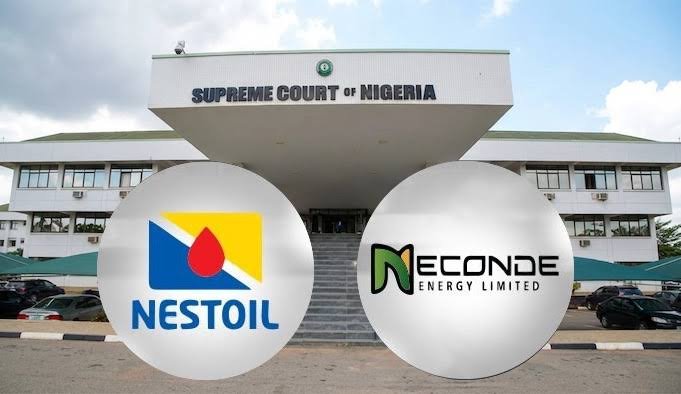
The Supreme Court on Monday reserved judgment in an appeal filed by Neconde Energy Limited challenging the Court of Appeal’s decision that restored control of the company’s assets and operations to a receiver-manager appointed by a consortium of lenders.
A five-member panel of the apex court led by Justice Lawal Garba adjourned the matter for judgment after hearing arguments from parties in the high-stakes dispute linked to alleged debts exceeding $2 billion and related liabilities estimated at over ₦430 billion.
Lead counsel to Neconde, Wole Olanipekun, urged the apex court to set aside the interim restorative orders granted by the Court of Appeal in November 2025, arguing that the appellate court lacked jurisdiction to entertain the matter.
According to Olanipekun, the interim orders remain in force and have continued to restrict company officials from accessing corporate facilities and operations.
He argued that there was no valid record of appeal before the appellate court when the orders were issued, insisting that the entire process was fundamentally defective.
“My Lords, I am on my knees because of the peculiar nature and circumstances of this appeal,” the senior lawyer pleaded before the panel.
Counsel representing Nestoil Limited aligned with the submissions, maintaining that the notice of appeal was not properly served — a condition he said was necessary to activate the jurisdiction of the Court of Appeal.
The Supreme Court subsequently reserved judgment and informed parties that a date for the ruling would be communicated to counsel. The court also directed that the cross-appeal would abide by the outcome of the substantive appeal.
Background to the Dispute
The legal battle arose from debt recovery proceedings instituted by lenders, including FBNQuest Merchant Bank Limited and First Trustees Limited, against Nestoil and Neconde over financing arrangements tied to oil assets and operations.
In October 2025, the Federal High Court in Lagos granted an ex parte Mareva injunction freezing the companies’ assets, bank accounts and shares across more than 20 financial institutions.
The companies, however, challenged the order, arguing that it automatically lapsed after 14 days under the Federal High Court Civil Procedure Rules once a motion seeking to discharge it was filed.
On November 20, 2025, Justice Daniel Osiagor ruled that the ex parte order had expired by operation of law and was no longer valid.
But on November 27, 2025, Justice Yargata Nimpar granted an interim restorative injunction returning control of Nestoil’s assets and operations to the receiver-manager appointed by the lenders, while also sustaining the Mareva injunction.
The dispute later shifted to the issue of legal representation after the appointment of the receiver-manager.
In January 2026, the Court of Appeal disqualified Olanipekun and Muiz Banire from representing Neconde and Nestoil respectively, holding that the companies’ boards no longer had the authority to appoint counsel once the receivership took effect.
However, the Supreme Court later overturned that decision, restoring the companies’ right to engage counsel of their choice while contesting the validity of the receivership.
In the lead judgment delivered by Justice Mohammed Baba Idris, the apex court described it as a “legal anomaly” for lawyers appointed by the receiver-manager to simultaneously represent the companies whose interests were under dispute.
The court held that such an arrangement created a conflict of interest and undermined the companies’ right to independent legal representation.
The dispute centres on claims by lenders that Nestoil, Neconde and their promoters Ernest Azudialu-Obiejesi and Nnenna Azudialu-Obiejesi are indebted under financing agreements linked to oil assets, including interests in OML 42.