
Economy
Investing Stock Market: Global Stocks Rally as US Hits New Highs While Nigeria Sees Domestic Buying Surge

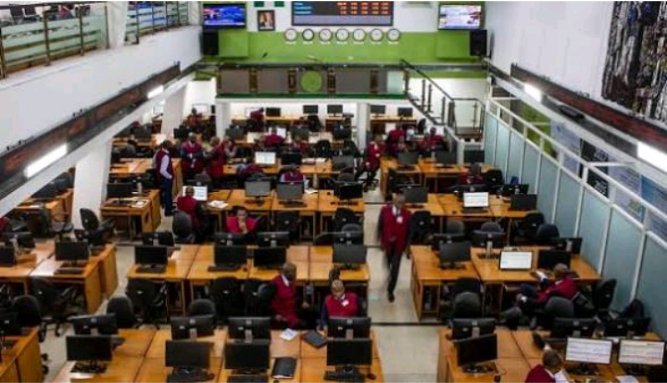
Global stock markets delivered strong performances this week, with US benchmarks hitting fresh record highs while Nigerian equities continued their remarkable run driven largely by domestic investors.
The rallies came amid easing geopolitical tensions, lower oil prices, and a wave of corporate earnings that restored investor confidence across major markets.


In the United States, stocks recorded solid gains on Tuesday as the market monitored developments in the Middle East and digested a fresh wave of corporate earnings.

The Dow Jones Industrial Average rose 907.47 points, or 1.71 percent, to 54,085.88. The S&P 500 added 136.02 points, or 1.79 percent, to 7,736.52, while the technology-heavy Nasdaq Composite Index soared 671.1 points, or 2.59 percent, to 26,584.99. The S&P 500 closed at a record level for the 25th time this year, marking its first all-time closing high since June 2.
The rally followed US President Donald Trump calling off planned military strikes against Iran, with bilateral diplomatic discussions resuming. Global energy benchmarks saw deep losses after US Treasury Secretary Scott Bessent confirmed active diplomatic discussions with Iranian representatives are underway.

West Texas Intermediate crude decreased 4.57 dollars, or 5.69 percent, to settle at 75.77 dollars a barrel, while Brent crude lost 4.41 dollars, or 5.26 percent, to settle at 79.36 dollars a barrel. The reduced geopolitical risk premium and corresponding decline in inflation expectations provided strong support for stock markets.
Market strategists noted that strong aggregate quarterly earnings have helped restore institutional confidence. “From watching the stock market zoom higher over the past three sessions, you wouldn’t think there’s anything wrong with the world,” said Thierry Wizman, global FX and rates strategist at Macquarie Group.
“After all, even the semiconductor makers have recovered from their big skid in July after some AI hyperscalers managed to quell analysts’ fears about whether their data center investments are excessively eating into cash-flow.”
Technology and materials led the S&P 500 gainers, advancing 4.09 percent and 1.99 percent respectively. Six of the 11 primary S&P 500 sectors closed in positive territory. In corporate developments, shares of SpaceX and Advanced Micro Devices surged more than 9 percent and 7 percent respectively during regular trading ahead of their earnings disclosures.
SpaceX reported a 92-percent year-on-year surge in revenue in its first quarterly report since going public.
Enterprise software firm Palantir Technologies surged nearly 30 percent following blowout second-quarter results. CEO Alex Karp characterized the performance as “otherworldly,” attributing the growth to surging global demand for artificial intelligence sovereignty solutions. Semiconductor equities continued their recovery, with Micron Technology advancing 7.62 percent and Marvell Technology surging 12.81 percent. Among Dow components, Caterpillar jumped 5.6 percent after delivering better-than-expected results and raising its full-year revenue outlook.
Nvidia rose nearly 3 percent on Monday, pushing the AI chipmaker’s market capitalization above 5 trillion dollars and reclaiming its position as the world’s largest publicly traded company.
The broad recovery in the technology sector became the key driver behind the index breakout, with the Roundhill Magnificent Seven ETF outperforming the S&P 500 by approximately 5 percentage points over two trading days, marking its largest two-day excess return since inception.
Meanwhile, Nigerian equities have presented a striking picture. The Nigerian Exchange has delivered the highest dollar returns globally, according to Bloomberg comparisons of 92 exchanges. Since the beginning of 2026, Nigerian stocks have risen 66 percent in dollar terms, leading all global markets.
The benchmark NGX All-Share Index currently stands at 245,283.68 points, with market capitalization at approximately 158.326 trillion naira, reflecting a year-to-date return of 57.62 percent.
However, a surprising contradiction has emerged. Despite the record-breaking performance, foreign investors remain net sellers while local institutions and individuals dominate trading.
Data from the Nigerian Exchange shows total trading volume in the first half of 2026 reached 9.61 trillion naira, more than double the 4.19 trillion naira recorded in the same period of 2025. Domestic investors accounted for 8.45 trillion naira, representing 87.93 percent of total activity, while foreign investors contributed just 1.16 trillion naira, or 12.07 percent. A year earlier, foreign participation stood at 27.08 percent.
The foreign portfolio flow direction is notable. From January to June, total foreign purchases amounted to 471.77 billion naira, while sales reached 688.4 billion naira, resulting in net outflows of 216.63 billion naira.
This suggests that while foreign investors remain active, more capital is leaving Nigerian equities than entering. Market observers note that foreign investors have shown greater preference for Nigerian short-term debt instruments, which offer average yields around 20 percent with lower company-specific and liquidity risks compared to equities.
The surge in domestic participation has been fueled by financial sector gains, naira exchange rate strength, and improved foreign exchange liquidity.
Nigerian institutional investors traded 5.06 trillion naira in the first half, while retail investors contributed 3.39 trillion naira, indicating that local players have stepped in to fill the gap left by retreating foreign capital.
In a significant development for market infrastructure, the Nigerian Securities and Exchange Commission has approved the listing and trading of blockchain-based traditional stock tokenized assets on the NASD OTC Securities Exchange.
The service is planned for launch in early September, allowing companies to issue tokenized versions of traditional stocks through blockchain technology, aiming to promote the development of Nigeria’s capital market.
India has also introduced market reforms, with the National Stock Exchange and Bombay Stock Exchange launching a new Closing Auction Session on August 3.
The system replaces the volume-weighted average price method with a 20-minute auction window from 3:15 PM to 3:35 PM, where a single equilibrium price emerges. The initial rollout covers over 200 futures and options stocks, with equity derivatives trading extended to 3:40 PM.
The Securities and Exchange Board of India approved the framework in January, positioning the change to align India with global standards and prevent price manipulation.
The reform triggered immediate trader confusion and an unexpected spike in the Nifty 50 Index as participants scrambled to understand the new price discovery mechanics.
Mutual fund net asset values, derivatives settlements, and index fund rebalancing all depend on closing prices, making the transition significant. A second phase, revising the pre-open auction session, is scheduled for September 7.
In corporate earnings developments in Australia, investors are closely watching dividend payouts from banks and miners. The S and P/ASX 200 index gained 2.2 percent in July, with Commonwealth Bank of Australia and BHP Group set to report in August.
BHP’s annual operational update already provided key metrics including record iron ore production and copper prices about 35 percent higher year-on-year. Rio Tinto set the tone on July 29, with shares closing 3.67 percent higher after declaring its highest interim dividend in four years.
For technology investors, the central question remains whether corporate spending on AI infrastructure can generate adequate returns. The tail end of July saw four major hyperscalers report quarterly earnings with contrasting investor reactions.
Alphabet reported record Google Cloud revenue growth of 82 percent year-on-year to 24.8 billion dollars, but shares fell more than 7 percent as investors focused on first quarterly negative free cash flow and continued delays to its Gemini AI model. Amazon, reporting 37 percent growth in Amazon Web Services revenue to 42.2 billion dollars, saw shares surge 15 percent. CEO Andy Jassy said the “lion’s share” of AWS compute capacity for 2027 had already been reserved by customers.
Morningstar analyst Brian Han noted that Telstra’s defensive business model and steady earnings growth support its dividend payouts, which have become its “core appeal.” He expects Telstra to deliver resilient full-year earnings and believes the recent mobile network outage will not result in “permanent diminution of Telstra’s sustainable earnings power.” Morningstar’s Tyger Fitzpatrick observed that “for fully franked dividends, the prepaid company tax acts as a shield, lowering the investor’s personal tax bill or even generating cash refunds. Overall, this makes franked dividend-paying stocks key for investors seeking tax-efficient returns.”