Opinion
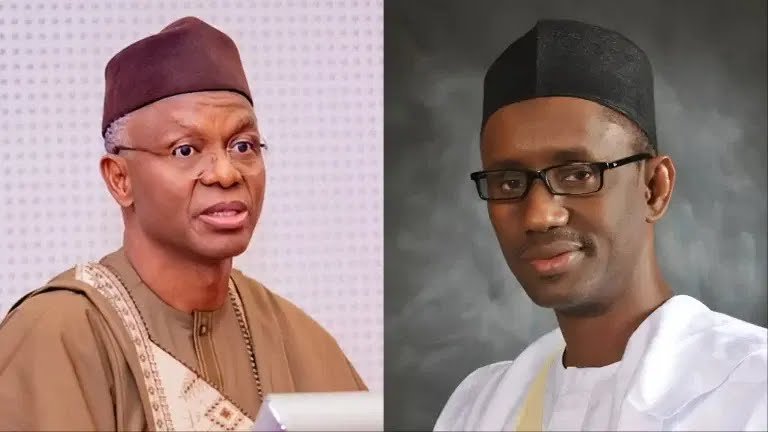
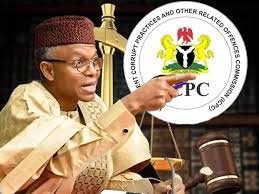
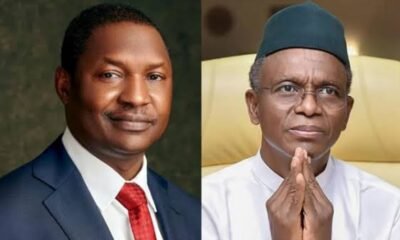
El-Rufai Puts Ribadu on Trial
By Frank Tietie
A man who is neither drunk nor high on drugs, but in his clear and sane mind, goes on a prime-time show on a continental television network like the Arise News Channel and proclaims that he got information from someone who tapped the phone line of the National Security Adviser (NSA) of the Federal Republic of Nigeria. How should the Nigerian government react?
It becomes a Catch-22 for the Nigerian government whether to respond to El-Rufai’s latest tirade. But to react hastily would fail to see the damning point Nasir El-Rufai is trying to make, which is to show the ineptitude of Nuhu Ribadu as NSA. The government should have seen through the former Kaduna State governor’s bravado.
Of course, El-Rufai knows the possibility that Ribadu would fall for the trick and might actually order his detention, either for statements made on live international television or for the bared waiting fangs of the EFCC. Sonit appears he had prepared for the worst, but probably not for death in the hands of his sworn enemies through poisoning. Hence, he immediately alerted the world to the Gestapo treatment that is usually given to some government enemies when they are in detention. So he quickly accuses the same Nuhu Ribadu of importing thallium sulphate, a lethal poison suitable for eliminating political enemies quietly. This he has done, in case he, himself or any other opposition politicians die in detention as 2027 approaches. What a way to shift the burden?
The choice of the government to charge El-Rufai for cybercrimes over the claims he made on live on Arise News Prime Time show about tapping the NSA’s phone is a tacit yet loud acknowledgement that any NSA whose phone can be tapped so easily is not only incompetent, but highly undisciplined and lackadaisical on national security matters. Tell me, which serious country, like the United States of America, the United Kingdom, France, Germany, Russia, or Saudi Arabia, would take the National Security Adviser of Nigeria seriously if they knew that an ordinary citizen could easily tap his phone?
What Malam Nasir El-Rufai has done is not to present technical evidence of interception. Rather, he has thrown a political gauntlet designed to provoke a reaction. The trap is simple: once the state moves against him, the conversation shifts from the accuracy of his claim to the conduct and capability of those charged with safeguarding national security.
A hurried resort to criminal prosecution risks missing the wider implication that public officers, particularly those occupying sensitive security positions, are expected to inspire confidence, not anxiety.
Therefore, if the state frames a prosecution around a claim that the NSA’s line could be tapped, the unintended consequence is that the allegation receives international circulation, renewed media life and diplomatic attention. In effect, the courtroom becomes a megaphone for the NSA’s failures.
Consequently, if the charge against El-Rufai is driven by reputational discomfort or the political embarrassment that he has caused Ribadu or the Tinubu government. It risks being counterproductive, especially in a democratic setting that has a high tolerance for speech directed at public officials.
Statements that are provocative, speculative or even reckless are often part of political contestation, especially as 2027 approaches. They should not be the basis for criminal charges. Such statements are best answered by clarification, transparency, and institutional reassurance, rather than the coercive weight of arrest, arraignment, and trial.
To prosecute El-Rufai in circumstances such as this may therefore produce the exact opposite of deterrence. It can elevate and transform him into a cause, especially among Northern Nigeria elements, and suggest that the government is more eager to punish criticism than to disprove it.
The other dimension is the possibility that such a trial would invite scrutiny, arguments, cross-examinations, and global reporting, further exposing Ribadu or the government. Meanwhile, silence would have buried it faster.
Instead of dismissing El-Rufai as someone probably chasing political clout, the choice to charge him would validate his point and expose Nuhu Ribadu as unfit to be NSA.
El-Rufai is no ordinary politician. He combines the arts of casuistry, statecraft, populism and activism for political relevance, and he is yet on another journey to reinvent himself politically to the detriment of his foes like Ribadu. But he also wants to come out alive. And even if he dies in the process, he seems not to care much, as long as such would deal the maximum blow to the political careers of his traducers.
If anyone thinks El-Rufai is being diminished by his latest travails, they should think again. In fact, it is he who is putting some persons on trial in the court of reason.
Frank Tietie
Lawyer and Public Affairs Commentator,
Writes from Abuja
Opinion
Oil Is Not Enough: Lessons from Norway, UAE, and Saudi Arabia
By AVM (RTD) Akugbe Iyamu, MNSA, fsi
Countries blessed with hydrocarbons are often presented with a defining choice: allow oil wealth to create dependency or deploy it as a catalyst for sustainable development. The difference between these two paths is not geology; it is governance.
Norway, Saudi Arabia, and the United Arab Emirates demonstrate that hydrocarbons, when strategically managed, can become instruments of national transformation rather than traps of economic complacency.
When Norway discovered oil in 1969, it quickly established a governance structure rooted in transparency, heavy taxation of petroleum companies up to 78 per cent — and disciplined savings. Rather than overspend during boom cycles, Norway created the Government Pension Fund Global.
Today, that fund stands at roughly $2 trillion, the largest sovereign wealth fund in the world. It represents approximately $356,000 per Norwegian citizen and is invested globally to protect long-term economic stability. Norway understood early that oil was a means to an economic end, not the end itself.
The United Arab Emirates adopted a dual-track strategy: expand production capacity while aggressively diversifying the economy. With plans to increase oil production to five million barrels per day by 2027, the UAE ensures sustained medium-term revenue.
Through its national oil company, ADNOC, the UAE has modernised exploration, adopted artificial intelligence-driven trading platforms, and strengthened midstream infrastructure. Simultaneously, hydrocarbon revenues have funded massive investments in tourism, aviation, logistics, renewable energy, and technology. Oil revenue in the UAE finances transformation rather than dependency.
Saudi Arabia has leveraged its hydrocarbon resources to build one of the world’s most influential energy economies. Through Saudi Aramco, oil has funded industrialisation, domestic power generation, and geopolitical leverage.
Under Vision 2030, the Kingdom is deliberately transitioning from a crude-dependent exporter to a diversified energy and petrochemical powerhouse. Strategic investments in infrastructure, manufacturing, entertainment, and technology are designed to secure long-term resilience beyond oil.
Nigeria, Africa’s largest oil producer with approximately 37 billion barrels in reserves, remains heavily dependent on hydrocarbons, which account for roughly 70 per cent of government revenue. While the country exports crude through 31 terminals and is taking steps toward expanding domestic refining capacity, its hydrocarbon wealth has not yet translated into transformative sovereign wealth accumulation or large-scale economic diversification
Hydrocarbons alone do not create prosperity. Governance does. Vision does. Institutional discipline does. The experiences of Norway, the UAE, and Saudi Arabia demonstrate that resource wealth must be managed with vigour, creativity, innovation, and accountability.
Norway discovered early that oil was an economic building block, not a permanent embrace. Its sovereign wealth framework reflects meritocracy and long-term planning, prioritising competence over primordial considerations.
For resource-rich nations, the lesson is clear: natural endowment is not destiny. The quality of leadership, institutional strength, and strategic foresight ultimately determine whether hydrocarbons become a blessing or a missed opportunity.
AVM (RTD) Akugbe Iyamu, MNSA, fsi
Consultant on Climate Change and Analyst on Environmental Policies
President, Association of Environmental Protection, and Climate Change Practitioners
Celebration
BELLO MATAWALLE AT 57: THE CIVILIAN GENERAL AND THE ARCHITECTURE OF VALOR
By Comrade James Okoronkwo
When the history of Nigeria’s battle against insurgency is written, a special chapter will be reserved for those who did not just issue orders from the comfort of Abuja, but who dared to walk the path of the soldier. As the Honourable Minister of State for Defence, Dr. Bello Muhammad Matawalle, marks his 57th birthday this Thursday, February 12, 2026, we celebrate a leader who has redefined the meaning of patriotic duty.

HEEDING THE COMMANDER-IN-CHIEF
True leadership is tested in the crucible of obedience and action. When President Bola Ahmed Tinubu issued the strategic directive for the defense leadership to relocate to the front lines of the North-West, Dr. Matawalle did not hesitate. He understood that to secure the people, one must be amongst the people.
By heeding this call, Matawalle moved the “Ship House” to the trenches of Sokoto, Katsina, and Zamfara. His presence on the front lines was not a mere photo opportunity; it was a “Kinetic Statement” that the era of armchair defense was over. This move boosted the morale of our troops and sent a clear, terrifying message to the enemies of the state: the “Civilian General” is at the gate.

THE POWER OF SYNERGY
One of Matawalle’s greatest achievements at 57 is the seamless synergy he has fostered within the military hierarchy. His working relationship with the Chief of Defence Staff, *General Christopher Musa*, is a masterclass in civil-military cooperation. Together, they have formed a “Unified Command” that has dismantled the infrastructure of terror, proving that when political will meets military professional excellence, the result is an unbreakable shield for the nation.
A FATHER TO THE NATION AND A FATHER AT HOME
Perhaps the most touching testament to the Minister’s character occurred just last Friday. In an era where family values are often sidelined by the weight of office, Dr. Matawalle celebrated the historic wedding of ten of his children at the National Mosque.
Standing as a father to ten newlyweds—with the President himself as the Wali—Matawalle showed the nation that he is a man of balance. He who secures the nation’s borders also honors the sanctity of the home. This milestone is a divine blessing, signaling a man who has “Internal Peace” even as he manages “External Power.”
THE VISION FOR 2027 AND BEYOND
At 57, Bello Matawalle is no longer just a politician from Maradun; he is a national asset. He is the bridge between the grassroots of the North and the strategic vision of the *Renewed Hope Agenda. As he celebrates this milestone, the **Coalition of Civil Society Groups (CCSG)* and millions of Nigerians salute his courage, his loyalty to the President, and his unrelenting pursuit of a peaceful Nigeria.
Happy 57th Birthday to the Architect of the Shield—the Civilian General!
Opinion
ENDING THE CYCLE – WHY ELECTRONIC TRANSMISSION SHOULD BE ENSHRINED IN THE ELECTORAL ACT BEFORE 2027
Dr Olisa Agbakoba SAN, pens reasons why ‘Electronic Transmission’ must be enshrined in the electoral laws.
Nigeria’s electoral framework has been plagued by persistent legal uncertainty, forcing courts to determine election outcomes. This uncertainty stems from a fundamental failure: the absence of strong regulatory processes backed by express statutory authority. With every election cycle, we rush to amend the Electoral Act. Yet we continue to grapple with the same challenges, leading to continued rounds of amendments. This vicious cycle must end.
The 2023 election exposed a critical gap in our electoral legal framework. Despite INEC’s deployment of the IReV portal for electronic transmission of results, the Supreme Court ruled that this innovation lacks legal force. The Court held that because electronic transmission is not expressly provided by the Electoral Act 2022 (appearing only in INEC’s Regulations and Guidelines), it is not legally binding. And that the IReV portal serves merely for public viewing and is not admissible evidence of results in election petitions. The message was unmistakable: without explicit statutory provision, electronic transmission remains optional and legally inconsequential, no matter how transparent or efficient it may be.
This legal gap creates an insurmountable evidentiary burden in election petitions. The late Justice Pat Acholonu, in Buhari v. Obasanjo (2005), doubted that a petitioner could successfully challenge a presidential election. He noted that a petitioner needed to call approximately 250,000 to 300,000 witnesses across electoral constituencies in the country, and even if successful, the president-elect would have completed the four-year tenure, rendering any victory “an empty victory bereft of any substance.” This prophecy has proven tragically accurate. No presidential election petition has ever succeeded since 1999. This is precisely because the evidentiary proof of results verification from over 176,000 polling units nationwide is a practical impossibility within the short timelines allowed by law.
History offers a proven solution. The June 12, 1993 election remains Nigeria’s gold standard for electoral credibility, not because of sophisticated technology, but because of uncompromising transparency. The Option A4 system ensured immediate, open verification at polling units, where voters, party agents, and observers could witness and confirm results before any collation occurred. Despite entirely manual processes, this transparency generated unprecedented public confidence. Both local and international observers acclaimed it as Nigeria’s freest and fairest election. If manual transparency could achieve such credibility in 1993, imagine the transformative impact of real time electronic transmission in our digital age in 2026! It would combine immediate verification with tamper proof digital records, delivering the same transparency with far greater efficiency, security, and verifiability.
The current legislative process represents a monumental opportunity for the National Assembly to resolve this fundamental issue before the 2027 general elections. Nigerians need a perfect framework for transparency and to restore confidence in the electoral process. Without this amendment, we risk perpetuating the same cycle of disputed elections, protracted litigation, and damaged democratic credibility that has plagued Nigeria’s Fourth Republic.
The National Assembly must act decisively to embed mandatory real time electronic transmission of results in the Electoral Act, removing all ambiguity and closing the legal loopholes that have been exploited to undermine the people’s will. Democracy demands nothing less.
Dr. Olisa Agbakoba, SAN
February 9, 2026