Connect with us

Judiciary

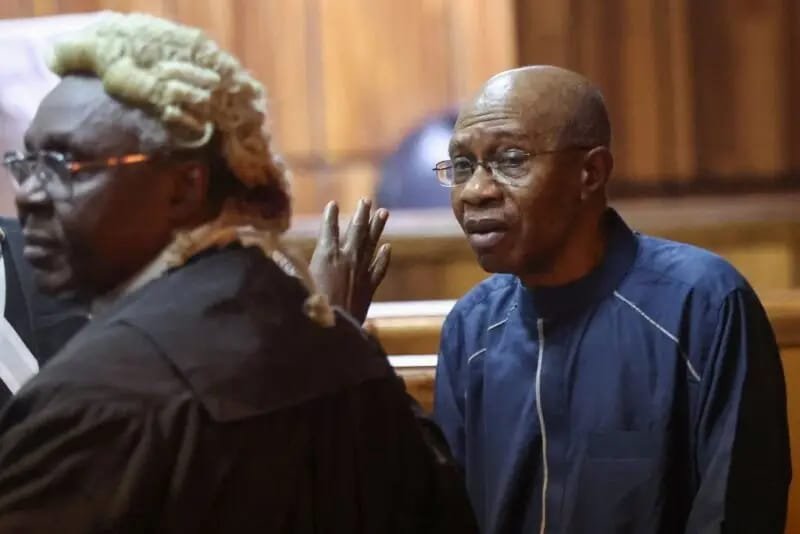
‘I Didn’t Collect Any Money From Emefiele’ – Prosecution Witness Testifies in Court

Published

on

Share


The trial of former Central Bank of Nigeria Governor, Godwin Emefiele, resumed on Tuesday with a prosecution witness telling the court that he never received funds directly from the former apex bank chief in connection with the controversial 753 Abuja duplexes case.


Testifying under cross-examination, the witness, Mr. Richard Agulu stated clearly that all funds he handled were received through Emefiele’s Personal Assistant, Mr. Eric Ocheme.

“I never received a dime directly from the defendant,” Agulu told the court. “I received the funds through his personal assistant, Eric Ocheme.”


Agulu, who previously worked with Zenith Bank Plc and now serves with the Nigeria Communications Commission, explained that his dealings were limited to Ocheme and not the former CBN governor personally.


When questioned by defence counsel, Mr. Matthew Burkaa (SAN), on whether he ever witnessed Emefiele hand money to Ocheme, the witness responded that he had not. However, he added that instructions were relayed through Ocheme, sometimes via phone calls.


He admitted that his earlier extrajudicial statement did not specifically mention phone communications but maintained that instructions were indeed conveyed to him through Ocheme.


Agulu further testified that the transactions he processed were authenticated by the account holders: Chukwuma Okpala of Kelvito Integrated Services and Peter Adebayo of Ifeadigo Integrated Services.


According to him, the transactions were executed using banking instruments, not through cheques, letters, emails, or text messages.


However, under further questioning, Agulu acknowledged that under Central Bank guidelines and Zenith Bank’s operational procedures, bank staff are expected to honour only formal instructions issued by the account holder, either via cheque or when the customer is physically present.

See also  HIGH COURT RESTRAINS SOLE ADMINISTRATOR FROM RESUMING DUTIES IN RIVERS STATE


Since neither Emefiele nor Ocheme was the account holder in the transactions, the witness disclosed that he routinely included the names of the actual account owners on deposit slips to validate the process.


The testimony forms part of the prosecution’s case in the ongoing trial concerning funds allegedly linked to the development of 753 duplexes in Abuja, a matter that has continued to draw significant public attention over issues of financial accountability and compliance with banking procedures.


The case was adjourned for further hearing.

Continue Reading
Click to comment

Leave a Reply

Your email address will not be published. Required fields are marked *

Judiciary

2027 Polls: ADC, Accord, ZLP, Action Alliance Face De-Registration Suit

Published

on

Share


The Federal High Court in Abuja has fixed February 24 for the commencement of hearing in a suit seeking the de-registration of the African Democratic Congress (ADC) and three other political parties ahead of the 2027 general elections.


The suit, marked FHC/ABJ/CS/2637/25, was filed by the Incorporated Trustees of the National Forum of Former Legislators (NFFL).


In the action, the plaintiff is asking the court to compel the Independent National Electoral Commission (INEC) to remove the affected parties from its register, alleging that they failed to meet constitutional electoral performance requirements.


The political parties listed in the suit are the African Democratic Congress, Accord Party, Zenith Labour Party, and Action Alliance.


Also joined as defendants in the case are the Independent National Electoral Commission and the Attorney-General of the Federation.


The plaintiff anchored the suit on Section 225(A) of the 1999 Constitution (as amended) and Section 75(4) of the Electoral Act, 2022.


According to the NFFL, the affected parties failed to meet minimum constitutional benchmarks required to retain registration. These include securing at least 25 per cent of votes in one state during a presidential election, winning at least one local government area in a governorship election, or obtaining at least one seat in elections ranging from councillorship to the National Assembly.


The group argued that the parties had not won any elective office since their registration and therefore no longer qualified to remain recognised political parties under Nigerian law.


In its reliefs, the plaintiff is seeking declarations that INEC is constitutionally obligated to enforce the prescribed electoral thresholds and that continued recognition of the parties allegedly violates existing constitutional provisions.

See also  UNIPORT STUDENT SENTENCED TO DEATH BY HANGING FOR GIRLFRIEND'S MURDER


The suit also seeks orders compelling INEC to formally de-register the parties and restrain the commission from recognising their congresses, primaries, campaigns, or participation in the 2027 elections unless they fully comply with constitutional requirements.


In a supporting affidavit sworn to by Hon. Igbokwe Nnanna, Chairman of the NFFL Board of Trustees, the plaintiff accused INEC of failing in its constitutional duty by maintaining the registration of parties that allegedly secured no representation across Nigeria’s 8,809 wards, 774 local government areas, 36 states, and the Federal Capital Territory.


The NFFL further contended that allowing the parties to participate in the 2027 elections could overcrowd the ballot, place additional strain on administrative resources, and potentially mislead voters.


The group maintained that the suit was filed in the public interest, aimed at strengthening constitutional compliance and enhancing the credibility of Nigeria’s democratic process.


The matter is expected to come up for a hearing on February 24.

Continue Reading

Judiciary

Federal High Court Announces Leadership Transition in Administrative Arm

Published

on

Share


The Federal Judicial Service Commission, at its 98th meeting held on January 22, 2026, approved the appointment of Yahaya Yakubu Shafa, FCArb, as the Acting Chief Registrar of the Federal High Court of Nigeria.


According to a press release issued by the Court’s Director of Information, Dr. Catherine Oby Christopher, the appointment takes effect from February 17, 2026.


Mr. Shafa’s appointment follows the elevation of the outgoing Chief Registrar, Sulaiman Amida Hassan, to the Bench of the Honourable Court, a development described as consistent with the Court’s commitment to continuity, efficiency, and stability in its administrative leadership.


A seasoned judicial administrator and legal practitioner, Mr. Shafa brings over eighteen years of progressive experience in the justice sector. Prior to his new role, he served as Executive Secretary of the Nasarawa State Judicial Service Commission, where he played a significant role in judicial administration, policy coordination, and institutional development.


The Court expressed confidence that his wealth of experience in court administration, legal practice, and institutional reform will further strengthen the administrative machinery of the Federal High Court and enhance the efficient delivery of justice.


The management and staff of the Court congratulated Mr. Hassan on his elevation and commended his service while also wishing Mr. Shafa a successful tenure in his new position.


See also  UNIPORT STUDENT SENTENCED TO DEATH BY HANGING FOR GIRLFRIEND'S MURDER
Continue Reading

Judiciary

Judge Withdraws from EFCC Cases Against Ex-AGF Malami

Published

on

Share


A Federal High Court judge, Justice Obiora Egwuatu, on Thursday recused himself from two cases filed by the Economic and Financial Crimes Commission (EFCC) against former Attorney-General of the Federation and Minister of Justice, Abubakar Malami.

Justice Egwuatu, who was recently assigned the matters by the Chief Judge of the Federal High Court, Justice John Tsoho, said his decision to step aside was based on personal reasons and in the interest of justice. He ordered that the case files be returned to the Chief Judge for reassignment to another judge.

The development occurred shortly after one of the cases—relating to the alleged forfeiture of 57 properties linked to Malami—was called up for mention. The cases were previously handled by Justice Emeka Nwite, who presided as vacation judge during the Christmas court recess.

The EFCC is prosecuting Malami, alongside his son Abdulaziz and one of his wives, Hajia Bashir Asabe, on a 16-count charge bordering on alleged money laundering involving about ₦9 billion. The anti-graft agency alleged that the defendants acquired multiple properties across Abuja, Kebbi and Kano states to conceal proceeds of crime.

Earlier, on January 6, Justice Nwite granted an interim forfeiture order for the 57 properties after an ex parte application by the EFCC. The court also directed the commission to publish notices inviting interested parties to show cause why the assets should not be permanently forfeited to the Federal Government.

According to the EFCC, the defendants allegedly used a company—Metropolitan Auto Tech Limited—to conceal over ₦1.01 billion in a Sterling Bank account between July 2022 and June 2025. They were also accused of channeling about ₦600 million through the same firm between September 2020 and February 2021.

See also  UNIPORT STUDENT SENTENCED TO DEATH BY HANGING FOR GIRLFRIEND'S MURDER

The commission further alleged that ₦600 million was retained in March 2021 as cash collateral for a ₦500 million loan obtained by another firm, Rayhaan Hotels Ltd, despite knowing the funds were proceeds of crime. The alleged actions were said to contravene provisions of the Money Laundering (Prohibition) Act, 2011.

Malami and his co-defendants have denied the allegations. Through his counsel, Joseph Daudu (SAN), the former minister filed a motion asking the court to set aside the interim forfeiture order on three of the listed properties and restrain the EFCC from interfering with them.

He told the court that one of the assets was inherited from his late father, while the others were acquired before he became Attorney-General and were duly declared in his asset declaration forms submitted to the Code of Conduct Bureau.

Malami listed his sources of income as including earnings from salaries and allowances, proceeds from disposed assets, business turnover, loans to businesses, and monetary gifts from associates. He argued that these disclosed financial streams demonstrated that the properties were lawfully acquired.

He also accused the EFCC of suppressing material facts and inflating asset values to obtain the forfeiture order, describing the proceedings as an infringement on his right to property and presumption of innocence.

Among witnesses expected to testify in the case are investigators, bank officials, real estate agents and Bureau de Change operators.

Continue Reading