Government
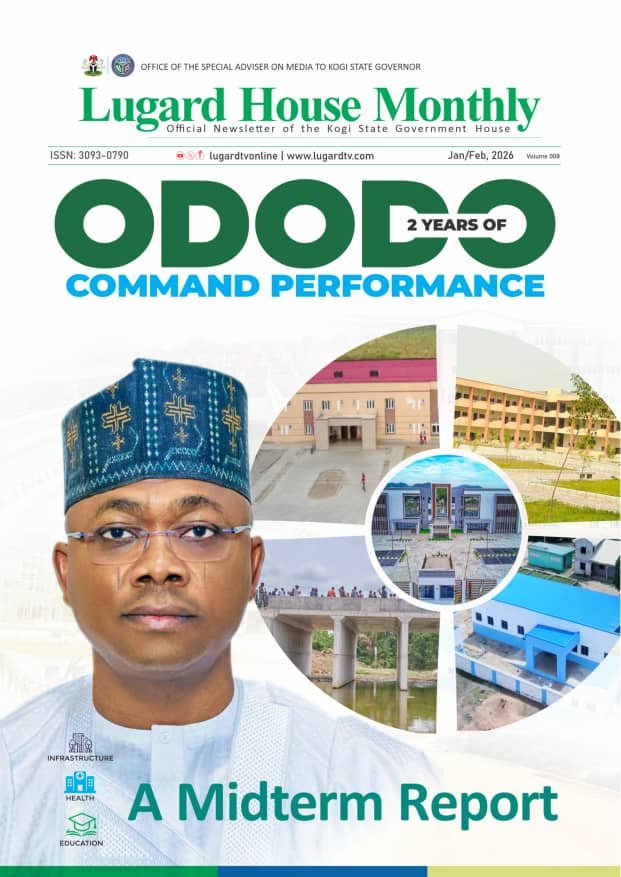
Kogi Publishes Ododo’s Midterm Performance Report In Lugard House Newsletter
The Kogi State Government has released a summary of Governor Ahmed Usman Ododo’s performance over his first two years in office, detailing achievements across key sectors and outlining priorities for the next phase of his administration.
The report, published in the 8th edition of Lugard House Monthly Newsletter, was issued by the Special Adviser on Media to the Governor, Hon. Ismaila Isah, who described it as a timely review of what he called two years of purposeful governance.
According to Isah, the latest volume opens the year with a comprehensive assessment of progress recorded across critical sectors while setting the tone for continued development efforts in the state.
He explained that the publication documents the governor’s leadership trajectory, highlighting policy implementation, institutional consolidation, and measurable outcomes in infrastructure, healthcare, education, security, economic management, and governance reforms.
The newsletter, he said, presents governance through verifiable evidence by detailing completed projects, ongoing initiatives, and strengthened systems intended to drive long-term development.
“It lays out the journey in clear, sharp perspectives of projects started, work completed and systems that define leadership in a state buoyed by renewed hope; marked by roads connecting communities, public buildings breeding efficiency in governance, health facilities promoting wellbeing and schools shaping the future of generations,” he stated.
Isah also emphasised the importance of collaboration in governance, noting that the Office of the Kogi State First Lady featured prominently in the report for its social interventions supporting women, children, vulnerable groups, and underserved communities.
He added that the first edition of the newsletter for the year serves both as a record of achievements and a signal of policy continuity, reaffirming the administration’s commitment to steady development and inclusive growth.
The media aide further said the publication reflects the governor’s commitment to transparency and accountability by keeping citizens informed about government activities as the administration continues to implement its agenda.
Government
Tinubu Appoints SHETCO DG, NEMSA CEO, Board Members, Nominates RMAFC Commissioners
President Bola Tinubu has approved a series of appointments, naming Hon. Magaji Da’u Aliyu as Managing Director of the Sheda Science and Technology Complex (SHESTCO), Abuja.
SHESTCO is tasked with conducting research and development in technology and operating a nuclear research facility.
The appointments were announced in a statement issued Wednesday by the President’s Special Adviser on Information and Strategy, Bayo Onanuga.
The President also appointed Engr. Adesayo Olusegun Michael as Managing Director and Chief Executive Officer of the Nigerian Electricity Management Services Agency (NEMSA).
In addition, Tinubu constituted the board of NEMSA with Engr. Aliyu Abdulazeez as Executive Director (Technical), Ikechi Clara Nwosu as Chairman representing the South East, Zubair Abdur’rauf Idris as member, Igba Elizabeth as member representing North Central, Sani Alhaji Shehu as member representing North East, Adeyemi Adetunji as member representing South West, Engr. Emmanuel Eneji Nkpe as member representing South South, and Engr. Charles Ogbonna Asogwa as member representing South East.
The President also nominated Amina Gamawa, representing Bauchi State, and Abdullahi Muktar, representing Kaduna State, as commissioners of the Revenue Mobilisation Allocation and Fiscal Commission (RMAFC), and forwarded their names to the Senate for confirmation.
General News
FG ALLOCATES ₦10.49BN TO MARINE, BLUE ECONOMY MINISTRY FOR 2026; OYETOLA FLAGS FUNDING GAPS
The Federal Ministry of Marine and Blue Economy has proposed a ₦10.49 billion budget for the 2026 fiscal year, but the Minister, Dr. Adegboyega Oyetola, CON, has warned that the allocation is insufficient to meet the ministry’s critical mandate.
Oyetola presented the budget on Tuesday before a joint session of the Senate Committee on Marine Transport and the House of Representatives committees on Ports and Harbours, Maritime Safety, Education and Administration, Shipping Services, Inland Waterways, and Ocean and Fisheries.
The proposed ₦10,499,984,667.10 budget comprises ₦8.24 billion for capital expenditure, ₦453.86 million for overhead costs, and ₦1.81 billion for personnel. The minister noted that while the funding could sustain basic operations, it falls short of supporting sectoral reforms or driving significant growth.
He explained that the ministry oversees multiple interconnected subsectors — including ports, shipping, inland waterways, fisheries, and aquaculture — which collectively account for over 90 per cent of Nigeria’s international trade by volume, contribute to food and nutrition security, and underpin national economic competitiveness.
Oyetola highlighted operational challenges faced by agencies under the ministry, such as the Nigerian Ports Authority (NPA), Nigerian Maritime Administration and Safety Agency (NIMASA), and Nigerian Shippers’ Council. While largely self-funding and contributing substantial remittances to the Consolidated Revenue Fund, these agencies are constrained by “excessive deductions at source” by the Office of the Accountant-General of the Federation, he said. The minister warned that these deductions have led to port congestion, rising logistics costs, delayed cargo movement, revenue losses, and inflationary pressures, describing the issue as a national economic concern.
He also flagged an apparent misplacement in the 2026 budget, where the Council for the Regulation of Freight Forwarding in Nigeria (CRFFN) was listed under the Federal Ministry of Transportation instead of the Ministry of Marine and Blue Economy, complicating oversight and policy coordination.
On inland waterways, Oyetola called for increased funding to improve safety and efficiency, noting that water transport is globally cheaper than road haulage. He said Nigeria’s reliance on road transport for over 80 per cent of freight has accelerated road deterioration and raised logistics costs.
Turning to fisheries and aquaculture, the minister said Nigeria’s annual fish demand exceeds 3.6 million metric tonnes, while domestic production is around 1.4 million metric tonnes, resulting in over $1 billion in annual imports. He added that post-harvest losses of up to 30 per cent worsen supply shortages, stressing that boosting local production could reduce import dependency and provide affordable protein to households.
Oyetola further disclosed that in 2025, the ministry’s revised capital budget of ₦3.53 billion received only ₦202.47 million, about 1.7 per cent, while overhead releases stood at 35 per cent. He said ongoing engagements with the Ministry of Budget and Economic Planning aim to address these funding gaps in line with the Federal Government’s agenda to diversify the economy through the marine and blue economy.
Senator Wasiu Eshilokun, Chairman of the Senate Committee on Marine Transport, assured that the National Assembly would carefully review the proposals, emphasizing the strategic importance of the marine and blue economy to Nigeria’s development and economic resilience.
General News
VP SHETTIMA TO CHAIR NATIONAL ECONOMIC COUNCIL CONFERENCE TO DRIVE INCLUSIVE GROWTH
The Federal Government is set to convene the National Economic Council (NEC) Conference on Monday to strengthen economic coordination and accelerate inclusive growth across the 36 states of the federation.
The two-day conference, scheduled for February 9 and 10, 2026, will take place at the Banquet Hall of the Presidential Villa, Abuja, and will be attended by governors of the 36 states, senior government officials, development partners, and private-sector leaders.
The conference is being convened by the Minister of Budget and Economic Planning, Senator Abubakar Atiku Bagudu, as part of efforts to align state-level economic strategies with the Federal Government’s long-term development objectives.
Vice President Kashim Shettima, who chairs the National Economic Council, will preside over the summit, which will focus on strengthening fiscal coordination, mobilising investments, and fostering shared development strategies between the federal and state governments.
The theme of the conference is “Delivering Inclusive Growth and Sustainable Development: The Renewed Hope National Development Plan.” Deliberations are expected to generate far-reaching policy directions to guide states in implementing economic reforms under the Federal Government’s Renewed Hope Agenda.
Speaking on the objectives of the conference, the Permanent Secretary of the Federal Ministry of Budget and Economic Planning and Secretary of the NEC, Dr. Deborah Oko Odo, said the gathering would address key macroeconomic priorities confronting the nation.
According to her, “the conference will focus on national economic issues aimed at encouraging economic growth and development across the country.”
President Bola Ahmed Tinubu will attend the event as Special Guest of Honour, underscoring the importance the administration attaches to deepening economic reforms and promoting sustainable development nationwide.
The NEC Conference is expected to serve as a critical platform for policy coordination and consensus-building as the Federal Government continues to drive economic transformation and inclusive growth under the Renewed Hope National Development Plan.