Labour
May Day 2026: Tinubu Declares Insecurity, Poverty National Emergencies as Workers Protest Unpaid Minimum Wage

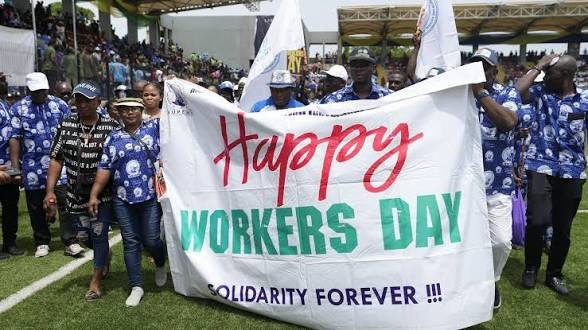
President Bola Tinubu declared insecurity and poverty national emergencies during the 2026 Workers’ Day celebration on Friday, warning that the twin crises pose grave threats to jobs, productivity and national stability, even as workers in some states took to the streets to protest the non-implementation of the minimum wage.
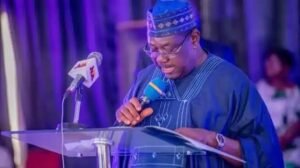 Akume, SGF[/caption]
Speaking through the Secretary to the Government of the Federation, Senator George Akume, at the national May Day event held at Eagle Square in Abuja, the President told thousands of workers and labour leaders that his administration was confronting both challenges with urgency and deliberate policy action.
“There cannot be decent work where workers fear for their lives, where wages cannot feed a family, or where insecurity disrupts farms, factories, markets and other economic activities. These hydra-headed challenges, the government notes, have been treated as a national emergency due to their impact on productivity, livelihoods, and the confidence of both workers and employers,” Tinubu said.
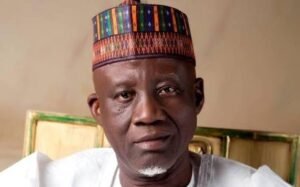
Dingyadi, Minister for Labour and Employment
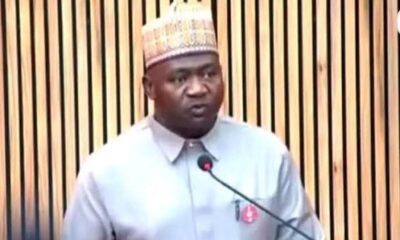
The 2026 May Day celebration was observed under the theme “Insecurity and Poverty: Bane of Decent Work,” a theme that the Minister of Labour and Employment, Dr Muhammad Dingyadi, described as deeply reflective of the realities confronting workers across the nation.
Dingyadi, who addressed workers during the celebration in Abuja, described Nigerian workers as the backbone of national growth, productivity and sustainable development. “Without labour, there can be no progress, productivity or sustainable national development. Nigerian workers remain the driving force behind the nation’s growth and shared prosperity,” he said.
The Minister assured workers that the recently implemented minimum wage was only the beginning of broader wage reforms. “Decent work must never be compromised at any level,” Dingyadi stated, adding that the government was investing in agriculture, technology and infrastructure to expand sustainable employment opportunities.
President Tinubu, in his address, highlighted a range of interventions under his Renewed Hope Agenda, including expanded cash transfers reaching 15 million vulnerable households and lifting an estimated 7.5 million Nigerians out of poverty. He added that infrastructure projects, among them the Lagos-Calabar Coastal Highway and the Ajaokuta-Kaduna-Kano Gas Pipeline, have generated over 600,000 jobs.
The President also noted that the government has implemented a new national minimum wage, cleared pension arrears and reintroduced gratuity payments from January 2026. According to him, over 800,000 informal sector workers have been enrolled in the micro pension scheme, with small businesses continuing to draw support from a N200 billion MSME fund.
“To you, our dear workers, I say this clearly; your welfare remains a priority. We are committed to improving working conditions, promoting fair wages, and ensuring that every Nigerian worker enjoys dignity, safety and equal opportunity in the workplace; hence, the recent reactivation of the payment of gratuity to Nigerian workers with effect from January 2026,” the President said.
However, the President also appealed to strike-prone unions, warning that industrial action should be a last resort. “Strike should be the last resort, not the first,” he said, urging sustained dialogue and restraint in industrial disputes.
Meanwhile, in Borno State, local government workers across the state protested on Friday over the non-implementation of the N70,000 minimum wage by the state government. The protest, held in Maiduguri, was organized by the Nigerian Labour Congress and the Trade Union Congress as part of activities marking this year’s International Workers’ Day.
Addressing journalists during the protest, the state NLC Chairman, Yusuf Inuwa, said local government workers were among the most affected by the prevailing economic hardship in the country. He said workers chose to mark Workers’ Day on the streets to draw attention to their plight.
“Last two years, the national leadership of organized labour negotiated the N70,000 minimum wage for Nigerian workers. That makes it a law for all states to pay their workers. Here in Borno, teachers and primary healthcare workers have been covered, but local government staff are yet to be captured. An injury to one is an injury to all,” Inuwa said, describing the situation as unacceptable.
In Rivers State, Governor Siminalayi Fubara commended the Nigeria Labour Congress, the Trade Union Congress, and their affiliate unions in the state for consistently resolving trade disputes through dialogue rather than confrontation. He said this approach has strengthened industrial harmony in Rivers State and urged labour unions to sustain dialogue to ensure stable and progressive industrial relations.
Governor Fubara also disclosed that the ongoing rehabilitation of the State Secretariat Complex would improve the work environment and boost efficiency and productivity.
In Katsina State, Governor Dikko Radda assured workers of his administration’s continued commitment to their welfare. Speaking during the 2026 May Day celebration held at Muhammadu Dikko Stadium, Katsina, Governor Radda acknowledged the prevailing economic challenges nationwide but said his administration has taken deliberate and strategic steps to prioritize workers’ welfare. He noted that thousands of personnel have been recruited into critical sectors, including education and healthcare, to strengthen service delivery and reduce unemployment.
Benue State Governor Hyacinth Alia also commended workers in the state and across the country, describing the celebration as an opportunity to recognize workers and highlight their importance in his administration’s efforts to transform the state. “Workers’ welfare is essential for improved performance,” Governor Alia assured, pledging that his administration would continue to prioritize workers’ welfare, implement supportive policies, and enhance their capacity.
The Corporate Accountability and Public Participation Africa, CAPPA, however, struck a more cautionary note, calling on all tiers of government to move beyond symbolic gestures and confront the worsening socioeconomic realities confronting the country’s workers.
In a statement, CAPPA’s Executive Director Akinbode Oluwafemi said, “May Day should not be reduced to ceremonial speeches. It must be a moment of reckoning. For millions of Nigerian workers, survival has become a daily negotiation with inflation, rising rents, and shrinking real incomes”.
CAPPA expressed particular concern over media reports of university lecturers and other public sector workers resorting to sleeping in offices and on campuses, unable to afford rent close to their workplaces. “That Nigeria’s educators, entrusted with shaping the nation’s future, are compelled to sleep in their offices is an indictment of our economic priorities,” Oluwafemi said.
The organisation warned that the continued commercialisation of basic services risks widening inequality and pushing more Nigerians into precarious living conditions, and called for a national housing strategy that prioritizes affordable rental schemes.
The 2026 Workers’ Day celebration was observed as a public holiday across Nigeria, with the Federal Government having declared Friday, May 1, a public holiday to commemorate the event.