Connect with us

World News

Mexico’s Most Wanted Drug Kingpin ‘El Mencho’ Killed in Military Operation

Published

on

Share


Mexico’s most powerful drug lord and leader of the Jalisco New Generation Cartel, Nemesio Rubén Oseguera Cervantes, widely known as “El Mencho,” has been killed in a military operation, Mexican defense authorities confirmed on Sunday.


Oseguera’s death marks one of the most significant blows to organized crime in recent years, targeting a figure long regarded as one of Mexico’s most wanted fugitives.


He co-founded the Jalisco New Generation Cartel (CJNG), an organization that evolved into one of the country’s most powerful and violent criminal networks. The cartel has been heavily involved in trafficking fentanyl, cocaine, heroin and methamphetamine into the United States.


The operation comes amid continued pressure from Donald Trump, who has repeatedly urged Mexico to intensify its crackdown on drug trafficking organizations operating across the U.S.-Mexico border.


Further details about the operation and its broader security implications are expected in the coming days.

See also  GARY LINEKER SET TO LEAVE BBC AFTER CONTROVERSY
Continue Reading
Click to comment

Leave a Reply

Your email address will not be published. Required fields are marked *

World News

Mexico Deploys 2,000 Troops to Jalisco After El Mencho’s Fall

Published

on

Share


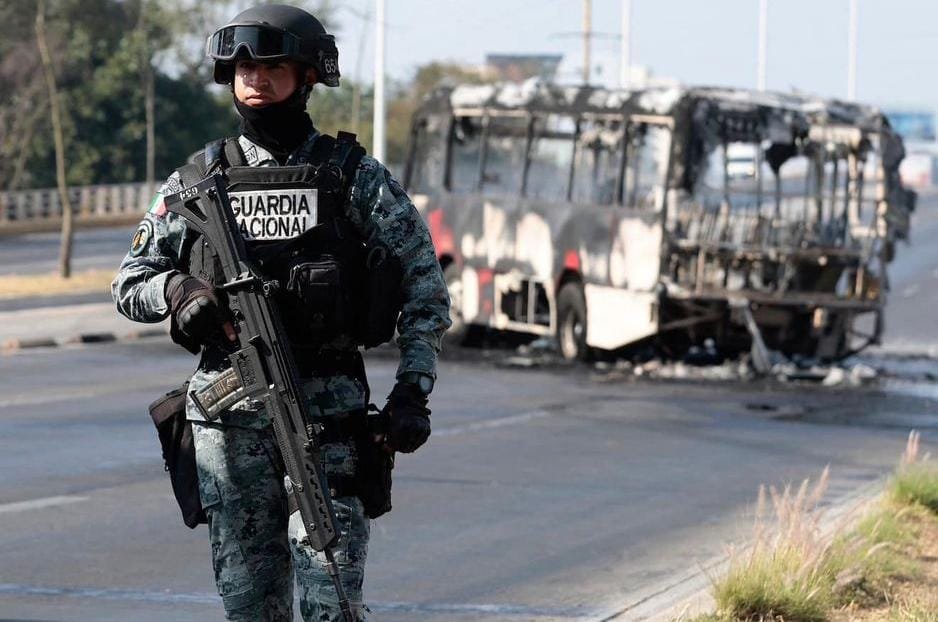
Mexican authorities have deployed an additional 2,000 military troops to the western state of Jalisco following renewed violence after the reported capture and death of cartel kingpin Nemesio Oseguera, widely known as “El Mencho.”


Security forces moved swiftly into the region as tensions escalated in the aftermath of the operation that brought down one of the most feared drug lords in the country. The reinforcement is aimed at preventing retaliatory attacks, dismantling remaining criminal cells, and restoring public order.


Oseguera was the leader of the powerful Jalisco New Generation Cartel (CJNG), a group long considered one of the most violent and influential drug trafficking organizations in Mexico. Under his command, the cartel expanded its operations across multiple states and was linked to high-profile attacks on security forces.


The western state of Jalisco has historically served as the stronghold of the cartel, making it a flashpoint for clashes between criminal groups and federal forces. Following news of Oseguera’s capture and death, reports emerged of road blockades, vehicle burnings, and sporadic gunfire in parts of the state.


Authorities say the military deployment is part of a broader stabilization effort designed to deter further unrest and prevent power struggles within the cartel’s ranks. Security analysts warn that the fall of a major crime boss often creates a temporary vacuum, sometimes triggering violent infighting as rival factions compete for control.


For residents of Jalisco, the heavy military presence brings both reassurance and anxiety. While many hope it signals a turning point in the fight against organized crime, others fear potential reprisals in the coming days.

See also  Guterres Urges Nigeria to Lead Africa’s Push for New Global Order


The federal government has yet to release detailed information on the operation that led to Oseguera’s capture and death, but officials insist that security operations will remain active in the region to ensure stability.

Continue Reading

World News

Billions at Stake as U.S. Stops Illegal Tariff Collections

Published

on

Share


The U.S. Customs and Border Protection (CBP) has announced it will stop collecting tariffs imposed under the International Emergency Economic Powers Act (IEEPA), following last week’s ruling by the Supreme Court of the United States declaring the duties unlawful.


According to a notice issued to shippers through CBP’s Cargo Systems Messaging Service, all tariff codes linked to former President Donald Trump’s IEEPA-based orders will be deactivated effective 12:01 a.m. EST (0501 GMT) on Tuesday.


The suspension comes more than three days after the Supreme Court struck down the measures. The agency did not explain the delay in halting collections at U.S. ports, nor did it provide guidance on whether importers will receive refunds for duties already paid.


The pause in IEEPA-related collections coincides with the introduction of a fresh 15% global tariff announced by Trump under a separate legal authority. That move effectively replaces the invalidated measures but keeps overall tariff pressure in place.


CBP clarified that the suspension applies only to tariffs imposed under the emergency powers law. Other trade measures; including those enacted under Section 232 on national security grounds and Section 301 addressing unfair trade practices remain in force.


The agency said further updates would be communicated to the trade community as necessary.


The Supreme Court decision has significant financial implications. Economists at the Penn-Wharton Budget Model estimate that more than $175 billion in revenue collected under the IEEPA tariffs could now be subject to potential refund claims. Their analysis suggests the duties had been generating over $500 million per day in gross revenue for the U.S. Treasury.

See also  THREE CUSTOMS OFFICERS KILLED IN ISWAP TERRORIST AMBUSH IN KEBBI


The development adds another layer of uncertainty for businesses navigating shifting U.S. trade policies.

Continue Reading

World News

EU Demands Clarity from U.S. After Supreme Court Strikes Down Trump Tariffs

Published

on

Share


The European Commission has urged the United States to honour the terms of last year’s EU-U.S. trade agreement following a fresh wave of tariff uncertainty triggered by a U.S. Supreme Court ruling.


After the Supreme Court of the United States invalidated  President Donald Trump’s sweeping global tariffs, Trump responded by announcing new across-the-board levies. Brussels said Washington must now provide “full clarity” on how it intends to proceed and whether the new measures are consistent with the existing bilateral deal.


“The current situation is not conducive to delivering fair, balanced, and mutually beneficial transatlantic trade,” the Commission said, stressing that the agreement reached last year remains binding. “A deal is a deal.”


The statement marked a sharper tone compared to the Commission’s earlier reaction when it said it was still assessing the court’s ruling.


Under the 2025 EU-U.S. trade arrangement, most EU exports to the U.S. face a 15% tariff ceiling, with exemptions for certain goods such as aircraft and spare parts. In return, the EU reduced duties on a range of American products and shelved plans for retaliatory tariffs.


However, uncertainty now surrounds whether Trump’s newly announced 15% tariffs override the agreed framework. If so, existing exemptions could be scrapped, and new duties might be layered on top of standard U.S. “most-favoured-nation” rates, something the deal was designed to prevent.


Analysts warn that the EU’s competitive edge under the 15% cap could also erode, as countries without specific agreements may now face similar rates.


Trade monitor Global Trade Alert estimates the EU economy could be 0.8 percentage points worse off under the new tariff regime, with Italy potentially hit harder at 1.7 percentage points.

See also  OVER 10 SECURITY PERSONNEL KILLED, OTHERS MISSING IN BENUE STATE ATTACK


The Commission warned that unpredictable tariff changes risk undermining investor confidence and destabilizing global markets. EU Trade Commissioner Maros Sefcovic has already held talks with the U.S. Trade Representative Jamieson Greer and Commerce Secretary Howard Lutnick in a bid to clarify Washington’s position.


Brussels insists that EU exports must continue to receive the “most competitive treatment” under the agreed ceiling, warning that any deviation could strain transatlantic trade relations.

Continue Reading