
General News
NiMet DG Calls for Greater Private Sector Role in Weather and Climate Projects

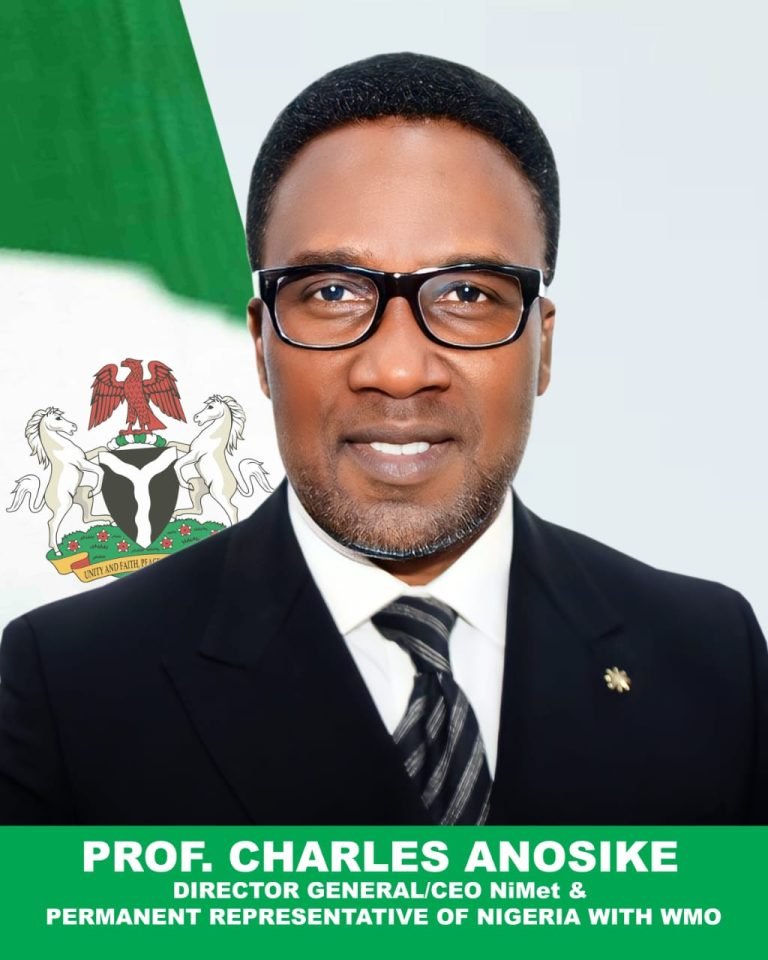
Professor Charles Anosike, Director General and CEO of the Nigerian Meteorological Agency (NiMet), has urged Nigerian companies, universities, and organizations to invest in weather and climate monitoring, prediction, and public awareness to mitigate climate change impacts and save lives.
Anosike, who also serves as Nigeria’s Permanent Representative to the World Meteorological Organization (WMO), made the call on Wednesday at the National Weather Forecasting and Climate Research Centre, Abuja, during the celebration of this year’s World Meteorological Day, themed “Observing Today, Protecting Tomorrow.”
Highlighting the vital role of the private sector, he noted that global companies are increasingly investing in weather stations, remote sensing, data analytics, artificial intelligence (AI) weather models, and innovative observation tools. He encouraged Nigerian firms to participate in this growing trend.
“Public-private collaboration is essential to achieving a robust and sustainable national observation system,” Anosike said. “Strategic partnerships promote shared investment in meteorological infrastructure, improve data exchange, and foster innovation in observation technologies. Every observation collected today safeguards our future.”
He emphasized NiMet’s commitment to expanding services regionally, providing technical assistance to Liberia, Niger, Somalia, and Burkina Faso under the WMO’s Systematic Observations Financing Facility (SOFF). These efforts aim to strengthen meteorological capacity in developing countries.
Anosike highlighted the increasing demand for meteorological services due to climate change, citing the State of the Climate in Nigeria 2025 report: “Extreme daytime temperatures above 40℃ were recorded across 23 Nigerian cities, with Nguru, Yobe State, recording 100 days above 40℃. Flood frequency and intensity are also rising nationwide.”
He urged industry leaders, innovators, research institutions, financial organizations, and development partners to collaborate with NiMet to expand Nigeria’s observational capabilities.
In his remarks, WMO Secretary-General Prof. Celeste Saulo emphasized the urgency of climate resilience. “Extreme weather is the top long-term global risk. Observations and prediction systems coordinated by the WMO underpin economies and daily life worldwide,” she said.
Director-General of the Nigerian Hydrological Services Agency (NIHSA), Umar Ibrahim Mohammed, praised NiMet for its decades-long contribution to national development, disaster risk mitigation, and reliable weather forecasting.
Similarly, Nigeria Civil Aviation Authority (NCAA) DG Chris Najomo stressed the critical partnership between aviation and meteorology, noting that high-precision, real-time data ensures flight safety. He called for investment in weather-resilient infrastructure and integration of AI and satellite technology to protect lives and maintain operational continuity.
Anosike concluded: “As we celebrate World Meteorological Day, let us reaffirm our commitment to strengthen meteorological observations, deepen partnerships, and invest in science that protects our present and secures our future.”