Connect with us

Security

Troops Repel ISWAP Attack, Kill 16 Terrorists, Rescue 11 Kidnap Victims in Borno

Published

on

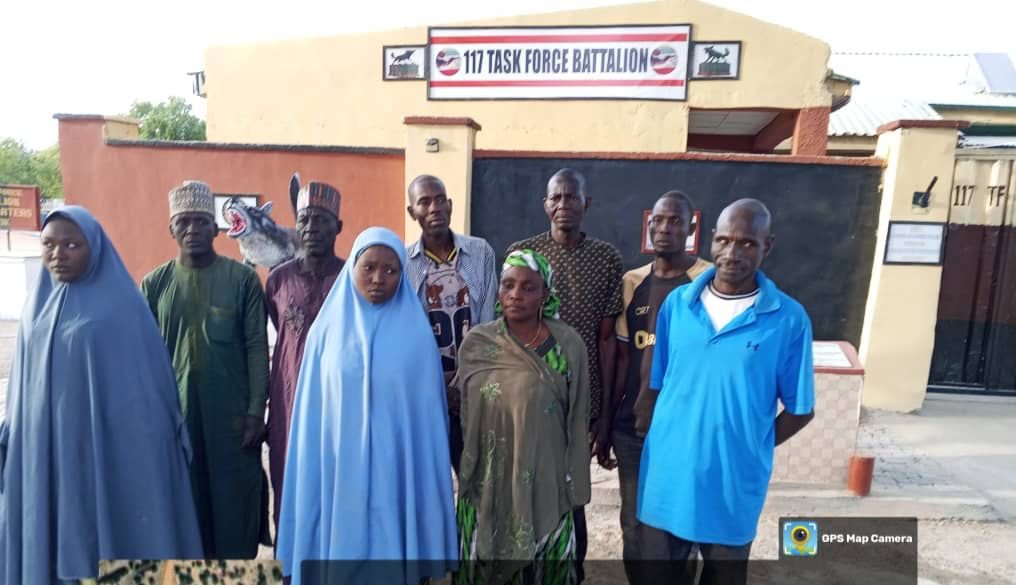
Some rescued victims


Troops of the Joint Task Force (North East) Operation HADIN KAI (OPHK) have repelled an attack by suspected Islamic State West Africa Province (ISWAP) fighters on a military position in Borno State and subsequently launched a counter-offensive that neutralised 16 terrorists, disrupted their logistics network, and rescued kidnapped civilians.


According to a statement issued by the Media Information Officer of OPHK, Lieutenant Colonel Sani Uba, the failed attack occurred late on February 5, 2026, when ISWAP fighters attempted to overrun the Forward Operating Base (FOB) in Auno shortly before midnight. Troops of Sector 1 reportedly repelled the assault with what the military described as disciplined firepower and tactical precision.

Following the encounter, troops, working in synergy with members of the Civilian Joint Task Force, launched a follow-up offensive on February 9 along the Komala axis in Konduga Local Government Area. During the operation, forces pursued retreating fighters up to the Gidan Kaji axis, where 16 terrorists were killed while others fled with injuries.

The military said troops recovered more than 20 bicycles as well as weapons, logistics materials, and other supplies believed to be critical to insurgent operations. On the same day, soldiers also arrested suspected ISWAP logistics suppliers who were allegedly transporting large quantities of drugs intended for terrorists around the Bukarti axis.

In a related development, troops foiled a kidnapping attempt along the Buratai–Kamuya road at about 5:20 p.m. on February 9 after detecting suspicious movements. The suspects abandoned their captives and fled into nearby bushes when pursued by soldiers. Two victims identified as Mallam Idris Adamu and Mallam Muhammadu Safiyanu were rescued and safely reunited with their families in Buratai.

Similarly, troops responding to a distress call along the Chibok–Damboa axis on the same day rescued nine kidnapped persons.

The military said the operations highlight its continued commitment to degrading terrorist networks, safeguarding civilians, and supporting humanitarian efforts across Nigeria’s North-East region.

Continue Reading
Click to comment

Leave a Reply

Your email address will not be published. Required fields are marked *

Security

Report: U.S. To Deploy 200 Troops To Nigeria For Military Training

Published

on


The United States government is reportedly preparing to deploy about 200 troops to Nigeria to support the country’s armed forces with training and operational assistance as they continue campaigns against militant groups.

According to a U.S. official cited by The Wall Street Journal, the soldiers will help strengthen Nigeria’s military capacity through specialised training and collaboration with local forces.

The planned deployment comes weeks after U.S. President Donald Trump approved airstrikes targeting what he described as Islamic State positions.

Reports indicate that a small number of American military personnel are already in Nigeria, with the U.S. military confirming last week that a limited team had been sent, though it did not disclose the size.

That announcement marked the first public confirmation that U.S. troops were on the ground following airstrikes carried out on Christmas Day.

The additional 200 personnel are expected to reinforce the existing team and work closely with Nigerian forces to enhance their response to militant attacks. The U.S. Africa Command did not immediately comment further on the reported deployment.

Separately, reports suggest the United States has been conducting surveillance flights over Nigeria from Ghana since late November to monitor security threats.

Washington has in recent months increased pressure on Nigeria over its handling of security challenges, particularly after Trump accused the country of failing to adequately protect Christians from attacks by Islamist militants in the northwest.

Nigerian authorities have rejected the claim, insisting there is no organised persecution of Christians and maintaining that military operations target armed groups irrespective of religion.

Nigeria has battled insurgent violence for about 17 years, with groups such as Boko Haram and the Islamic State West Africa Province (ISWAP) carrying out attacks against both civilians and security personnel.


The country, with a population exceeding 230 million, is almost evenly divided between Christians largely in the south and Muslims, predominantly in the north, and the conflict has affected communities across both faiths.

Continue Reading

Security

NIGERIAN ARMY MOVES TO SECURE FARMING COMMUNITIES IN BENUE, NASARAWA, TARABA

Published

on


The Nigerian Army has deployed Special Forces to Benue, Nasarawa, and Taraba states in a renewed effort to combat insecurity and stabilise affected communities across the North-Central region.

The deployment, approved by the Chief of Army Staff (COAS), Lieutenant General Waidi Shaibu, comes hours after a similar reinforcement was announced for Plateau State.

According to a statement issued by the Acting Spokesperson of Operation Whirl Stroke (OPWS), Ahmad Zubairu, the newly deployed unit, COAS Special Intervention Battalion XV, will serve as a force multiplier to the ongoing joint security operations in the region.

The statement noted that the troops recently completed an intensive Special Forces training programme at the Nigerian Army Training Centre in Kontagora, Niger State.

“The deployment is in line with the Chief of Army Staff’s strategic efforts to strengthen internal security operations and stabilise vulnerable communities,” the statement said.

Upon arrival in the Joint Operations Area, the soldiers reportedly demonstrated high morale and combat readiness.

The Special Forces are expected to complement ongoing operations aimed at dismantling criminal networks, curbing banditry and armed violence, and restoring normalcy to communities affected by persistent attacks.

Military authorities said the intervention is specifically targeted at safeguarding farming communities, protecting livelihoods, and reviving socio-economic activities disrupted by insecurity.

The Commander of Operation Whirl Stroke, Major General Moses Gara, welcomed the troops and urged them to apply the skills and discipline acquired during their training effectively.

He stressed that the mission requires professionalism, resilience, and total commitment, warning that the operational environment does not tolerate complacency.

General Gara further charged the soldiers to remain decisive against terrorist and criminal elements while collaborating closely with other security agencies.

He also advised the troops on responsible use of social media, highlighting its implications for operational security.

“The newly inducted troops were also sensitised on the need to maintain cordial relationships with host communities while upholding human rights in line with established rules of engagement,” the statement added.

The Army reiterated its commitment to restoring peace and ensuring the safety of residents in the affected states.

Continue Reading

Security

I SAW HIM CLEARLY ”: DSS WITNESS IDENTIFIES ALLEGED OWO CHURCH ATTACKER

Published

on

A Department of State Services (DSS) witness on Tuesday identified one of the defendants’ standing trial over the June 5, 2022 attack on St. Francis Xavier Catholic Church in Owo, Ondo State, is one of the gunmen involved in the deadly assault.

Testifying before the Federal High Court in Abuja, the witness, identified as PW7 and codenamed SSG, told the court that he recognised the second defendant, Al Qasim Idris, during a close-range exchange of gunfire on the day of the attack.

SSG, an Assistant Commander with the Ondo State Security Network Agency, Amotekun, said he was deployed to the church shortly after receiving an emergency alert from his commander.

According to him, he arrived to find scenes of mass casualties with the bodies of men, women, and children scattered within and around the church premises.

“I saw about 35 corpses,” he told the court.

The witness said eyewitnesses informed him that the attackers had escaped in a blue Nissan Sunny vehicle heading towards the Achievers University axis along Ute Road.

He said he and his team pursued the vehicle and tracked it to Ijegunman Village, where the suspects abandoned the car by the roadside and fled into the bush.

“They were four in number. They abandoned the vehicle and ran into the bush. When I searched the vehicle, I found packs of sachet water inside,” SSG said.

He identified the vehicle as a blue Nissan Sunny with registration number AKR 895 AG, adding that two operatives later drove it to the Amotekun office in Owo.

SSG further told the court that he and a hunter attached to his team pursued the suspects into the bush, where they later encountered them.

“They opened fire on us with AK-47 rifles. I responded with my pump-action rifle,” he said.

According to the witness, three of the attackers escaped deeper into the bush, while one hid behind a tree and shot the hunter, killing him instantly.

“I saw him clearly at close range,” SSG said, adding that he could still identify the shooter despite the incident occurring nearly four years ago.

Following an application by the prosecution, led by Ayodeji Adedipe (SAN), and with no objection from defence counsel Abdullahi Mohammad, the court allowed the witness to move closer to the dock to identify the suspect.

SSG stepped forward and pointed at Al Qasim Idris as the man who shot and killed the hunter. He repeated the identification during cross-examination, explaining that he could not arrest the suspect at the time because the defendant was armed with an AK-47 rifle, which he said outmatched his own weapon.

He added that the defendant was later arrested through a joint operation involving security agencies in Ondo State.

Earlier in the proceedings, the sixth prosecution witness (PW6), a pathologist codenamed SSF, tendered a certified true copy of the autopsy report on victims of the attack.

The report, which was admitted without objection, confirmed that the victims died from gunshot wounds that caused severe organ damage, skeletal injuries, and massive bleeding.

“Generally, all the bodies bore marks of gunshot injuries fired from varying distances, leading to fatal internal damage and exsanguination,” the pathologist testified.

The DSS is prosecuting Idris Abdulmalik Omeiza, Al Qasim Idris, Jamiu Abdulmalik, Abdulhaleem Idris, and Momoh Otuho Abubakar over the attack, which claimed dozens of lives.

This marks the second time a prosecution witness has directly identified some of the defendants as participants in the Owo church massacre.

Continue Reading