
Politics
ZIMBABWE ABOLISHES DEATH PENALTY AS PRESIDENT MNANGAGWA SIGNS HISTORIC BILL INTO LAW

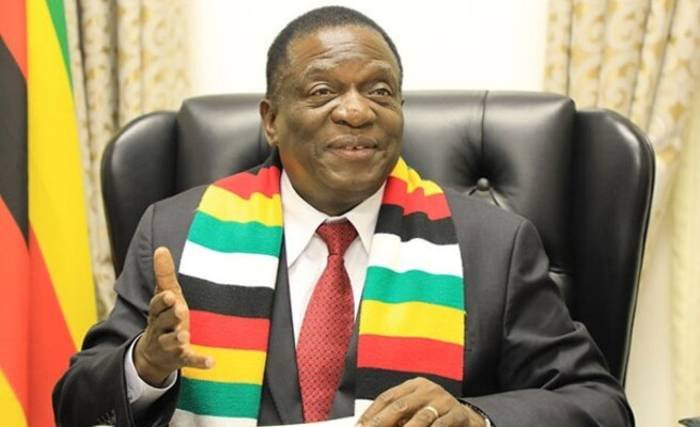
Zimbabwe has taken a significant step towards upholding human rights by abolishing the death penalty, with President Emmerson Mnangagwa signing the Death Penalty Abolition Act into law. This move comes after Parliament pushed to amend the Criminal Law Code, Criminal Procedure Law, and the Defence Act, which previously allowed the death penalty in cases of murder committed under aggravating circumstances.
The abolition of the death penalty is a welcome development for the over 60 prisoners on death row, who will now have their sentences commuted. Zimbabwe has not carried out an execution since 2005, and this move aligns the country with international human rights standards.
President Mnangagwa, who has expressed his opposition to capital punishment, shared his personal experience of being sentenced to death for blowing up a train during the 1960s war, only to have his sentence commuted to 10 years in prison. This experience has likely influenced his stance on the death penalty.

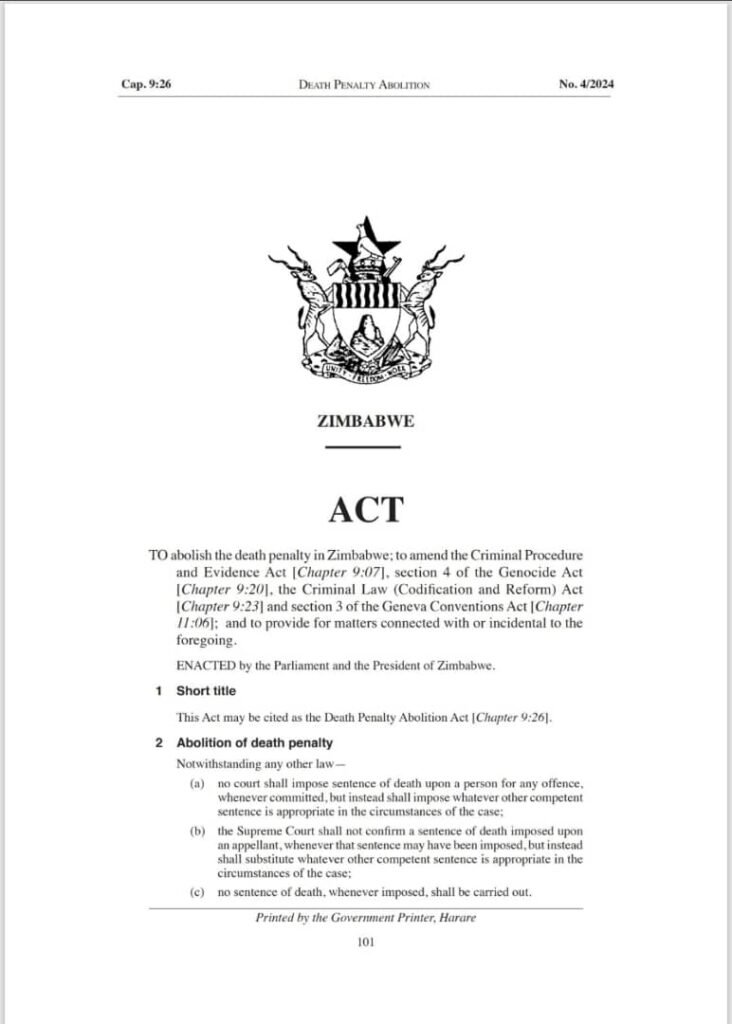
The Death Penalty Abolition Act ensures that no court shall impose a death sentence, and instead, shall impose alternative competent sentences. The Supreme Court is also prohibited from confirming death sentences, and must substitute them with alternative sentences.
International bodies such as Amnesty International have long advocated for the removal of the death penalty, arguing that it violates the right to life. Lucia Masuka, Amnesty International Zimbabwe’s Executive Director, praised Zimbabwe’s decision, stating that it is a “beacon of hope for the abolitionist movement in the region”.
Zimbabwe joins 24 other African countries, including Zambia, that have fully abolished the death penalty. This move is a significant step towards upholding human rights and promoting justice and compassion in the country.


The Independent National Electoral Commission (INEC) has unveiled a revised draft of its 2026 Regulations and Guidelines for Political Parties as part of efforts to strengthen Nigeria’s electoral process ahead of the 2027 general elections.
INEC Chairman, Joash Amupitan, disclosed this on Tuesday during a consultative meeting with political party leaders in Abuja, where he called for stakeholder input on the proposed framework.
Amupitan said the revised guidelines were developed to align with the Electoral Act 2026 and to address shortcomings identified in previous regulations, particularly those guiding the 2022 electoral cycle.
He emphasised that credible elections begin with transparent processes within political parties, especially in candidate selection.
“We are not just here to discuss new regulations, but to reaffirm our shared commitment to strengthening Nigeria’s democracy. Credible elections begin long before polling day—they begin with the transparency of candidate emergence,” he said.
According to the INEC chairman, the review followed a comprehensive assessment supported by empirical data, including insights from the Political Party Performance Index developed in collaboration with the Westminster Foundation for Democracy.
He noted that the assessment revealed a significant gap between party constitutions and actual practices at the grassroots level.
The revised guidelines introduce reforms across key areas such as party registration and mergers, internal administration, conduct of primaries, campaign operations, financial transparency, and conditions for party deregistration.
Amupitan said the measures are specifically designed to curb irregularities in party primaries and promote internal democracy.
“These guidelines aim to sanitise party primaries and eliminate opaque processes that impose unpopular candidates, which often lead to voter apathy and avoidable litigation,” he added.
On campaign finance, he explained that the Electoral Act 2026 empowers INEC to set spending limits in consultation with political parties, urging stakeholders to pay close attention to provisions relating to election funding and expenditure.
With the 2027 general elections scheduled for January 16 for presidential and National Assembly polls, and February 6 for governorship and state assembly elections, Amupitan noted that the commission is working within a tight timeline.
“We are operating within a compressed timetable that requires precision and efficiency in implementation,” he said.
He further revealed that the draft guidelines include measurable benchmarks aimed at increasing participation among women, youth, and persons with disabilities in the electoral process.
Calling for constructive engagement, the INEC chairman urged political parties to see the guidelines as protective measures rather than restrictions.
“By strengthening these rules, we are safeguarding the sovereign will of Nigerians from the nomination stage to the final declaration of results,” he stated.
Reaffirming the commission’s neutrality, Amupitan maintained that INEC remains an impartial umpire committed to defending democratic values and ensuring credible elections.

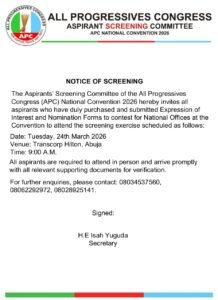
The All Progressives Congress (APC) has announced Tuesday, March 24, 2026, as the date for the screening of aspirants seeking to contest for national offices at its forthcoming national convention.
In a notice issued by the party’s Aspirants’ Screening Committee, Secretary, His Excellency, Isa Yuguda stated that aspirants who have purchased and submitted their Expression of Interest and Nomination Forms are required to attend the exercise in person.
The screening is scheduled to hold at Transcorp Hilton Abuja, with proceedings set to commence at 9:00 a.m.
According to the statement, aspirants are expected to arrive early and come along with all relevant supporting documents for verification.
The committee stressed that attendance is mandatory for all aspirants, as the exercise forms a critical part of the process leading to the party’s 2026 national convention.
For further enquiries, aspirants and stakeholders are advised to contact the committee via 08034537560, 08062292972, or 08028925141.
Politics
2027 Shake-Up: Kogi Governor Allegedly Double-Dealing, Campaigns for Opposition in Mopamuro


In a development sending shockwaves through Kogi State politics, Governor Ahmed Usman Ododo has been accused of orchestrating support for opposition candidates, raising fresh questions about his loyalty to the All Progressives Congress (APC) ahead of the 2027 elections.
According to an APC chieftain in Mopamuro Local Government Area, who spoke on condition of anonymity, the governor directed his political appointees led by the state Commissioner for Information, Kingsley Fanwo to campaign for ADC’s Hon. Leke Abejide in his bid for a third term in the House of Representatives.
Eyewitnesses said the rally saw appointees don T-shirts and caps celebrating APC achievements but without any party logos, creating confusion about their political stance.
Many APC faithful reportedly resisted participating, with some sustaining minor injuries after falling off vehicles during the walk.
Following the event, appointees from Mopamuro were allegedly summoned to a meeting where they were given an ultimatum: support the ADC candidate or resign.
The insider claimed this move undermines the rotational arrangement in Yagba Federal Constituency, where Mopamuro is expected to produce the next representative.
“It is astonishing that a sitting governor would order his own appointees to campaign for a candidate of another party,” the source said. “It smacks of double-dealing and raises serious questions about his political intentions.”
Attempts to reach Governor Ododo and Commissioner Fanwo for comment were unsuccessful.
Political analysts warn that if these claims are substantiated, they could spark internal crises within APC and reshape the electoral landscape in Kogi State ahead of 2027.