General News
NIGERIAN SENATE IN UPROAR DURING HEATED DEBATE ON WORSENING INSECURITY
The Nigerian Senate has begun a heated debate on the country’s worsening security situation. The debate followed a motion by Senator Lola Ashiru from Kwara South on the urgent need to address escalating insecurity in Kwara, Kebbi, and Niger states. The motion called for immediate and comprehensive federal intervention, highlighting recent attacks including the abduction of schoolchildren in Kebbi and concerns about military withdrawals and compromised operations.

Deputy Senate President Barau Jibrin stated that the security challenges confronting the nation were surmountable but required international support. “We should seek assistance from overseas, urging collaboration with global partners to stem the crisis,” he said.
Senate Leader Opeyemi Bamidele described the current wave of insecurity as a turning point that must not be business as usual. Bamidele warned that the nation risks losing it unless decisive action is taken. While welcoming the safe rescue of abducted captives, the lawmaker expressed concern that there were no words on the terrorists neutralized in the process. Referencing a debate in the House of Representatives calling for a shutdown of the National Assembly, Bamidele cautioned lawmakers against grandstanding, describing such arguments as a move geared towards the abdication of responsibility. He also challenged the Senate to examine its own internal structures, stating, “If we are calling on the President to rejig the security architecture, we must also look into our own arrangement. I am not impressed with our Committee on Security and Intelligence. We should rejig it ourselves.”
Opposition lawmaker Senator Enyinnaya Abaribe criticized efforts to blame past administrations, insisting that the current government must take responsibility for today’s failures. Abaribe cited reports that troops withdrew shortly before the attack in the Kebbi school, asking, “Who asked them? Nobody knows. If I were the Commander-in-Chief, I would demand answers.”
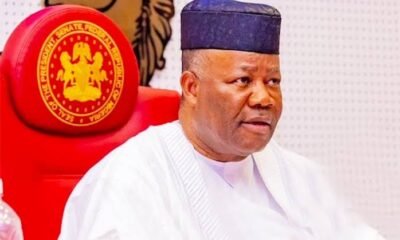
Senate President Godswill Akpabio highlighted reports that the location of a brigadier general killed in Borno was compromised, raising fears of internal sabotage. Akpabio also expressed concern that despite security advisories and defensive training given to students in Kebbi, bandits still invaded the school unhindered.
An uproar occurred when Senator Seriake Dickson warned that Nigeria was losing prestige and integrity before our eyes, accusing the majority caucus of managing the issues rather than confronting them. Dickson’s comments triggered an uproar from lawmakers of the All Progressives Congress, leading to the cutting off of his microphone.
As some lawmakers continued to propagate the claim that security agencies know the locations and motives of bandits, Senator Akpabio condemned attempts to frame the crisis along religious or sectional lines. “This is orchestrated to damage the image of democracy. There is nothing like targeting Muslims or Christians. It is an attack on all. This country is under attack,” he said.
Meanwhile, Senator Adams Oshiomhole defended President Bola Tinubu, saying he is doing his best under difficult circumstances. He demanded a probe into the troop withdrawal before the Kebbi school attack, stating, “Who ordered the military to withdraw? That person should be tried for terrorism.” The Senate subsequently adopted this demand among its resolutions. Senator Oshiomhole also questioned what he called inconsistencies in the justice system, noting that a convicted terrorist named Hassan received a 20-year sentence while people who killed a bandit in self-defense were sentenced to death. Some lawmakers are pushing for the death penalty to be imposed on kidnappers.
Education
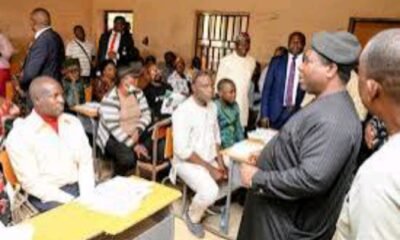
FG to Scrap Common Entrance, Introduce Learner ID for Pupils
The Federal Government has announced plans to abolish the Junior Secondary School Common Entrance Examination and introduce a nationwide Learner Identification Number system to track pupils throughout their academic journey.
Minister of Education, Tunji Alausa, disclosed the proposal during an interactive session with journalists in Lagos, stating that the reforms are aimed at improving access to education and strengthening monitoring mechanisms across the country.
Under the proposed framework, the current common entrance examination will be phased out and replaced with a Continuous Assessment (CA) system. The minister explained that pupils would be evaluated based on their academic performance from primary one, allowing for seamless transfer of records when moving between schools.
Alausa said the reform is designed to address long-standing challenges in the transition from primary to secondary education, particularly the high number of pupils who fail to progress.
According to him, Nigeria has over 50,000 public primary schools with more than 23 million pupils, yet only slightly above three million transition to junior secondary school within the public system.
He described the gap as a reflection of limited access, noting that private schools cannot fully absorb the shortfall.
“The issue is simply lack of access,” he said, adding that the Federal Government is working with state governments to expand infrastructure and build more schools to accommodate the growing number of pupils.
To support the reform, the government plans to introduce a unique Learner Identification Number for every child from the primary school level. The number will remain with each pupil throughout their education, regardless of school transfers.
The system, the minister said, will enable authorities to track students’ progress and identify dropouts for timely intervention.
“If a child is expected to be in JSS1 and is not there, we will be able to determine the reason,” he added.
Alausa also revealed plans to revive the school feeding programme as part of efforts to boost enrolment and retention in public schools.
He noted that the programme may be placed under the supervision of the Federal Ministry of Education to improve monitoring and effectiveness.
The initiative forms part of broader efforts by the Federal Government of Nigeria to strengthen the education sector, improve retention rates, and ensure more children complete basic education.
General News
Alue-Do Festival Assault: First Lady Oluremi Tinubu Condemns Attack on Women, Calls for Justice
The First Lady of Nigeria, Oluremi Tinubu, has strongly condemned the reported assault of women and girls during the Alue-Do Festival in Ozoro, Delta State, describing the incident as “horrific” and unacceptable.
Reacting to viral footage from Ozoro, the First Lady expressed outrage over scenes showing young girls being physically and sexually assaulted, as well as subjected to degrading treatment during what was meant to be a cultural celebration.
While acknowledging Nigeria’s rich cultural diversity, Mrs. Tinubu stressed that no tradition or custom should be used as justification for violating the dignity and rights of women and girls.
She commended the efforts of the Nigeria Police Force for making arrests in connection with the incident and urged authorities to ensure that all perpetrators are brought to justice.
The First Lady also called on victims to seek immediate medical and psychological support, offering prayers for their healing, peace, and strength in the aftermath of the ordeal.
The incident has sparked widespread concern and renewed calls for stricter measures to protect women and girls during cultural and public events across the country.
General News
World Water Day 2026: Oluremi Tinubu Calls for Gender Equity Through Improved Water Access
The First Lady of Nigeria, Oluremi Tinubu, has called for collective action to promote gender equality through improved access to water and sanitation, as the world marks World Water Day 2026.
In a message commemorating the day, Senator Tinubu highlighted this year’s theme, “Water and Gender,” alongside the campaign slogan, “Where Water Flows, Equality Grows,” emphasizing the strong link between water access and gender equity.
She noted that in many communities, women and girls bear the burden of sourcing water, often trekking long distances to streams, a situation that negatively impacts their education, health, and economic opportunities.
“When we ensure safe, clean, and accessible water, we do more than quench thirst; we open doors for girls to stay in school, for women to pursue livelihoods, and for families to live healthier lives,” she said.
The First Lady urged Nigerians to work together to ensure equitable access to water resources across the country, stressing that improved water systems can drive social and economic development.
She concluded by encouraging citizens to embrace the spirit of the global observance and reaffirm commitments toward building a more inclusive society.
“Let us work together to ensure that where water flows in Nigeria, equity truly grows,” she added.
World Water Day is observed annually on March 22 to raise awareness on the importance of freshwater and advocate for sustainable management of water resources worldwide.