Connect with us

General News

NAFDAC ENFORCES SENATE BACKED BAN ON ALCOHOL IN SACHETS, SMALL BOTTLES

Published

on

Share

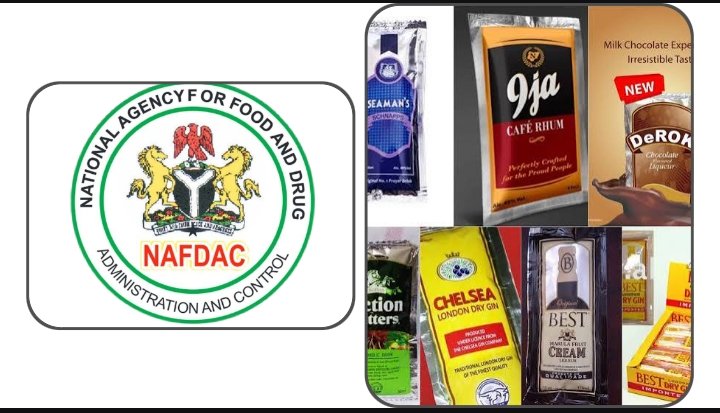
The National Agency for Food and Drug Administration and Control (NAFDAC) has resumed enforcement of the ban on the production and sale of alcoholic beverages packaged in sachets and small-volume PET or glass bottles below 200 millilitres, following a recent directive by the Nigerian Senate.

NAFDAC clarified that no alcohol-producing company has been shut down, stressing that the enforcement strictly targets specific packaging formats considered harmful to public health.

This was confirmed in statement signed by Prof. Mojisola Christianah Adeyeye, Director-General of NAFDAC, and issued in Abuja on Thursday.

The enforcement action, ordered by the Senate of the Federal Republic of Nigeria and supported by the Federal Ministry of Health and Social Welfare, is in line with NAFDAC’s statutory mandate to safeguard public health, particularly among vulnerable populations such as children, adolescents and young adults.

According to the agency, the widespread availability of high-alcohol-content drinks in sachets and small containers has made them cheap, easily accessible and easy to conceal, contributing to alcohol misuse and addiction among minors and some commercial drivers.

NAFDAC linked the trend to rising cases of domestic violence, road accidents, school dropouts and other social vices in many communities.NAFDAC noted that warning labels such as “Not for children” on sachets and small containers have proven ineffective, given societal realities.

Many parents, the agency said, are unaware that their children consume alcohol because sachets are easily concealed and inexpensive.

The agency recalled that in December 2018, it, alongside the Federal Ministry of Health and the Federal Competition and Consumer Protection Commission (FCCPC), signed a five-year Memorandum of Understanding (MoU) with the Association of Food, Beverage and Tobacco Employers (AFBTE) and the Distillers and Blenders Association of Nigeria (DIBAN) to phase out sachet and small-volume alcohol packaging by January 31, 2024.

See also  FORMER PRESIDENT BUHARI REVEALS HE LEFT OFFICE WITH SAME ASSETS AS WHEN HE ENTERED

The moratorium was later extended to December 2025 to allow manufacturers exhaust existing stock and reconfigure their production lines.

NAFDAC said the renewed enforcement aligns with both the MoU and Nigeria’s commitment to the World Health Assembly Global Strategy to Reduce the Harmful Use of Alcohol (WHA63.13, 2010), which aims to protect vulnerable groups, including children and youths.

The agency explained that alcohol packaged in larger sizes remains approved, noting that smaller packs make it easier for underage users to hide consumption from parents and teachers.

It cited reports from schools indicating that students conceal sachets, including a recent account where a student reportedly claimed he could not sit for an examination without first consuming sachet alcohol.

Reiterating its position, NAFDAC stated that it has not closed any alcohol-producing company, but has only banned alcohol packaged in sachets and containers below 200 millilitres.

Speaking on the policy, the Director-General of NAFDAC, Prof. Mojisola Christianah Adeyeye, said the ban is protective rather than punitive.“This ban is not punitive; it is protective. It is aimed at safeguarding the health and future of our children and youth by not allowing alcohol in small pack sizes.

The decision is rooted in scientific evidence and public health considerations. We cannot continue to sacrifice the wellbeing of Nigerians for economic gain. The health of a nation is its true wealth,” she said.

NAFDAC further clarified that only two categories of alcoholic beverage packaging are affected: spirit drinks packaged in sachets and small-volume PET or glass bottles below 200 millilitres.

See also  FRANCE TO BAN SMOKING IN OUTDOOR PUBLIC SPACES TO PROTECT CHILDREN

The agency called on manufacturers, distributors and retailers to fully comply with the phase-out deadline, stressing that no further extensions will be granted beyond December 2025.

The agency also said it would continue to collaborate with the Federal Ministry of Health and Social Welfare, the FCCPC and the National Orientation Agency (NOA) to roll out nationwide sensitisation campaigns on the health and social dangers of alcohol misuse.

NAFDAC reaffirmed its commitment to ensuring that only safe, wholesome and properly regulated products are available to Nigerians.

General News

Global Oil Prices Rise on Strait Disruptions, as Iran Rejects U.S. Dialogue, Supply Risks Persist

Published

on

Share

Global oil prices climbed sharply on Tuesday as ongoing supply disruptions in the Middle East and renewed geopolitical tensions between Iran and the United States rattled energy markets.


Benchmark crude prices rose above the $100 per barrel mark, with Brent crude gaining nearly $2 and U.S. West Texas Intermediate also posting significant increases. The surge comes amid persistent concerns over disrupted supply routes, particularly through the strategic Strait of Hormuz; a critical chokepoint that handles roughly 20% of global oil shipments.


Tensions escalated further after Iran denied claims by the U.S. officials that negotiations were underway to ease the conflict. The denial contradicted earlier remarks, suggesting progress in diplomatic engagement, adding to uncertainty in global markets.


The ongoing conflict has already disrupted energy infrastructure across the region, with reports indicating that dozens of oil and gas facilities have been damaged. Analysts warn that these disruptions could keep prices elevated for an extended period, even if hostilities ease in the near term.


Adding to market volatility are continued military exchanges and attacks on energy assets, which have heightened fears of a prolonged supply crunch. Oil prices have already surged significantly since late February as traders factor in the risk of further escalation.


Energy experts caution that if the disruption to shipping routes persists, prices could spike even higher, potentially exceeding previous record levels. The uncertainty surrounding diplomatic efforts and the ongoing damage to infrastructure continue to weigh heavily on global energy markets.


The developments underscore the fragile state of global oil supply chains, with markets reacting swiftly to both geopolitical tensions and conflicting signals on potential negotiations.

See also  NIGERIAN BAR ASSOCIATION URGES SENATE TO REINSTATE SUSPENDED SENATOR AKPOTI-UDUAGHAN
Continue Reading

General News

Court Adjourns El-Rufai’s Bail Hearing to March 31 After Arraignment

Published

on

Share

A Federal High Court sitting in Kaduna has adjourned the hearing of the bail application of former Kaduna State governor, Nasir El-Rufai, to March 31, 2026, following his arraignment on alleged corruption-related charges.

El-Rufai was on Tuesday brought before the court by the Independent Corrupt Practices and Other Related Offences Commission (ICPC) and arraigned before Justice Rilwan M. Aikawa.

During the proceedings, the former governor was docked on one count out of a 10-count charge filed by the anti-graft agency. The charge, according to his counsel, Ubong Akpan, relates to alleged deposits into a domiciliary account and the monetisation of earnings.

El-Rufai was arraigned alongside a co-defendant, Joel Adoga.

Despite pending applications earlier filed before the court, Justice Aikawa proceeded with the arraignment and subsequently adjourned the matter to March 31 to consider all outstanding applications, including the bail request.

No bail application was moved or granted during Tuesday’s session.

Speaking to journalists after the court sitting, Akpan maintained that there was nothing unusual about the proceedings, adding that the defence team was yet to be served with processes relating to other potential charges.

The case is expected to resume on the adjourned date for hearing of the bail application and other pending matters.

See also  PRESIDENT TINUBU DEPARTS BRAZIL FOR ABUJA AFTER STATE VISIT
Continue Reading

General News

ECOWAS Unveils Regional Plan to Protect Food Security Amid Global Pressures

Published

on

Share


The Economic Community of West African States (ECOWAS) has introduced an urgent, coordinated strategy to safeguard food security across West Africa and the Sahel, as global economic disruptions and rising oil prices continue to threaten agricultural production.

The decision followed an extraordinary virtual meeting of ECOWAS Ministers of Agriculture held on March 23, 2026, where regional leaders assessed the growing risks to food systems.

The high-level meeting, convened by the ECOWAS Commission through its Department of Economic Affairs and Agriculture under Commissioner Kalilou Sylla, brought together key regional institutions, development partners, and financial stakeholders.

Participants—including representatives from the West African Economic and Monetary Union and the Permanent Inter-State Committee for Drought Control in the Sahel—reviewed the impact of rising fertiliser costs, driven by global market volatility and increasing energy prices, on agricultural productivity across the region.

Deliberations resulted in the adoption of a medium- to long-term operational framework aimed at strengthening food sovereignty and building resilience within regional food systems.

Key measures outlined in the plan include the immediate establishment of regional agreements to secure strategic fertiliser supplies, as well as the creation of emergency reserves to cushion the effects of future price shocks.

The ministers also approved the introduction of liquidity swap mechanisms through central banks to address foreign exchange constraints faced by importers—an intervention expected to improve access to critical agricultural inputs.

“Our collective response underscores the urgency of safeguarding food security in the face of external shocks,” Sylla said, noting that enhanced regional coordination and targeted interventions would help sustain agricultural production and protect vulnerable populations.

See also  ELECTRICITY RESTORED TO EKUKU-AGBOR COMMUNITY AFTER 13 YEARS OF DARKNESS

The initiative highlights ECOWAS’ commitment to deepening regional cooperation and implementing sustainable solutions to emerging threats to food security across West Africa and the Sahel.

Continue Reading