Economy
NIGERIA PUSHES FOR INDUSTRIAL REVAMP WITH KEY APPOINTMENTS AND PRIVATE SECTOR DRIVE
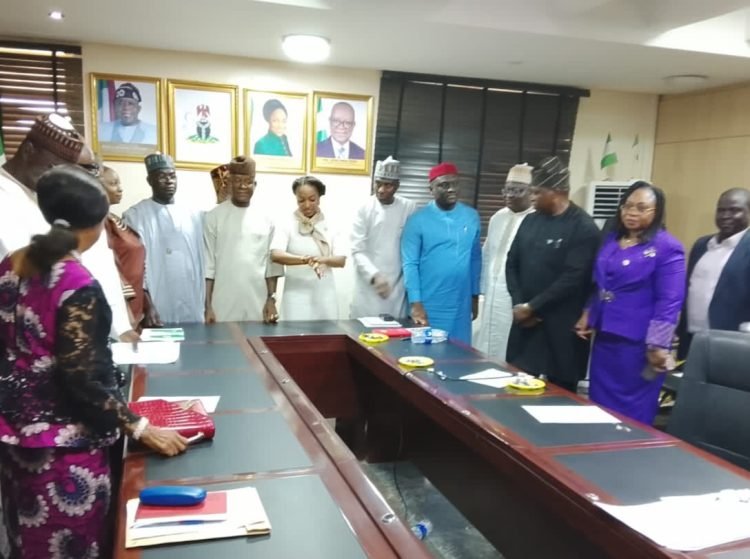
The Federal Government of Nigeria has reaffirmed its commitment to industrial transformation, export competitiveness, and strong public-private collaboration. This was highlighted by the inauguration of key governing boards under the Federal Ministry of Industry, Trade and Investment and a high-level engagement with the organised private sector in Abuja.
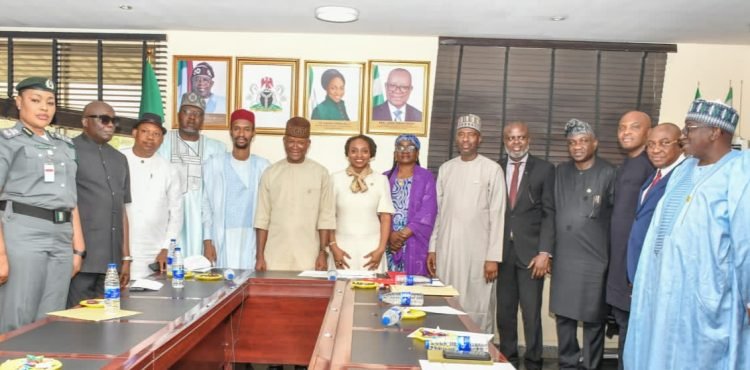
The series of activities commenced with the inauguration of the Governing Board of the Oil and Gas Free Zones Authority (OGFZA). The Permanent Secretary of the Ministry, Amb. Nura Abba Rimi, delivered opening remarks, underscoring the importance of institutional leadership and effective governance in advancing national economic objectives.
Inaugurating the Board, the Honourable Minister of Industry, Trade and Investment, Dr. Jumoke Oduwole, described oil and gas free zones as strategic instruments for industrialisation. She said, “They are for investment attraction and value chain development under the Renewed Hope Agenda of President Bola Ahmed Tinubu.” She emphasised the Board’s responsibility to provide direction and oversight, ensuring that government incentives translate into tangible economic value.
The Honourable Minister of State for Industry, Senator John Owan Enoh, noted the inauguration marked a critical governance milestone. He stressed, “Export processing zones must function as effective engines of production, employment and foreign exchange generation. Government expectations now centre on performance, accountability and measurable outcomes.”
The Chairman of the OGFZA Governing Board, Mrs. Lydia Kalat Musa, in her acceptance, pledged a commitment to responsible leadership and the effective discharge of the Authority’s statutory mandate.
The second event was the inauguration of the Governing Board of the Nigeria Export Processing Zones Authority (NEPZA). Amb. Nura Abba Rimi reiterated the Ministry’s commitment to strengthening institutional frameworks for industrial growth.
Dr. Oduwole reaffirmed the government’s resolve to reposition export processing zones as drivers of non-oil exports. Senator Enoh emphasised that NEPZA’s mandate is central to Nigeria’s industrial competitiveness, noting that effective governance is essential to unlocking the full potential of the zones.
The Chairman of the NEPZA Governing Board, Senator Tijani Yahaya Laura, pledged to work collectively to advance the Authority’s objectives in line with national priorities.
The final inauguration was that of the Council of the Standards Organisation of Nigeria (SON). Amb. Rimi highlighted the importance of adherence to international best practices in strengthening Nigeria’s standards.
Addressing the Council, Dr. Oduwole described standards as a cornerstone of economic transformation, noting their critical role in protecting consumers and supporting local industries. Senator Enoh reinforced the strategic importance of effective standardisation for investor confidence.
The Chairman of the SON Governing Council, Honourable Yahuzu Ado Inuwa, pledged to advance quality assurance and strengthen compliance mechanisms.
Earlier, the Honourable Minister hosted a delegation from the Lagos Chamber of Commerce and Industry (LCCI). Dr. Oduwole reaffirmed the government’s commitment to deepening public-private sector collaboration as a critical driver of investment.
The LCCI delegation was led by its President, Engr. Leye Kupoluyi, who described the visit as an opportunity to align private sector priorities with ongoing reforms. He said, “We commend the Ministry’s efforts to reposition Nigeria as a competitive destination for trade and investment.” He highlighted key policy initiatives and business challenges, proposing enhanced dialogue and regulatory reforms. Kupoluyi also congratulated the Minister on Nigeria’s successful bid to host the Intra-African Trade Fair (IATF) 2027 in Lagos.
The engagements collectively underscored the Federal Government’s renewed focus on institutional strengthening, quality assurance, and sustained partnership with the private sector as central pillars of Nigeria’s industrial and economic transformation drive.

Economy
CARDOSO, REAFFIRMS APEX BANK’S COMMITMENT TO FINANCIAL SECTOR REFORMS
By Akpo Ojo
The Governor of the Central Bank of Nigeria (CBN), Olayemi Cardoso, has reaffirmed the apex bank’s commitment to financial sector reforms and long-term capital inflows as he hosted a high-level delegation from the British International Investment (BII) in Abuja.

Cardoso received the BII delegation, led by its Chair, Diana Layfield, alongside the British High Commissioner to Nigeria, Richard Montgomery, in what the CBN described as part of sustained efforts to strengthen macroeconomic stability and attract patient capital into Nigeria’s financial system.

At the meeting, the CBN governor said the bank remains focused on credible monetary policy, transparent regulation and data-driven supervision to deepen financial inter mediation and enhance the resilience of the banking sector.
He noted that development finance institutions with long-term investment horizons and strong governance standards are critical partners in Nigeria’s ongoing reform agenda, particularly in stabilising the financial system, expanding financial inclusion and supporting private-sector-led growth.
Discussions during the engagement centred on recent developments in Nigeria’s financial services sector, BII’s investment outlook, and opportunities to deploy long-term capital to support banking sector stability and sustainable economic growth.
Layfield reaffirmed BII’s continued interest in Nigeria, describing the country’s financial services sector as a key investment destination.
She stressed the importance of regulatory clarity and consistent engagement with policymakers to unlock investment and drive inclusive growth.
The meeting was attended by senior BII officials, including its Chief Executive Officer, Leslie Maarsdorp; Non-Executive Directors Andrew Alli and Simon Rowlands; Managing Director and Head of Africa, Chris Chijiutomi; and West Africa Regional Director and Head of the Nigeria Office, Benson Adenuga.
Senior officials of the British High Commission were also present.
Economy
SENATE SETS MARCH 17TH FOR PASSAGE OF ₦58.472 TRILLION 2026 BUDGET
The Senate, through its Committee on Appropriations, has tentatively fixed Tuesday, March 17, 2026, for the final consideration and passage of the ₦58.472 trillion 2026 Appropriation Bill.
The decision was taken at a special meeting of the committee held on Friday, as part of efforts to meet the proposed timeline for the budget’s passage.
According to the timetable adopted by the committee, budget defence sessions at the committee level will hold from February 2 to February 13, 2026.
To ensure an inclusive and transparent process, the committee has also scheduled a public hearing on the 2026 budget proposal for Monday, February 9, 2026.
The Chairman of the Committee on Appropriations, Senator Solomon Olamilekan Adeola (Ogun West), disclosed that a renowned Professor of Economics from the University of Lagos, Wasiu Adeoye, will deliver a PowerPoint presentation at the hearing.
Senator Adeola further revealed that Thursday, March 5, 2026, has been set aside for an interactive session between members of the committee and key economic managers of the Federal Government.
Expected at the session are the Minister of Finance and Coordinating Minister of the Economy, Mr. Wale Edun, the Minister of Budget and National Planning, Senator Atiku Bagudu, among other top officials.
He added that February 16 to February 23, 2026, has been earmarked for the submission of reports on budget defence by various standing committee chairmen, ahead of the presentation of the harmonised report to the Senate on March 17.
The Appropriations Committee Chairman informed members that while the Senate leadership initially preferred the budget to be passed by March 12, 2026, he successfully appealed for an additional one week to allow for more thorough scrutiny.
He also disclosed that hard copies of the 2026 budget estimates have been printed and distributed to chairmen and members of the various standing committees to facilitate detailed examination of the proposals.
The timetable was formally adopted following a motion moved by Senator Adamu Aliero (Kebbi Central) and seconded by Senator Orji Uzor Kalu (Abia North).

Economy
NAIRA HITS TWO-YEAR HIGH AGAINST DOLLAR AS EFEMS TAKES EFFECT
The naira has posted its strongest gain against the United States dollar in the official foreign exchange market in two years, buoyed by the launch of the Electronic Foreign Exchange Matching System (EFEMS).
Data released by the Central Bank of Nigeria (CBN) on Thursday showed that the naira appreciated to N1,396.99 per dollar at the official market, marking a day-on-day gain of N3.49.
The local currency also strengthened in the parallel market, where it gained N5 to close at N1,480 per dollar, compared with N1,485 recorded the previous day.
The latest performance extends a four-day rally by the naira in the official foreign exchange window, signalling improved market confidence since the introduction of EFEMS, which is aimed at enhancing transparency and efficiency in FX trading.
The appreciation coincided with a rise in Nigeria’s external reserves.
According to the apex bank, reserves climbed to $46.11 billion as of January 28, 2026, from $46.04 billion on January 26, reflecting increased inflows and improved liquidity conditions.
Market watchers say the combination of rising reserves and the new FX matching framework has contributed to the recent stability and strengthening of the local currency, after months of volatility in the foreign exchange market.
The CBN has maintained that ongoing reforms in the FX market are designed to restore confidence, improve price discovery, and ultimately support macroeconomic stability.