
Opinion
FROM MY WINDOW: EDO ICONS (LEGACY SERIES- Samuel Ogbemudia: The Man Who Built Beyond His Time

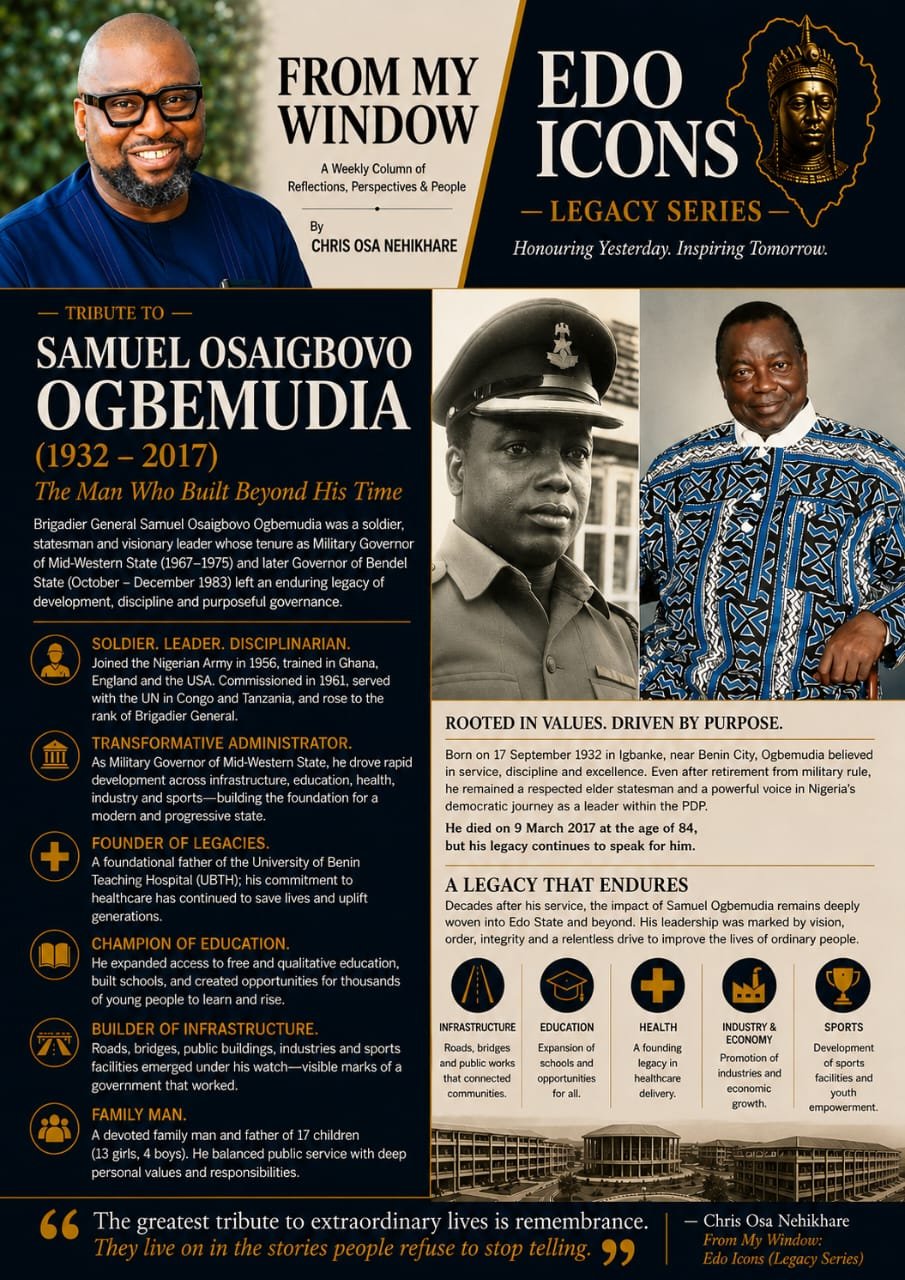
By Chris Osa Nehikhare
There are certain names that no longer need introduction in Edo history.
They have moved beyond politics.
Beyond office.
Beyond generations.
They have become memory itself.
One of those names is Brigadier General Samuel Osaigbovo Ogbemudia: soldier, administrator, builder, statesman, and one of the most consequential leaders ever produced by Edo State.
Even today, decades after his years in power, conversations about development in old Bendel State still return to one recurring conclusion:
“Ogbemudia built it.”
And indeed, he did.
Born on September 17, 1932, he hailed from Igbanke in present-day Orhionmwon Local Government Area near Benin City.
His upbringing reflected discipline, structure, and ambition long before public office found him.
From Benin Baptist School to Western Boys High School, and later through military training in Ghana, England, and the United States, Ogbemudia’s life followed the path of preparation before prominence.
The Nigerian Army shaped his discipline.
But history would later reveal that governance would define his legacy.
Ogbemudia belonged to a generation forged by turbulence.
After joining the Nigerian Army in 1956, he trained internationally and served with the United Nations Peacekeeping Mission in Congo, experiences that broadened his worldview and sharpened his understanding of leadership and organisation.
By the late 1960s, Nigeria was in crisis as civil war threatened national unity.
It was in that difficult era that Ogbemudia emerged as Military Governor of Mid-West State in 1967.
What followed would become one of the most transformative periods in the history of the region that became a State.
For Ogbemudia, governance was not about slogans.
Education flourished under his administration, and healthcare gained remarkable attention, including his foundational role in establishing what would become the University of Benin, and University of Benin Teaching Hospital (UBTH) — today one of Nigeria’s major educational and medical institutions.
Roads were constructed.
Schools were built.
Hospitals expanded.
Industries emerged.
Sports infrastructure developed.
And founded New Nigeria Bank.
At a time when many parts of the country struggled with instability, Mid-West State experienced aggressive development driven by vision and execution.
And the people saw it.
When Mid-West later became Bendel State, the developmental philosophy remained unmistakably Ogbemudia.
His name became associated with order, discipline, and results.
Older generations still speak about his tenure not merely with nostalgia, but with evidence.
Perhaps one of the most striking things about Ogbemudia was the simplicity with which he carried enormous authority.
He governed with the mindset of a man who believed public office was a responsibility, not a performance.
Under Ogbemudia, we were hailed Up Bendel!
Even after military rule ended, his influence did not disappear.
In Nigeria’s democratic era, he remained politically relevant and became a respected elder statesman and influential figure within the PDP.
Governors consulted him.
Politicians respected him.
Citizens remembered him.
That kind of relevance cannot be manufactured.
It is earned over time.
Behind the public figure was also a deeply rooted family man, father to seventeen children, thirteen girls and four boys.
And perhaps that says something profound about him:
For all the power and influence he wielded publicly, he remained connected to family, community, and identity.
Samuel Ogbemudia passed away on March 9, 2017, at the age of 84.
Today, across Edo and Delta States, his legacy remains physically visible and emotionally alive.
And perhaps that is the highest form of immortality available to public servants.
To be remembered not for noise, but for usefulness.
In remembering Samuel Osaigbovo Ogbemudia, we remember more than a former governor or military officer.
We remember a generation that believed leadership should produce results.
We remember discipline.
We remember structure.
We remember development with intention.
Above all, we remember a man who built beyond his own lifetime.
And because of that, his story will continue to echo through Edo history for generations yet unborn.
“The greatest tribute to extraordinary lives is remembrance. They live on in the stories people refuse to stop telling.”
Chris Osa Nehikhare
*NOTE*
From My Window: Edo Icons (Legacy Series)
There comes a time when a people must pause not merely to celebrate the living, but to honour those whose footsteps helped shape the path we now walk.
With the introduction of Edo Icons: (Legacy Series), From My Window begins a special tribute to distinguished Edo sons and daughters whose lives, work, sacrifice, influence, and vision left enduring marks on our society and our history.
These are not just stories of success.
They are stories of impact.
Of courage.
Of enterprise.
Of leadership.
Of cultural identity and lasting relevance.
Though these icons are no longer with us, their legacies continue to speak through institutions they built, lives they touched, ideas they championed, and generations they inspired.
As we remember them, we also remind ourselves that true greatness never truly departs.
It echoes.