
General News
AI-Powered Disinformation Now Threatens Democracies, Economy as Nigeria Launches Nationwide Counter-Propaganda Network

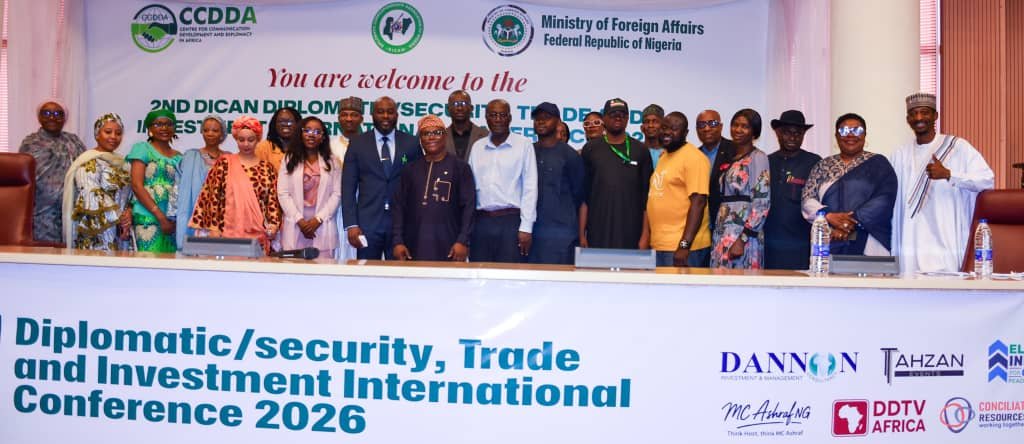
Nigeria has declared a major offensive against the growing global threat of AI-driven disinformation and foreign propaganda operations with the launch of a nationwide fact-check and information integrity network aimed at combating coordinated misinformation campaigns.
The declaration came in Abuja at the 2nd Diplomatic, Security, Trade and Investment International Conference organised by the Diplomatic Correspondents’ Association of Nigeria (DICAN), where experts warned that Foreign Information Manipulation and Interference (FIMI) now causes more than $100 billion in annual global losses and poses an increasing danger to democratic systems, economic stability, and national security.
Stakeholders at the conference revealed that over 70 per cent of modern disinformation operations are now powered by advanced generative artificial intelligence capable of producing deepfakes, manipulating public opinion, inflaming ethnic tensions, influencing elections, and destabilising diplomatic relations within minutes.
Opening the conference, DICAN Chairman, Idehai Frederick, warned that information warfare has evolved into a sophisticated global industry driven by technology, political interests, and coordinated international actors.
According to him, the era of “ordinary fake news” has given way to what he described as the “industrialisation of deception,” where false narratives are strategically weaponised to undermine democratic institutions and national sovereignty.
He warned that with more than 40 countries scheduled to conduct major elections between 2024 and 2026, disinformation campaigns have become powerful geopolitical tools capable of influencing electoral outcomes and weakening public trust in governance.
Representing former President Goodluck Jonathan, Executive Director of the Goodluck Jonathan Foundation, Ann Iyonu, described misinformation as a new form of conflict that can destabilise societies without the use of conventional weapons.
She warned that manipulated content and fake narratives have increasingly become instruments for fuelling insecurity, deepening ethnic and religious divisions, and eroding public confidence in democratic institutions.
Iyonu stressed that Nigeria’s experience has shown how unchecked misinformation can worsen political tensions and threaten national cohesion, especially during election periods.
The Permanent Secretary of the Ministry of Foreign Affairs, Dunoma Umar Ahmed, said the media remains a critical pillar in shaping global perception and promoting transparency in international relations.
He reaffirmed Nigeria’s commitment to strengthening foreign policy through economic diplomacy, regional stability, and the protection of Nigerians abroad, while urging journalists to uphold professionalism and factual reporting.
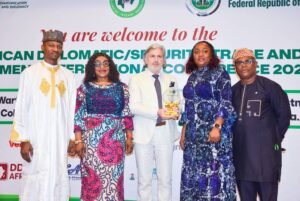
In a strong economic warning, the Chief Executive Officer of the Nigerian Export Promotion Council, Nonye Ayeni, said misinformation now directly threatens trade, investment flows, and economic confidence.
Ayeni disclosed that Nigeria earned more than $6.1 billion from non-oil exports in 2025, representing an 11.5 per cent increase from the previous year, but cautioned that distorted information ecosystems could discourage investors and weaken international trade partnerships.
Also speaking, Zhou Hongyou of the Embassy of the People’s Republic of China in Nigeria called for responsible journalism and stronger media cooperation to counter misinformation and improve international understanding.
A key outcome of the conference was the launch of the Nigeria Fact-Check and Information Integrity Network (NFIIN), a coordinated national platform designed to combat misinformation through collaboration among government agencies, civil society groups, security institutions, and media organisations.
The initiative, spearheaded by the Centre for Communication Development and Diplomacy in Africa in partnership with DICAN and PR Nigeria, has already mobilised 69 civil society organisations across Nigeria’s 36 states.
To strengthen rapid response capabilities, organisers announced the establishment of six regional situation rooms dedicated to tracking, verifying, and analysing misleading online content in real time.
The network also unveiled nationwide awareness campaigns including “Verify Before You Share,” “Truth Matters: Build a Stronger, Safer Society,” and “Think Before You Share,” translated into English, Hausa, Yoruba, and Igbo to broaden public engagement.
Conference participants warned that information warfare is increasingly linked to insurgency, social unrest, economic sabotage, and diplomatic crises, making the protection of information integrity a critical national security priority.
They called for urgent international cooperation and stronger technical support to help Nigeria and other developing countries counter the rising sophistication of AI-powered propaganda and digital manipulation campaigns.
Organisers announced that the 2027 conference will examine the connection between disinformation, migration, insecurity, and human trafficking, amid growing concerns that false narratives are worsening instability across vulnerable regions.
The conference concluded with a unified call for governments, media institutions, civil society groups, and international partners to work together to defend truth, protect democratic systems, and strengthen public trust in the digital age.
