
International
Eviction of 87-Year-Old Sparks Housing Protest Camp in Madrid


The eviction of an 87-year-old woman from the Madrid apartment where she had lived for more than seven decades has sparked a growing protest movement, with hundreds of demonstrators setting up an overnight encampment in the Spanish capital’s central Puerta del Sol square.
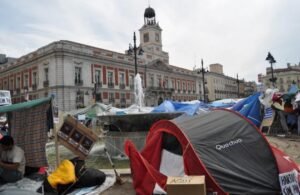
The protests followed a mass demonstration on Saturday in which tens of thousands of people marched through Madrid demanding stronger protection for tenants, measures to tackle housing fraud and restrictions on evictions when no alternative accommodation is available. Many protesters refused to leave after the march and pitched tents in the historic square.

The case centres on María del Carmen Abascal, widely known as Maricarmen, who was forcibly evicted on Wednesday from the apartment in Madrid’s Retiro neighbourhood where she had lived since 1956. Images of the elderly woman being taken from the property on a stretcher after police broke down the door fuelled anger among housing activists and turned her case into a symbol of Spain’s housing crisis.

Spanish media reports cited by the Associated Press said Abascal’s father originally rented the apartment in 1956 and she remained there after her parents died. The building changed ownership in 2018, after which, according to the Madrid Tenants’ Union, the rent was increased from about €500 to €2,650 a month. It was later reduced to €1,650, which the union said was still unaffordable for Abascal, who lives on a pension.

The eviction had previously been postponed several times, according to Spanish media reports. Wednesday’s operation was the fourth attempt to remove her from the property. Supporters gathered outside the building in an effort to prevent the eviction, while police established a security cordon and later cleared protesters from the area.

The subsequent demonstrations have spread beyond Abascal’s individual case, reflecting broader anger over rising rents, a shortage of homes and limited public housing in Spain. The Bank of Spain has estimated a housing shortage of hundreds of thousands of homes, while public rental housing accounts for less than 2% of Spain’s housing stock, compared with an EU average of about 8%.
Saturday’s demonstration attracted competing estimates. Government authorities put the turnout at around 25,000, while the Madrid Tenants’ Union, which organised the protest, claimed more than 300,000 people participated. Protesters marched with banners, rattled keys and called for measures to prevent people from being forced from their homes without alternative accommodation.

After the march, protesters established an encampment in Puerta del Sol. AFP reported that about 100 tents had been erected across the square on Sunday, while other reports put the number closer to 150 as the protest grew. Demonstrators said they intended to remain until the government responds to their demands.

Spanish Prime Minister Pedro Sánchez has described Abascal’s eviction as a “social tragedy” and said the government would take action on the housing crisis. His government is expected to consider a package of measures, reportedly including stronger protections for tenants and restrictions on evictions, although it remains uncertain whether proposed legislation can secure enough support in parliament.
The issue has gained additional political significance ahead of Spain’s next general election, expected in 2027. For protesters, however, the immediate focus remains housing affordability and tenant protection, with Abascal’s eviction becoming a rallying point for wider demands over access to housing in Madrid and across Spain.