
Judiciary
FEDERAL HIGH COURT DECLARES CONCEPT OF ‘SHADOW GOVERNMENT’ UNCONSTITUTIONAL IN NIGERIA


Abuja’s Federal High Court has ruled against the establishment of a shadow government in Nigeria, dismissing plans by Professor Pat Utomi and associates to form such an entity. Delivering judgment in a suit brought by the Department of State Services (DSS), Justice James Omotosho declared that the concept of a shadow government is alien to Nigeria’s Constitution, emphasizing the country’s presidential system differs from the UK’s parliamentary system where a shadow cabinet finds relevance.
“A shadow government or cabinet is alien to the Nigerian Constitution as Nigeria practices a presidential system, unlike the Parliamentary system in the UK which has room for a shadow cabinet,” Justice Omotosho stated. The judge underscored that no opposition political party holds the power to establish a parallel government; their role is limited to criticizing the incumbent administration.
Justice Omotosho noted opposition parties can pursue democratic transition through elections – not by overthrowing an elected government – as the lawful path to securing power. “Opposition political parties can rely on democratic transition, through elections, without overthrowing an elected government, to secure power,” he said.
Declaring the notion of a shadow government as ‘strange’ to Nigeria’s legal framework, the judge ruled it amounts to creating a parallel authority unrecognized by the 1999 Constitution (as amended). “A shadow government is ‘strange’ to Nigeria and amounts to creating a parallel authority not recognized by the Constitution of the Federal Republic of Nigeria, 1999 (as amended),” Justice Omotosho asserted, adding any government structure outside constitutional provisions is null and void.
While acknowledging freedom of expression is protected – as argued by Professor Utomi – Justice Omotosho stressed such rights have limits when they threaten governmental authority and national stability. “The action of Utomi portends a threat to the peace and stability of the country,” the judge remarked.
“The court will not sit idle and watch the defendant cause ‘confusion’ in the guise of establishing a shadow government,” Justice Omotosho declared, issuing a perpetual injunction restraining Professor Utomi and others with similar future aspirations from pursuing establishment or operation of a shadow government or like entity unrecognized by Nigeria’s Constitution.





International
Court Orders Revival of Voice of America as Trump Administration Moves to Block Comeback
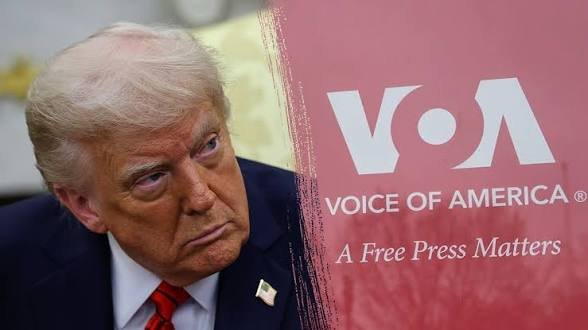
A U.S. federal court has ordered the immediate restoration of Voice of America, but the administration of Donald Trump is pushing back, setting the stage for a prolonged legal and political showdown over the future of the global news outlet.
In a strongly worded ruling, Royce C. Lamberth directed that hundreds of VOA employees, who have been on paid leave for nearly a year, be reinstated. He held that Kari Lake, appointed to supervise the U.S. Agency for Global Media, acted beyond her powers by reducing the broadcaster to minimal operations.
However, the administration swiftly filed an appeal, signaling that the judge’s order may not translate into an immediate return to full operations.
Established during World War II, VOA has historically delivered news to countries with limited press freedom, broadcasting in multiple languages to a global audience of hundreds of millions. Before its shutdown, the outlet operated in 49 languages and reached an estimated 362 million people weekly.
The Trump administration had defended the scale-down as part of efforts to eliminate government excess and reform publicly funded media, while critics argue it threatens editorial independence and undermines credible journalism.
VOA Director Michael Abramowitz urged cooperation across political lines, noting that Congress has already approved funding to support the agency’s return. Still, the White House insists reforms at the agency have been successful and that the court ruling will not be the final word.
Inside VOA, staff say rebuilding the organisation will be a complex process after months of disruption. Patsy Widakuswara highlighted both the financial and emotional toll, stressing that restoring morale may prove even more difficult than restarting operations.
Doubts also persist among media veterans. Former VOA director David Ensor questioned whether the current administration is committed to maintaining an independent newsroom.
Further controversy has emerged following the appointment of Christopher Wallace as deputy director, raising concerns about potential shifts in editorial direction.
Although lawmakers have allocated about $200 million for VOA’s operations, the reduced budget and ongoing legal battle leave the organisation’s future uncertain.
For now, the court has spoken but whether Voice of America will fully return to its former role remains unclear as the fight over its fate intensifies.

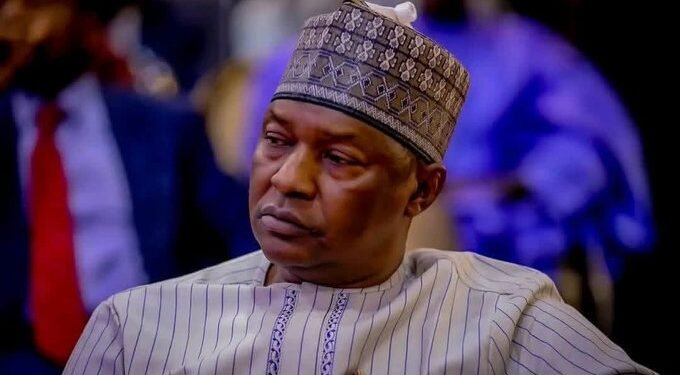
Former Attorney-General of the Federation and Minister of Justice, Abubakar Malami, has declared that he has no regrets over decisions taken during his time in office, despite ongoing legal battles and recent detention.
Malami made the statement shortly after regaining freedom from custody, where he had been held over multiple charges, including alleged money laundering filed by the Economic and Financial Crimes Commission.
The former minister, who was detained in facilities including Kuje Prison and also held by the Department of State Services (DSS), insisted that his experiences were part of “God’s will” and maintained his innocence.
“I have no regrets regarding what I did during my time as a minister,” Malami said, adding that he would vigorously defend himself against all allegations.
He, alongside his wife and son, is facing a 16-count charge related to alleged financial crimes, to which they have all pleaded not guilty.
Malami also accused security agencies of violating his rights during the investigation, alleging that his homes and business premises were searched without his presence or prior notification.
Despite the controversy surrounding his tenure and the ongoing legal proceedings, the former minister struck a defiant tone, suggesting that his ordeal has not shaken his confidence in his actions while in office.
The development is expected to reignite public debate over accountability and the legacy of public officials in Nigeria’s anti-corruption landscape.
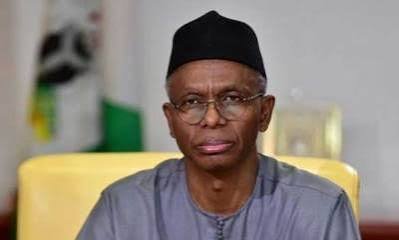
The Court of Appeal has upheld the right of former Kaduna State governor, Nasir El-Rufai, to a fair hearing, setting aside the earlier judgment of the Federal High Court in Kaduna.
The appellate court, in its ruling on the appeal marked CA/K/240/2024, nullified proceedings conducted on July 18, 2024, as well as the judgment delivered on July 30, 2024, by Justice R.M. Aikawa, citing lack of jurisdiction and breach of due process.
According to a statement by El-Rufai’s media adviser, Muyiwa Adekeye, the court found that the trial court erred by proceeding with the case without properly serving the appellant notice of hearing, thereby denying him the opportunity to respond to the respondents’ counter-affidavit.
The appeal stemmed from a suit filed by El-Rufai in 2024 against the Kaduna State House of Assembly, alleging denial of fair hearing during legislative investigations.
In its decision, the Court of Appeal emphasised that proper service of court processes is fundamental to fair hearing, noting that there was no evidence the appellant was duly notified of the proceedings.
The court also held that under the Fundamental Rights (Enforcement Procedure) Rules, El-Rufai was entitled to file a further affidavit and respond on points of law, a right the lower court wrongly denied him.
Consequently, the appellate court ordered that the case be remitted to the Federal High Court for reassignment to another judge for a fresh hearing.
El-Rufai, through his counsel, A.U. Mustapha (SAN), had argued that the matter was irregularly heard during the court’s vacation period without a formal application and that the trial judge declined to recuse himself despite concerns raised.
The ruling underscores the judiciary’s commitment to upholding due process and safeguarding fundamental rights in judicial proceedings.