
Education
GOVERNOR OKPEBHOLO COMMISSIONS RENOVATED ALMA MATER, HAILS CHINA-NIGERIA PARTNERSHIP


Edo State Governor, Senator Monday Okpebholo, has commissioned the newly renovated Ujabholo Grammar School in Uwessan, a project executed through a China-Nigeria cooperation initiative. The Governor commended the People’s Republic of China and the Nigeria Yongxing Steel Company Limited for the school’s facelift, describing it as a symbol of friendship and progress, in a statement from his Chief Press Secretary, Owaen Fred Itua.

Governor Okpebholo expressed profound gratitude to the project partners, stating, “On behalf of the Government and the people of Edo State, I sincerely thank the Consulate-General and the Government of the People’s Republic of China.” He revealed his personal connection to the school, noting it was where he began his secondary education and that his return after over 20 years was an emotional and fulfilling moment.
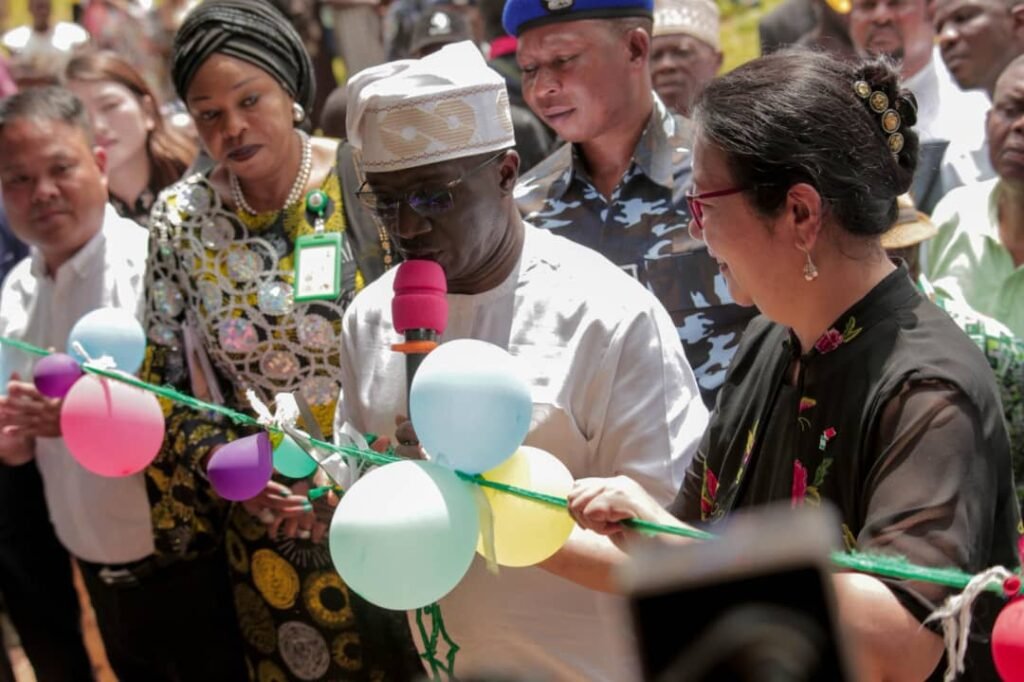
The project was instituted by the Consulate-General of China in Lagos with Edo State Government support, under the theme “Love Builds Dreams, Steel Builds Foundations; China and Nigeria Nurture the Future Together.” The Consul-General, Mrs. Yan Yuqing, highlighted the importance of educational cooperation, noting it is a key component of the Forum on China–Africa Cooperation and that China is willing to further expand bilateral relations with Nigeria.
Okpebholo announced further state government plans to enhance the school, including electrification, street lights, a perimeter fence, and a 250-computer CBT centre. He urged the community to take good care of the upgraded facility and use it to inspire academic excellence and discipline, Itua further stated.
The Governor reiterated that Edo State is committed to partnerships that drive education, innovation, and sustainable development, emphasizing the state is open for collaborations that create jobs and boost local businesses. The principal of the school, Mr. Asemota, also expressed appreciation to the governments and partners for transforming the learning environment for students.
Itua confirmed the commissioning marks a milestone in Governor Okpebholo’s drive to promote quality education and partnerships that empower local communities and strengthen the state’s human capital development.








The Federal Government has announced plans to abolish the Junior Secondary School Common Entrance Examination and introduce a nationwide Learner Identification Number system to track pupils throughout their academic journey.
Minister of Education, Tunji Alausa, disclosed the proposal during an interactive session with journalists in Lagos, stating that the reforms are aimed at improving access to education and strengthening monitoring mechanisms across the country.
Under the proposed framework, the current common entrance examination will be phased out and replaced with a Continuous Assessment (CA) system. The minister explained that pupils would be evaluated based on their academic performance from primary one, allowing for seamless transfer of records when moving between schools.
Alausa said the reform is designed to address long-standing challenges in the transition from primary to secondary education, particularly the high number of pupils who fail to progress.
According to him, Nigeria has over 50,000 public primary schools with more than 23 million pupils, yet only slightly above three million transition to junior secondary school within the public system.
He described the gap as a reflection of limited access, noting that private schools cannot fully absorb the shortfall.
“The issue is simply lack of access,” he said, adding that the Federal Government is working with state governments to expand infrastructure and build more schools to accommodate the growing number of pupils.
To support the reform, the government plans to introduce a unique Learner Identification Number for every child from the primary school level. The number will remain with each pupil throughout their education, regardless of school transfers.
The system, the minister said, will enable authorities to track students’ progress and identify dropouts for timely intervention.
“If a child is expected to be in JSS1 and is not there, we will be able to determine the reason,” he added.
Alausa also revealed plans to revive the school feeding programme as part of efforts to boost enrolment and retention in public schools.
He noted that the programme may be placed under the supervision of the Federal Ministry of Education to improve monitoring and effectiveness.
The initiative forms part of broader efforts by the Federal Government of Nigeria to strengthen the education sector, improve retention rates, and ensure more children complete basic education.


The Edo State Police Command has arrested students involved in a viral bullying incident at Igbinedion Education Centre, following widespread public outrage.
Police authorities confirmed that all individuals linked to the incident have been identified and taken into custody, with plans to charge them in a family court in line with juvenile justice and child protection laws.
The case gained national attention after disturbing videos surfaced online showing a student being physically assaulted by fellow students. In one of the clips, the victim was reportedly beaten, kicked, and humiliated while others watched and recorded the incident.
Preliminary investigations revealed that the violence stemmed from an earlier altercation between students. Authorities said a disagreement involving offensive remarks escalated into physical attacks, with a cycle of retaliation contributing to the incidents captured on video.
The Edo State Police spokesperson stated that the arrests followed a “thorough and painstaking investigation,” adding that all suspects would face legal proceedings in accordance with the law.
In response to the incident, the police have also intensified the “Operation Safe Schools” initiative across the state to address gaps in supervision and prevent similar occurrences.
The school management had earlier taken disciplinary action by expelling students directly involved, while the Edo State Ministry of Education condemned the act, describing it as unacceptable and contrary to the values of discipline and safety expected in schools.
Authorities have urged parents, guardians, and school administrators to take greater responsibility in guiding students and ensuring that grievances are handled through proper channels rather than violence.

Amnesty Programme Boosts Education: 220 Nigerians Studying in UK, 8,000 Enrolled Locally
The Federal Government has disclosed that no fewer than 220 Nigerians are currently studying in the United Kingdom under the Presidential Amnesty Programme (PAP), while over 8,000 beneficiaries are pursuing various academic programmes within Nigeria.
Established in 2009, the Presidential Amnesty Programme was designed to address militancy in the Niger Delta by disarming and rehabilitating former agitators. Over time, the initiative has evolved into a comprehensive platform focused on education, skills acquisition, and empowerment to promote sustainable peace and development in the region.
Under the scheme, beneficiaries receive fully funded scholarships covering tuition, accommodation, monthly stipends, and book allowances for both undergraduate and postgraduate studies.
Participants are drawn from key Niger Delta states, including Abia, Akwa Ibom, Bayelsa, Cross River, Delta, Edo, Imo, Ondo, and Rivers.
In 2025 alone, the programme sponsored 161 beneficiaries for postgraduate studies in the United Kingdom, with an additional 34 deployed to various UK universities for the 2025–2026 academic session.
Administrator of the programme, Dennis Otuaro, reaffirmed the government’s commitment to expanding the initiative, with a renewed focus on critical and emerging fields such as data science, cybersecurity, and energy law.
According to him, the goal is to build a knowledge-driven Niger Delta by equipping beneficiaries with relevant global skills that can contribute to national development.
The programme continues to play a key role in transforming lives and fostering stability in the oil-rich region, while also positioning Nigerian youths for global competitiveness.