
Opinion
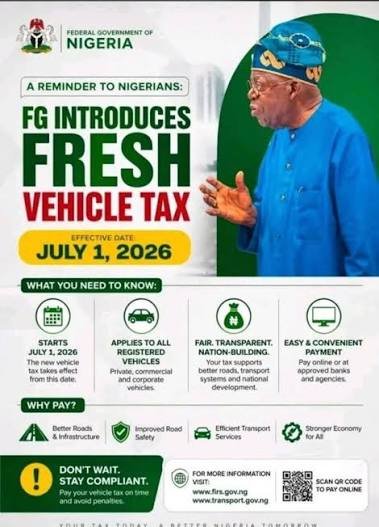
Green Tax in Vehicles: High in Semantics Less in Kinetics of Economic Development

By AVM (Rtd) Akugbe Iyamu


When a government consistently corner higher margin of taxes than obtained elsewhere and without looking at the poverty, hunger, insecurity including inequality development kinetics, it is evident that something else is at play.
High revenue cannot be the sole reason because the government is not acting like there is a problem since aspects that was once government responsibility is now individual citizens responsibility.
Nigeria is facing its worst hunger crisis in recent times, with a record 35 million people projected to face acute food insecurity by mid-2026, driven by conflict, economic instability, and climate change. The crisis is most severe in the northeast, with 19.9% of the population undernourished and 33.8% of children under five stunted.
AdditionallyPoverty in Nigeria has risen sharply from 56% in 2023 with the World Bank estimating that approximately 62% of the population (roughly 139 million people) may be living in poverty by 2026.
This increase was driven by fuel subsidy removal and exchange rate unification, rising from 115 million in 2023 to around 129 million in 2024, with over 63% currently classified as multidimensionally poor. On the otherhand,
Nigeria’s tax landscape for 2026, officially in effect from January 1, 2026, introduces comprehensive reforms that streamline the system, aiming for fairness and increased compliance.
Key changes include a new ₦800,000 yearly tax-free threshold for individuals, a 25% corporate tax rate, VAT removal on essential items (food, education, healthcare), and mandatory digitization of tax administration. If we must impose green tax on vehicles due to emissions, we must get the data, period and severity of the emissions because adequate data begets adequate planning and where there are no data, planning become a wishful exercise, not evidence based, not data driven, completely lacking in credible analysis and quantitative outcomes.
Nigeria need to spend less time on tax semantics and spend more time on the kinetics of development. If we have ever wondered why tax policies have been crawling, let look at this tax against
Imported used car age limits that vary significantly by country, with many nations enforcing restrictions to ensure safety and emissions standards. Does Nigeria enforce that? Most industrialized Nations dont have our size but they have managed to put extant laws on the types of vehicles that come into their country.
As of late 2025, Nigeria largely enforces a maximum age of 12 years, though some reports indicate stricter VIN valuation systems targeting 10 years or less. Other regional limits include Kenya (8 years) and Uganda (15 years).
The information available is that the Nigeria Revenue Service (NRS) has officially debunked the viral report regarding the new vehicle green tax set for July 1, 2026, describing it as false. While initial reports suggested a 2%–4% levy on vehicles with engines of 2,000cc or more to encourage cleaner, smaller cars, the agency clarifies that no such tax has been formally introduced at this time.
From the numerous taxation, the poverty, hunger and inequality has placed a mirror gently in front of the government with a lot of accusations of excessive taxation and now asking whether we have been paying attention.
AVM (RTD) AKUGBE IYAMU MNSA fsi IS A CONSULTANT ON CLIMATE CHANGE AND ANALYST ON ENVIRONMENTAL POLICIES ALSO PRESIDENT ASSOCIATION OF ENVIRONMENTAL PROTECTION AND CLIMATE CHANGE PRACTITIONERS