
Opinion
Mayday! Mayday! Our country in so much trouble, thinkers, fixers needed urgently (VI).


I have been inundated with calls and messages about my seeming silence on the serious issues that bother our nation. Some of my Readers and Followers guessed that I may have been indisposed on account of health, as true as that is, even more worrisome is the dearth of conscience and the death of sound values on our national fabric. Mayday!
Our collective canvas stinks, it stinks to high heavens that Herod and Herodias will pass for Saints. It stinks so badly that Pontius Pilate would pass his verdict on the Christ without the luxury of washing his hands clean, or better still atoning for his wrong. Our Socio-political kaleidoscope is vile and vain, and the Judiciary Crimson red soiled with the blood of the innocent. It is justice for hire everywhere, nay justice for the highest bidder, need I call it the Temple of Injustice? Mayday!
Where Rot Rules, Right Is Ruined.
A sage once opined that where vile and evil men hold sway those who repudiate evil are endangered. I’m compelled for emphasis to reproduce the quote verbatim. It was Edward Snowden who said, “When exposing a crime is treated as committing a crime, you are being ruled by criminals.” Does this quote speak to the Dele Farotimi ordeal? Does it capture the effort by the vile to stifle free Press? Does it speak to the now trending issues on Criminal Defamation and libel? Dem want make we nor talk again, whichside!!! They can’t win. Mayday!
I hear that beyond the hoopla about Criminal Defamation and the shambolic arrest, arraignment and remand of Citizen Farotimi in the Correctional Facility (Prison) in Ado-Ekiti with the imprimatur of Chief Afe Babalola SAN, that some Lawyers who felt defamed by Farotimi in his Book NIGERIA AND ITS CRIMINAL JUSTICE SYSTEM are fanning the embers of War. I hear that one is asking for 500m damages. Why are they all suddenly alive and woke now that Dele Farotimi is restrained, confined and cannot speak directly to the world about the Truth he has written in his book. Do they conceivably think that Farotimi will not have his day in the Court of Law, and in the Court of Public Opinion? Na lie dem dey lie. We shall speak on his behalf until he is free to speak for himself, and even when he is free, because he will surely come through this stronger and better, we shall continue to shout and cry Mayday, yes, our Country is in trouble, so much trouble that Thinkers and Fixers are needed Urgently.
To those whose ambivalence and indecision are deafening because they are scared to speak out for fear of being called out as having defamed ‘a big-man’, your cowardice is reprehensible. To those who nurse some bias against the courage and effrontery of Citizen Dele Farotimi, your fears will most definitely be interred with your bones, for the slave only comes free through a fight. To those seeking to colour Dele Farotimi bad because he dared to tread where Angels dread, his legacy shall outlive y’all. I shall speak for Dele, I am speaking for Dele and will continue to Speak for Dele, and the many citizens of our Country who across the many Correctional Facilities in this nation are awaiting trial for no verifiable crime, and who a ‘Strong-man’ or ‘Big-man’ has vowed to bend the law against. We are not a Banana Republic where Judocracy is right, we are a society that must be governed by law and due process. Mayday!
If you are moralizing about the weight of the thoughts expressed by Citizen Farotimi in his Book, thoughts that are yet to be proven wrong, why not also moralize about the Gestapo style arrest, the hurried journey to Ekiti, the quick arraignment and the kamikaze remand of Dele Farotimi in Prison, does it not speak to the compromise and the filthiness of our Criminal Justice System? What about placing him in handcuffs like a common criminal? What about the Magistrate Court returning him to Prison even when a Federal High Court had granted him bail, should the Magistrate Court not have followed suit the difference in the matter before it notwithstanding. Or was the force of the Puppeteer so much that the Puppet must follow through with the instructions given. Are the Big and the Strong men not completely validating the thoughts that Dele expressed in his Book? Mayday!
In his 1845 Poem The Present Crisis, James Russell Lowell captured the times before us. He captured the duel between truth and falsehood. And placed a verdict, one so true and eternal that I must reproduce that verdict here and now. “Truth forever on the scaffold, wrong forever on the throne. Yet that scaffold sways the future. Behind the dim unknown stands God, within the shadow keeping watch above his own”. To Citizen Dele Farotimi and the many victims of the wrong/falsehood on the throne, I bring great words, the truth on the scaffold shall most definitely have the last laugh.
Countrymen and women, in the very end we shall win the victory set before us, for nothing is truer in God’s world than the ultimate victory of good over evil, of truth over falsehood, of light over darkness, and of love over hate. No matter how vicious and wicked the plot of those who do not want a Country that works for all, the universe stands tall for those who are ready, willing and able to fight for, and to die for a New Deal and a New Dawn, if need be. I must therefore salute all those who have taken side with the oppressed, who are calling out for freedom, and who have not elected the tranquilizing drug of gradualism. To y’all I say keep the faith and your belief going, knowing that sooner rather than later we shall rework the fabrics of this nation, and berth and birth a nation governed by Law, where justice is for all, and not for the highest bidder. Such is the Spirit of my MayDay Call.
And to the onlookers out there, I must remind you that History will be unkind to you for not taking the decision to fight on the side of right and justice. As I come to the conclusion of this piece, a sage once opined that ‘History will forgive you for taking a wrong decision BUT History will not forgive you for not taking a decision”, and my Mentor Martin Luther King Jr. put it more succinctly in the following quotes, “There comes a time when silence is betrayal”, “Our lives begin to end the day we become silent about things that matter.”, “In the end, we will remember not the words of our enemies, but the silence of our friends.”, “We will have to repent in this generation, not only for the evil words and deeds of the bad people, but for the appalling silence of the good people.”, and lastly that great Preacher from Atlanta, Georgia, Rev Martin Luther King Jr. again delivers a pungent punchline, “The ultimate tragedy is not the oppression and cruelty by the bad people but the silence over that by the good people.”. We must therefore rise up to be counted in the league of those who stood up against injustice, and amongst those who cried out and fought for a just and egalitarian society. Mayday!
Prof. Chris Mustapha Nwaokobia Jnr.
Convener COUNTRYFIRST MOVT. A Good Governance Advocacy Group.

By Chidi Anselm Odinkalu
“Minor judges have been known to abuse the contempt of court jurisdiction in an attempt to enhance their own dignity.” – David Pannick QC, Judges, 119 (1987)
Sardar Tejendrasingh lived in England but, by his own admission, was devoid of “respect for this country or its civilization or its courts.” In 1982, as plaintiff in a case for debt recovery at the Cambridge County Court, he chose to address the court sitting down. The court registrar, who took the view that this was contempt of court, decided in August 1982 to pause proceedings in Mr. Tejendrasingh’s case until he was purged of this contempt. One year later, in September 1983, Alan Garfitt, the trial judge, informed Mr. Tejendrasingh of the court’s decision to indefinitely suspend hearing of his case unless and until he provided a written undertaking to stand while addressing the court.
Mr. Tejendrasingh appealed against this to the Court of Appeal which affirmed the decision of the trial judge. In its decision in November 1985, the Court of Appeal reasoned: “if a court orders somebody to stand when addressing it or giving evidence, that order is not different from any other order of the court. It is something which has to be obeyed.”
The nature of orders that courts can give or which suitors in court are obliged to obey in such situations has varied through the ages. In his book on The Lives of the Lord Chancellors and Keepers of the Great Seal of England, John Lord Campbell tells a story from the first quarter of the 17th century of a “Catholic gentleman nearly eighty years old” who was sentenced to “be fined £1000, lose his ears, stand on the pillory at Westminster and Lancaster, and suffer perpetual imprisonment, for merely presenting a respectful petition to the King, praying for inquiry into the conduct of one of the judges of assize, who had condemned to death a neighbour for entertaining a Jesuit.”
Others have been even less lucky. In 1631, Chief Justice Richardson of the Court of Common Bench was on his way out of court after pronouncing a sentence of death upon a suspect on trial for a felony when “the prisoner found himself able to express his dissent from the sentence pronounced upon him by hurling a brickbat at the Chief Justice’s head.” For his contempt, the prisoner was reportedly “immediately hanged in the presence of the court.”
Recent events in Nigeria have extinguished any misapprehensions that these flashes of judicial savagery may have ended with the transition from the Medieval to the early modern period. In the past week, a judge of the Federal High Court, Mohammed Umar, reopened the question as to what kind of orders a judge may be at liberty to give in seeking to uphold his or her judicial authority or dignity.
The circumstance was the trial of publisher and politician, Omoyele Sowore, who is being prosecuted by the State Security Service on the charge of having called Nigeria’s president, Bola Ahmed Tinubu, a criminal. At the resumed trial on Monday, 16 March 2026, contretemps reportedly erupted between the judge and the defence counsel, Marshall Abubakar, over the scheduling of a date for the defence to argue its no-case submission at the end of the prosecution’s case. The defence apparently desired a longer adjournment than the court was willing to grant.
Ordinarily, this should not have been raucous. In the midst of the exchanges over the dates, however, the judge reportedly took exception to the inflection or tone of counsel and threatened to cite him for contempt. Almost immediately, it appears, the judge thought the better of it or lost his temper “and ordered the lawyer to step forward and kneel down as punishment for what he described as contempt of court.”
In response, Marshall Abubakar is reported to have informed the court that “kneeling before a judge was unknown to Nigerian law and could not be imposed as a lawful punishment.” At this point, other lawyers present in court, fearing the onset of a judicial meltdown, reportedly rose in collective de-escalation. They eventually managed to stay the hand of His Lordship from also asking the lawyer to raise his hands over his head, close his eyes, and expose his buttocks for licks from a judicial Sjambok.
The Nigerian Bar Association (NBA), through its president, Afam Osigwe, a Senior Advocate of Nigeria (SAN), took a serious view of the matter. In a statement issued the following day, the NBA president cautioned that “directing a legal practitioner or indeed any person whatsoever to kneel in court is not a recognised judicial sanction under our laws and does not align with the standards of judicial conduct expected on the Bench.”
At the heart of the objection by the NBA is the guarantee of the right to human dignity in section 34 of Nigeria’s constitution, reinforced by the prohibition of torture, cruel, inhuman or degrading treatment or punishment. The Uganda Law Society (ULS) also weighed in. Their reaction issued through its president, Isaac Ssemakadde, warned that “no judge possesses the legal power to order a legal practitioner to kneel. That directive was not discipline; it was humiliation.”
This episode raises important questions concerning both the limits of judicial power and standards of professional comportment for participants in the judicial and legal process.
For advocates of the rule of law, judicial orders are to be obeyed at all times. So, should the lawyer (not) have obeyed the order to kneel down even if he could then have appealed against it subsequently?
The pivotal question here is when is an order judicial? The exercise of the power to punish for contempt of court or to preserve the authority of the judicial office is not at large. In exercising it, a judge is not precluded from the obligations to observe the basic rules of fair hearing or respect for constitutional guarantees.
In this case, the order to “kneel down” was a sentence issued without the opportunity of a hearing, formal conviction, or even a record. To be quite plain, there was nothing judicial about it. Even if the lawyer was minded to obey and then appeal later, the likelihood is that there would have been no record on the basis of which to appeal for, surely, the judge could not have written: “I hereby convict Mr. Abubakar and sentence him to kneel down.”
Whether or not the facts justified the judge in invoking the power of contempt is not in dispute at this time. For present purposes, that point is conceded. However, having done so, the court thereafter chose to sacrifice its power on the altar of abuse. In the circumstances, regrettably, Mr. Abubakar was well within his rights to be slow in complying with “kneel down.” Put differently, there was no order to obey.
It is not as if the judge was without options in the circumstances. He could have referred the lawyer to the Legal Practitioner’s Disciplinary Committee or, indeed, tried and convicted him for contempt before deciding what sentence to impose.
Even better, he may have been better served if he had read Brian McKenna’s famous lecture at the University of Durham in February 1969.
In the lecture, McKenna, a judge, tells the story of the conclusion of one of his earliest trials as a judge following which “a temperamental Irish lady flung her handbag in my direction after I had sentenced her delinquent brother to a period of training.” In response, he writes, “I gave her the benefit of doubt; I assumed that her target was the Clerk of the Court sitting beneath the throne, no myself.”
Mr. Justice Kneel Down may one day discover virtue in judicial forbearance.
A lawyer and a teacher, Odinkalu can be reached at chidi.odinkalu@tufts.edu
By Victor Oladokun
In the last decade, I have deliberately avoided publicly commenting on Nigeria’s often toxic political discourse.
2 reasons guided this decision.
■ Any stance invites criticism from all sides.
■ My past roles, first as Director of Communication at the #AfricanDevelopmentBankGroup; then as Senior Advisor to its then President, of which both required strict diplomatic adherence to neutrality on the affairs of member countries.
For the first time in 10 years, this rare milestone compels me to speak, as President #BolaAhmedTinubu and First Lady #OluremiTinubu receive the full pomp and pageantry of a State Visit from #KingCharles III at #WindsorCastle this week, the first by a Nigerian head of state in 37 years.
It is time to acknowledge the quiet, determined work underway. #PresidentTinubu’s administration has taken the bull by the horns with bold economic reforms. Though results are uneven and unfolding, they are creating macroeconomic stability, unlocking investments, and gaining recognition.
#TheEconomist (January 2026) described Nigeria’s economy as potentially “back from the brink,” with painful reforms showing results: sharp inflation drop (from 34.8% peak to around 15%), naira stabilization, and reserves at 7-year highs ($46 billion).
The #WorldBank has hailed Nigeria as a “global reference point” for steady, credible reform implementation and results over the past two years.
Nigeria is repositioning itself as a serious global partner with vast potential, and NOT as a perpetual supplicant.
This State Visit carries deep mutual strategic significance.
For Nigeria, it showcases a reform story and opens doors to fresh capital, technology transfer, and market access. For the #UnitedKingdom, it strengthens ties with Africa’s largest economy and most populous nation. Bilateral trade already stands at a record £8.1 billion annually.
Yet, while the red carpet rolls out in London, some voices at home and abroad remain stuck in perpetual de-branding mode.
Don’t get me wrong. #Nigeria faces real issues and challenges. But, we have a built-in cycle of demonization that ignores progress.
Professional critics seize every headline to paint the nation as hopeless, amplifying setbacks while dismissing strides. Their endless negativity deters investors, demoralizes youth, and markets Nigeria as a risk rather than an opportunity.
Constructive criticism has its place, but weaponized cynicism is not patriotism. It is self-sabotage.
Fellow Nigerians, let us choose pride and opportunity over perpetual complaint and a sense of hopelessness.
To investors and global partners eyeing Africa’s future, the door is wide open. Come see the real Nigeria. A nation brimming with youthful innovation, determination, and ready to deliver in a stable, reforming environment.
My humble plea is simple … Let us move forward united, focused, and unapologetically proud.
God bless you & God Bless the Federal Republic of Nigeria.
By DELE MOMODU
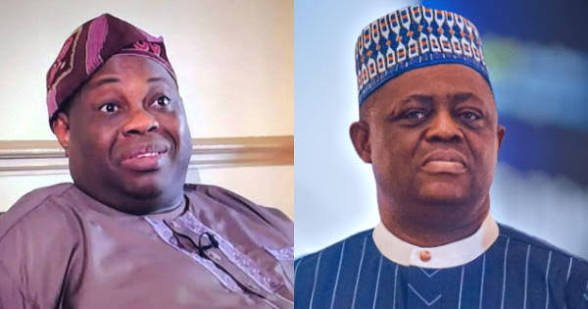
I knew Chief Babaremilekun Adetokunbo Fani-Kayode, Q.C, SAN, of blessed memory, the father of David Oluwafemi Adewunmi Abdulateef Fani-Kayode aka FFK, in Ile-Ife, long before I met his querulous, garrulous and cantankerous son.
Femi is a classic case of a wasted investment. He attended some of the best schools pedigree and/or money could purchase, but turned out an outright and incurable thug.
He went to Cambridge University, probably a 4th generation in his family, but became an enfant terrible, fighting anyone and anything, including esoteric spirits, in sight. All supplication and intercession by friends and family on his behalf have failed to cure his strange malady.
And this is the man President Bola Tinubu is about to unleash on Germany as an Ambassador of the Federal Republic of Nigeria, for God’s sake.
For Femi, it is a fulfillment of a long expected appointment. We discussed it several times. And I encouraged him to be patient and prayerful. I felt his deep frustration and depression.
He was already working on Plan B, and begging a few of us to help him reach out to Alhaji Atiku Abubakar (GCON), if all hopes evaporate.
Femi without power is like fish out of water. It is such a pity that now that Tinubu has finally looked at his side, with mercy and compassion, he is still busy fighting, like a pig, instead of seeking urgent rehabilitation into the comity of sane human beings.
– AARE BASORUN AKINROGUN DELE MOMODU is a journalist and former Presidential candidate.