
Opinion
US/ISRAEL/IRAN WAR SHOWS THAT LEADERS ARE THOSE WHO LIFT THE SPIRIT OF THEIR NATION DURING GLOBAL CHALLENGES

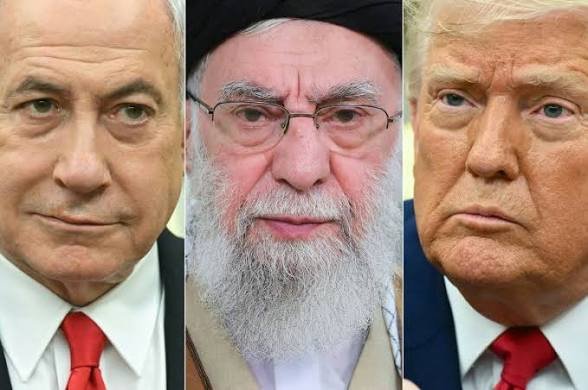
By AVM RTD AKUGBE IYAMU
Strategic processes decisions must continue to justify itself daily as Nigeria history with economic failures make skepticism understandable. It is therefore easy to conflate recent developments in the global oil sector with past failures and conclude that lack of economic consciousness, planning and thinking are behind the current manifestations. The world does not judge leaders by tweet, propaganda and sentiments but by lifting the spirit of the country and its citizens during economic challenges and nibbing it at the bud before it metastatises.
The war shows that the world have arrived at an economic juncture where oil has been redefined as a geopolitical volatile commodity that make countries more miserable, poorer and incrementally more alienated.
The US/Israel/Iran war has unravelled Nigeria fragile economy and has revealed that building a strong economy is no longer optional, add-on but a fundamental non negotiable policy that will withstand shocks and unpredictability in future oil instability. Stable economy matters during economic shock as seen in the current situation, without it policies and laws would be symbolic at best and dangerous at worst.
As of March 2026, the intensifying conflict involving Iran, Israel, and the United States has had a significant impact on the Nigerian economy, resulting in a complex scenario of high oil revenues alongside severe inflationary pressures. The crisis has driven global oil prices above $80–$90 per barrel, causing immediate fluctuations in Nigeria’s downstream petroleum sector and increasing the cost of living. The long-term impact on Nigeria’s economy will depend on the duration of the conflict and the ability of the government to manage the resulting economic volatility and maintain supply chain stability. While Nigeria benefits from higher oil prices (potentially exceeding its 2026 budget benchmark of $64.85/barrel), the rising cost of petrol risks increasing the subsidy burden despite the removal of official fuel subsidies as the government faces pressure to stabilize pump prices. The war matters because
Iran is a major global energy player, holding the world’s fourth-largest proven oil reserves (roughly 12% of the global total) and acting as a top 10 producer. The oil shock has created a society in which individual success is now defined as the ability to provide your own power, security, Medicare and security. While every economic growth and development presupposes the prosperity of the majority of the citizens, Nigeria economy has thrown up economic growth where very few people benefit.
The war has clearly shown that fear depresses governance more than anything else.
As of early 2026 before the war, Iran produces over 3 million barrels per day (bpd), with China being its primary destination, receiving roughly 91% of its exports. However, recent geopolitical events have introduced significant volatility, with The Conversation reporting U.S. efforts to control and redirect these vast reserves using the Strait of Hormuz: a vital global chokepoint, with ~20% of global oil (~20-21 million barrels/day) and ~20% of liquefied natural gas passing through it. The importance of the Strait is that it connects the Persian Gulf to the Arabian Sea, serving as the main route for oil exports from Saudi Arabia, Iran, Iraq, UAE, and Qatar to Asian markets. The broader pattern worth noting is that disruption or blockade of the narrow passage (approx. 33 km wide) can cause immediate, significant spikes in global oil prices as currently experienced in Nigeria market volatility showing that there is a long and often frustrating search for solutions due to its importance. This because oil is frequently used as a geopolitical lever by Iran, which has threatened to close it during regional conflicts because the pipelines that exist in Saudi Arabia and the UAE and most oil originating in the Gulf has no alternative way to exit the region, making the strait indispensable. The war has portrayed where Nigeria economic problem lies, how it mutates and what it feeds on bearing the hallmark of economic consciousness where good policy structures and improvisation are favoured over sentiments. The fallout from the war shows that for Nigeria to confront economic challenges without confronting hunger hunger, poverty and insecurity is to fight shadows as governance demand accountability and evidence and not conjecture or conjectural story telling that may only energize partisan audience but does little to elevate public understanding.
AVM RTD AKUGBE IYAMU MNSA fsi
CONSULTANT ON CLIMATE CHANGE AND ANALYST ON ENVIRONMENTAL POLICIES.
PRESIDENT ASSOCIATION OF ENVIRONMENTAL PROTECTION AND CLIMATE CHANGE PRACTITIONERS