
Opinion
NIGERIA BUDGETS WITHOUT BUDGETING AND THE CHALLENGES OF ASCENDING THE AMBITIOUS ONE TRILLION DOLLARS ECONOMY BY 2030


By AVM (RTD) AKUGBE IYAMU MNSA fsi
In developing countries like Nigeria where politics and elections are heightened over governance, building a budget that does not exhaust its citizens is lost in political driven noise, propaganda and motivational rhetoric. If the country want to restore her budgetary system, she need to stop treating moments of extreme economic challenges as isolated economic conditions and start reading them as symptoms.
Globally, budgets are intertwined with leadership which is shaped by in depth understanding of how economic institutions actually work because budgets operates across spheres that demand precision, discipline and credibility. In view of the foregoing, budget sustainability is not about whether a few people can endure a budget, it is about whether many can thrive within it because budgeting without budgets lead to economic burn out as most of the scaffolding is either weak or inconsistent with the country’s economic challenges and solutions.
Before looking at the issue, let’s contextualize what a budgetary process is.
Government budgeting is the systematic process of planning, forecasting, and authorizing government’s revenue (taxes, fees) and expenditures for a specific fiscal year. It acts as a financial roadmap, allocating public funds to achieve economic and social goals, providing public services, and ensuring legal accountability. Despite the leap in budgetary growth in Nigeria since 2023, the real sector of the economy which refers to the part of the sector concerned with the actual production of goods and services, including agriculture, manufacturing, mining, and construction have suffered significant decline. The real sector represents the tangible, measurable output (GDP) that satisfies human needs and desires, directly influencing employment, consumption, and economic growth. The increase in Nigeria budgets have negated this global economic system as
manufacturing in Nigeria since 2023 faced severe, turbulent contraction due to high inflation, currency devaluation, and subsidy removal, with real GDP growth slowing to 1.40% in 2023 despite high nominal figures. While Nigeria’s federal budgets have seen significant growth from 2023 to 2025: the 2023 budget was ₦21.83 trillion, increasing to ₦28.7 trillion in 2024 (plus ₦6.2 trillion supplementary, totaling ₦34.9 trillion), and rising dramatically to ₦54.99 trillion for the 2025 “Budget of Restoration,” focusing on security and infrastructure, the significant budgetary growth of the various sectors experienced lower real output in 2023-2024 facing reduced purchasing power, high operating costs, and a 54% plunge in foreign investment. This is an inconsistent pathway to climbing into the one trillion dollar club. Nigeria one trillion dollars economy is an unofficial classification into the world’s major economies with a gross domestic product (nominal GDP) of more than US$1 trillion per year. As of 2025, it included 21 countries.
For instance, agriculture, the major contributor to Nigeria GDP growth since 2023 has been characterized by slow, volatile, and, at times, negative growth, with the sector struggling against high input costs, insecurity, and climate-induced challenges such as, flash flooding. What we are witnessing is not argument about styles of actions, it is an economy negotiating with growing pains in public services and finances.
While agriculture remains a major economic driver, contributing around 25% to GDP and over 30% to employment the sector growth dropped to 1.13% in 2023, recovering slightly to 1.41% by Q2 2024. Additionally, since 2023, Nigerian SMEs have shown immense resilience despite a challenging economic environment marked by high inflation, foreign exchange volatility, and rising operational costs. The reality is that
business formation slowed with a decline to 24% in 2023 from 32% in 2022. There is no doubt that the sector remains critical contributing 96% of businesses and 84% of employment.
A progressive economy does not need fewer promotional options and strategies, it needs options and actions that travel through economic layers and space rather than trends. This requires continuous improvement in investment not just financial but intellectual. Until this happens, budgets without budgeting will keep recurring because the system keep asking poor citizens to give more of themselves that they can sustain. Whether we listen to the substance of hunger, poverty, insecurity and inequality or the noise around it will shape what kind of creative economy we become next.
AVM (RTD) AKUGBE IYAMU MNSA fsi
CONSULTANT ON CLIMATE CHANGE AND ANALYST ON ENVIRONMENTAL POLICIES
PRESIDENT ASSOCIATION OF ENVIRONMENTAL PROTECTION AND CLIMATE CHANGE PRACTITIONERS
Dear All,
By Paul EJIME
The Sahel region, including a large part of the ECOWAS space, bears the unenviable badge of the “epicentre of global terrorism.”
The attendant insecurity is compounded by poor and failed governance systems, resource mismanagement, the effects of climate change and geopolitical shifts, among the uncertainties challenging the world order.
Chatham House, London, the UK’s prominent policy and research think tank, also known as the Royal Institute of International Affairs, hosted the Foreign Affairs Ministers of Nigeria and Ghana to address these hydra-headed issues.
Attached for your kind attention and sharing.
PAUL EJIME IS AN AFRICAN AFFAIRS ANALYST
By Ehichioya Ezomon
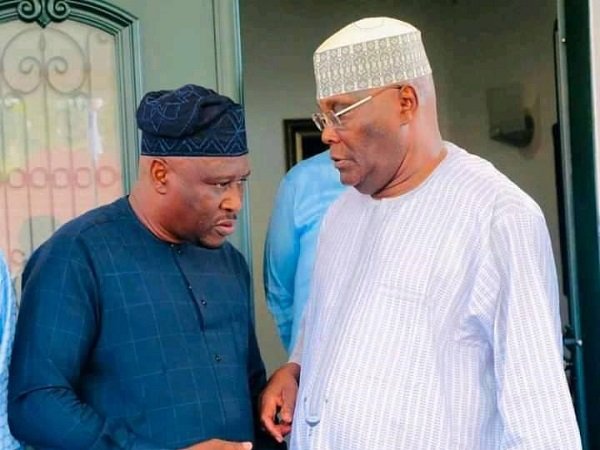
It’s looks strange that former Vice President and twice presidential candidate of the struggling Peoples Democratic Party (PDP), Alhaji Atiku Abubakar, doesn’t seem to realise what’s galvanising governors and other political chieftains and their supporters to switch camps from the opposition parties to the ruling All Progressives Congress (APC).
At every turn in the lead-up to the 2027 General Election, Atiku’s repeated tired and wornout claims that President Bola Tinubu’s deploying state powers to “pressure and intimidate” fiercely independent-minded governors to succumb to his alleged scheme to turn Nigeria into a one-party state, and lately to secure a “third term” after completion of his term-limit, eight-year tenure in 2031.
This assertion of a “third term” plot by Tinubu, who hasn’t got the affirmation of members for the APC ticket for the January 2027 election, confirms one quick fact: The opposition members have given up on the presidential poll for which Atiku’s rallied a Coalition of Opposition Politicians (COP) under the African Democratic Congress (ADC) to “remove” Tinubu from power in 2027.
Atiku’s obvious “bitterness” towards ‘Bola Tinubu’ (he can’t address him as “President”) and unchecked ambition to be President of Nigeria may’ve pushed him to surrender to emotions, and now sees things only in the abstract and negative, as he views the defection to the APC of his home Adamawa State Governor Ahmadu Fintiri – his protégé in the PDP that himself dumped in 2025 for the ADC!
Several factors – certainly not the polemics offered by the opposition – determine the governors’ movements: The intractable crises in the PDP; the need to align their states with the APC-led Federal Government; and to help re-elect Tinubu, whose economic reforms they attest to have positive impact on the revenues of subnational governments.
Across party lines, governors with no inhibition to truth, have publicly admitted that the Tinubu economic reforms have increased their allocations three-fold, and given them a wide berth to allocate resources. While Anambra State Governor and former Governor of the Central Bank of Nigeria (CBN), Prof. Chukwuma Soludo of the All Progressives Grand Alliance (APGA) has endorsed the Tinubu reforms; both APC Governors Abdullahi Sule of Nasarawa State and Monday Okpebholo of Edo State have credited their states’ development strides to the acruals from the president’s reforms.
In the past one year, the PDP’s lost to the APC Governors Umo Eno (Akwa Ibom), Sheriff Oborevwori (Delta), Peter Mbah (Enugu), Agbu Kefas (Taraba), Douye Diri (Bayelsa), Siminalayi Fubara (Rivers), and Caleb Mutfwang (Plateau). Like these counterparts, Fintiri, in a broadcast on Friday, February 27, 2026, at the Government House in Yola, Adamawa’s capital city, stated that his decision to leave the PDP wasn’t driven by personal ambition or convenience, but guided by one overriding consideration: “the long-term stability, development and prosperity of Adamawa State.”
According to Fintiri: “We (his government) have always been guided by the triple principles of consultation, legality and impact. As democrats, we consult with the people. As citizens we interrogate how every decision we make aligns with extant laws; and as leaders, we weigh the impact of every decision on the state and our people.
“Recent events in the polity demands that we take decisive and strategic decisions. There are seasons for political exigencies just like there are seasons for political expedience. We have come this far and built so much with the people that we are ready to move further to align our polity to national politics.
“After wide consultations with a large spectrum of our people, we have resolved to politically align Adamawa State with the All ProgressivesCongress (APC). This alignment would enable Adamawa State to effectively support and leverage the Renewed Hope Agenda of President Bola Ahmed Tinubu GCFR, which aims to transform the nation in critical sectors including social welfare, infrastructure, housing and inclusive economic development.”
Urging Adamawa citizens, as his administration’s most cherished partners, to trust that the decision to join the APC “is in our best interest,” Fintiri said that, “wherever we go from here, we are going as a collective, with the required political strength and the numbers that confer value.”
“We have structures everywhere. We are moving into the APC with all the 226 wards, 21 Local Government areas, all elected and appointed members and indeed our energy and our political machinery to confer benefit to our state, the nation and our people,” he said, adding, “I therefore call on all our supporters to fit in, register massively in the APC and gear up for a future that is assured.”
Can Nigerians imagine a sitting Governor of Lagos State – no matter the grievances he carries – decamping to the political party that vows to remove President Tinubu from power? Governor Fintiri hasn’t only joined the APC, but is also determined to stop Atiku from achieving his life-long ambition to be President in 2027 – perhaps his last chance to vie for the office, as he turns 80 plus on Election Day in January 2027.
Rather than engage in a sober assessment of his political journey that began in early 1990s when he first aspired to be President under the Social Democratic Party (SDP), Atiku’s digging around the main issue: That he’s lost his political mojo ahead of the 2027 contest. Serving under President Olusegun Obasanjo as vice president (1999-2007), Atiku became so powerful that he’d the PDP governors under his belt, and on that pedestal almost upstaged Obasanjo’s re-election bid in 2003.
Were Atiku still with such political gravitas that he wielded from pre-1998-1999 transition from military to civilian rule to the early 2000s, he wouldn’t react to Fintiri’s defection by appealing to “patriotism” he thinks resides only in Nigerians who’ll vote against Tinubu and the APC in 2027.
Atiku’s media office statement on February 28, 2026, as reported by The Nation, partly reads: “Former Vice President of Nigeria and chieftain of the African Democratic Congress (ADC), Atiku Abubakar, has declared that the 2027 election will be a straight fight between Bola Tinubu and the APC on one side, and the Nigerian people on the other.
“Atiku warned that the wave of defections by opposition governors is not a sign of APC strength, but evidence of pressure and intimidation. He accused the Tinubu administration of weaponizing state institutions to bully political opponents in a desperate bid to turn Nigeria into a one-party state.
“This government fears accountability. It fears credible elections. It fears the people. No amount of coercion can erase the daily hardship Nigerians face – rising hunger, crushing poverty, worsening insecurity, and mass unemployment caused by failed economic policies.
“Governors may defect for personal survival. Nigerians are defecting in their millions because they want survival. What will the APC campaign on in 2027 – hunger? hardship? hopelessness? Do not trade your future. Do not mortgage your children’s tomorrow. In 2027, the people will have their say – and their will shall prevail.”
Polity watchers may want to ask Atiku and his colleagues the kind of alternatives they’re offering to arrest the defections by governors and Nigerians to the APC? None! Hence their expectations of replacing the incumbent with a vacuous opposition leadership won’t materialise!
They remain in denial that Nigerians can discern what’s happening around them and in the polity, and able to decide between the Tinubu tough but promising economic reforms, and the opposition’s “no-show” alternative solutions other than a focus on how to “remove Tinubu from power in 2027.”
Ask them what happens the day after if they’re given power? First, they look blank, and then insist, “Let’s get the power first, and we’ll decide on what to do thereafter.” That’s the textbook definition of power for the sake of the opposition figures, and not the interests of Nigerians they mouth to represent and fight for!
The deliberate misconception about “patriotism” and “us versus them” mentality will be Atiku and the opposition’s undoing in the 2027 election – as exhibited by “Nigerians” during the February 21, 2026, area council poll in the Federal Capital Territory (FCT), Abuja, which became a referendum on the opposition rather than on the Tinubu APC government.
Atiku and the mega-rich politicians driving the ADC had campaigned vigorously for the FCT poll, boasting that “Nigerians” would vote against the APC as a test-run for the 2027 election.
But the “Nigerians” they tried to weaponize against Tinubu and his administration rejected the ADC and voted the APC overwhelmingly. So, 2027 isn’t looking good for Atiku and his colleagues. That’s the reality they should internalise till Poll Day!
Mr Ezomon, Journalist and Media Consultant, writes from Lagos, Nigeria. Can be reached on X, Threads, Facebook, Instagram and WhatsApp @EhichioyaEzomon. Tel: 08033078357

By Pelumi Olajengbesi, Esq.
Wealth creation is one thing; wealth preservation is another. Many individuals work tirelessly to accumulate assets through diligence, entrepreneurship, or opportunity but protecting that wealth requires foresight, structure, and professional safeguards.
As a legal practitioner, I’ve seen fortunes built over decades vanish in a single careless moment. One of the most common risks is the storage of cash or sensitive property documents at home—a practice that exposes owners to legal, financial, and security threats.
Who Should Avoid Keeping Assets at Home
Certain categories of individuals face heightened risks:
Politically Exposed Persons (PEPs): Current or former public office holders.
Sanctioned or Previously Convicted Persons: Individuals or entities under regulatory scrutiny.
High-Risk Industry Professionals: Those in extractive industries, government contracting, cross-border trade, or high-cash businesses.
Individuals with Media Exposure: Publicly associated with financial misconduct or allegations.
Executors, Trustees, and Custodians: People managing family estates or inheritance documents.
Public Figures and Influencers: Celebrities or leaders whose visibility attracts security risks.
Faith and NGO Leaders: Those managing donations, tithes, or international grants.
Real Estate Developers: Frequent buyers, sellers, or holders of property documents.
The Risks of Storing Cash and Documents at Home
Keeping assets at home opens individuals to a long list of potential dangers:
Regulatory investigations, law enforcement raids, and search warrants
Asset freezing, forfeiture orders, or tax audits
Fraud, forgery, blackmail, or extortion
Armed robbery, kidnapping, or other personal security threats
Loss due to fire, natural disasters, or accidental disposal
Family, matrimonial, probate, or inheritance disputes
These threats are not hypothetical. In a compliance-driven world, storing valuable documents or large sums of cash at home is no longer a symbol of power, it is a vulnerability.
A Professional Approach to Wealth Security
High-net-worth individuals and institutions often rely on professional custody arrangements, using trusted legal advisers, banks, or regulated custodial institutions. Such structures ensure assets are properly secured, accessible when needed, and legally protected.
In short, preserving wealth is about more than accumulation; it’s about structured protection. For anyone with valuable property, documents, or substantial cash holdings, professional custody isn’t just prudent. It’s essential.
Pelumi Olajengbesi, Esq.
Senior Partner & Group Lead
Family, Succession, and Wealth Management (FSW)
Law Corridor