General News
Nigeria, Kenya Move to Strengthen Bilateral Ties as Minister Receives Envoy
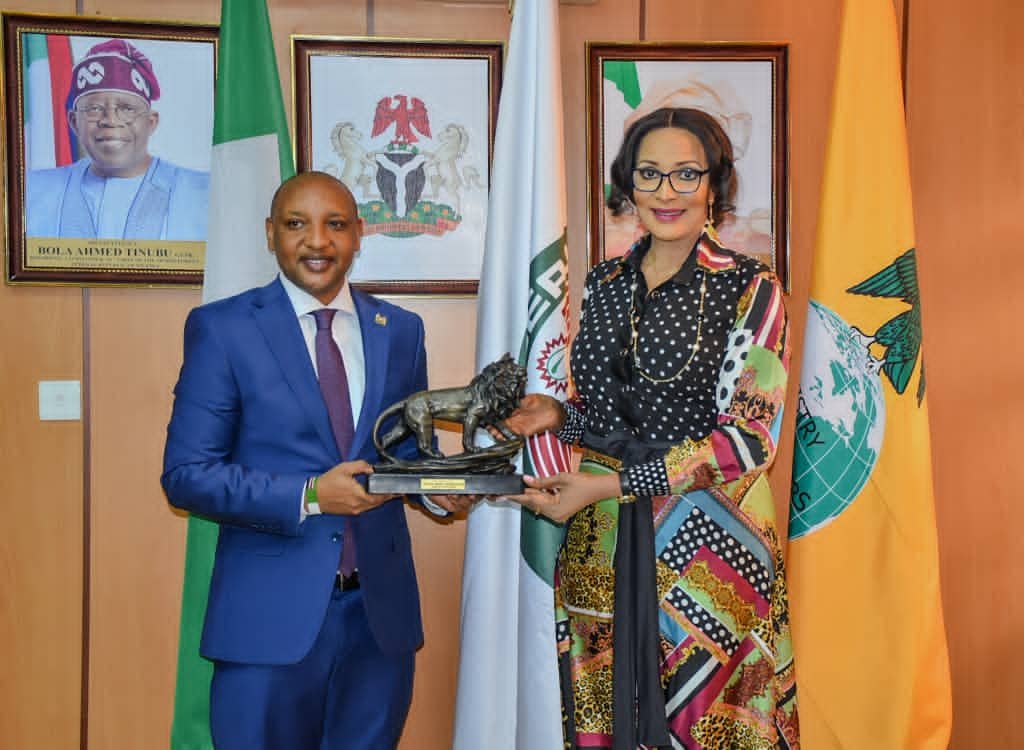
The Honourable Minister of State for Foreign Affairs, Bianca Odumegwu-Ojukwu, on Wednesday, February 18, 2026, received the High Commissioner of the Republic of Kenya to Nigeria, Isaac Keen Parashina, at the Ministry of Foreign Affairs in Abuja, reaffirming both countries’ commitment to strengthening bilateral relations and structured cooperation.
Welcoming the envoy and his delegation, the minister reiterated Nigeria’s appreciation for longstanding cordial relations with Kenya and recalled previous engagements between Abuja and Nairobi. She commended Kenya’s efforts to deepen ties, particularly its commitment to revitalizing the Nigeria–Kenya Joint Commission for Cooperation (JCC), which has not met in over a decade.
According to a statement issued by ministry spokesperson Kimiebi Imomotimi Ebienfa, the minister described the reactivation of the JCC as the most effective institutional mechanism for consolidating collaboration, reviewing Memoranda of Understanding, and ensuring measurable outcomes. She noted that although numerous agreements exist among African countries, weak review structures often limit their impact, stressing the need to prioritize sectors capable of delivering visible benefits.
Odumegwu-Ojukwu identified key areas of mutual interest, including trade facilitation, fintech innovation, digital agriculture, livestock development, tourism, migration management, and anti-human trafficking cooperation. She emphasized that as two of Africa’s largest economies—Nigeria with more than 230 million people and Kenya with nearly 60 million—both nations share responsibility for advancing intra-African trade within the framework of the African Continental Free Trade Area.
She also highlighted demographic realities facing both countries, noting that a significant share of their populations are under 45. Youth-driven migration pressures, digital transformation, and changing labour markets, she said, require coordinated African responses focused on job creation, entrepreneurship, and innovation-led growth.
The minister raised concerns over irregular migration, human trafficking networks, cybercrime syndicates, and the exploitation of vulnerable youths, stressing the need for collaborative prevention strategies, including possible cooperation between Nigeria’s National Agency for the Prohibition of Trafficking in Persons and corresponding Kenyan institutions.
In his remarks, Parashina conveyed greetings from his government and reaffirmed Nairobi’s commitment to strengthening relations with Nigeria. He expressed interest in operationalizing visa reciprocity arrangements and advancing discussions through the Joint Commission to resolve outstanding issues and create more predictable travel and business conditions for citizens of both countries.
The envoy also provided updates on Kenya’s forthcoming Africa–France Summit in Nairobi, clarifying that it is a continental platform aimed at strengthening Africa–France partnerships for development rather than a bilateral event. He said Kenya’s hosting role reflects a broader shift toward situating global engagement forums within Africa, enabling African states to negotiate partnerships with greater coordination and ownership. He invited Nigeria’s participation and stressed the importance of private-sector involvement.
Parashina referenced the Kenya–Nigeria trade mission held in November 2025 and welcomed Nigeria’s follow-up efforts to address logistical challenges identified during the mission. He noted that sustained follow-up mechanisms are essential for converting trade discussions into practical results and reaffirmed Kenya’s readiness to collaborate closely.
On multilateral issues, the High Commissioner expressed appreciation for Nigeria’s advocacy for reform of the United Nations and acknowledged the importance of stronger African representation in global governance institutions.
Both sides exchanged information on their respective international candidacies and pledged mutual support within multilateral platforms.
Responding, the minister said Nigeria views Kenya as a strategic partner in advancing African-led solutions to continental challenges. She noted that shifting geopolitical alignments and evolving development-finance patterns make it imperative for African states to deepen intra-continental partnerships capable of delivering prosperity, security, and resilience without excessive reliance on externally conditioned assistance.
She added that structured engagement through the Joint Commission would help identify priority ministries, define sectoral working groups, and ensure regular reviews of implementation progress.
She encouraged coordination between Nigeria’s diplomatic mission in Nairobi and relevant Kenyan institutions to prepare comprehensive briefs ahead of the commission’s reactivation.
Odumegwu-Ojukwu reaffirmed that the foreign ministry remains the appropriate institutional channel for diplomatic engagement and assured the envoy of Nigeria’s readiness to facilitate swift communication and inter-ministerial coordination. She urged continued direct engagement with relevant departments to expedite bilateral processes.
Both delegations expressed optimism that renewed diplomatic momentum would translate into tangible economic cooperation, stronger trade linkages, improved mobility frameworks, and enhanced collaboration on regional security and migration management.
The meeting concluded with a shared commitment to building a more integrated, prosperous, and self-reliant Africa through sustained bilateral engagement.
Next
General News
Tinubu: Democracy Thrives in Calm, Tolerant, and Orderly Elections
President Bola Ahmed Tinubu has urged voters, political parties, and security agencies to maintain calm, orderliness, and restraint ahead of Saturday’s elections in the Federal Capital Territory (FCT) and the states of Kano and Rivers.
The Independent National Electoral Commission (INEC) will conduct polls in the six area councils of the FCT, as well as bye-elections in Ahoada East II and Khana II constituencies in Rivers State, and Kano Municipal and Ungogo constituencies in Kano State.
In a statement, President Tinubu called on all eligible voters to participate without fear, stressing that democracy thrives in an atmosphere of tolerance and mutual respect. He appealed to political parties and candidates to avoid violence, inflammatory statements, or any actions that could undermine the electoral process.
The president also warned against intimidation or any form of disenfranchisement, emphasizing that security personnel are deployed to protect lives, property, and the integrity of the vote.
He further urged INEC to ensure smooth accreditation, accurate collation, timely transmission of results, and measures that strengthen voters’ confidence, in line with the 2026 Electoral Act.
“Fellow Nigerians, I commend your civic consciousness and assure you that these elections will reflect the will of the people, strengthening our democratic journey,” President Tinubu said.
General News
PRESIDENT TINUBU CALLS FOR ORDERLINESS IN FCT, KANO, RIVERS ELECTIONS
President Bola Ahmed Tinubu has called on voters, security agencies, and officials of the Independent National Electoral Commission to conduct themselves in an orderly manner during Saturday’s polls in the Federal Capital Territory and the states of Kano and Rivers.
The President issued the call in a statement on Friday. Bayo Onanuga, Special Adviser to the President on Information and Strategy, signed the press release detailing the President’s appeal.
INEC will conduct elections in the six area councils of the FCT and bye-elections in the Ahoada East II and Khana II State constituencies of Rivers State, and in the Kano Municipal and Ungogo constituencies in Kano State.

President Tinubu urged all eligible voters to come out and vote without fear, emphasising that the democratic process thrives best in an atmosphere of calm, tolerance, and mutual respect.
He appealed to political parties, candidates, and their supporters to shun violence, inflammatory statements, and actions that undermine the credibility of the process.
He cautioned against any form of high-handedness, intimidation, or actions that could disenfranchise voters or erode public trust, stressing that security personnel are present to protect lives, property, and the sanctity of the ballot.
President Tinubu appealed to the Commission to take all necessary measures to bolster voters’ confidence by ensuring timely accreditation, smooth voting processes, accurate collation, and prompt transmission of results, in line with the 2026 Electoral Act.
Onanuga quoted the President as assuring Nigerians of continued government support for institutions responsible for delivering free, fair, and credible elections.
“Fellow Nigerians, I assure you that the Federal Government under my administration will continue to support institutions responsible for delivering free, fair, and credible elections,” President Tinubu said.
“To all residents of the FCT, Kano and Rivers, I commend your civic consciousness. I am confident that these elections will reflect the will of the people and further strengthen our democratic journey as a nation,” the President added.
General News
UNICEF: Nigeria Registers 14 Million Births in Two Years
The United Nations Children’s Fund (UNICEF) says Nigeria has recorded a significant increase in birth registration over the past two years, with 14 million children officially registered.

UNICEF Country Representative to Nigeria, Wafaa Saeed Abdelatef, disclosed this during a courtesy visit to Nigeria’s First Lady, Oluremi Tinubu, at the State House in Abuja on Friday.
Abdelatef described birth registration as the first right of every child, noting that it ensures children are counted, recognised, and legally identified. She said the progress recorded in Nigeria within two years is remarkable.
“Birth registration is the first right of every child to be counted and recognised. I have served in many places, but I have not seen this level of progress achieved within two years,” she said.
She added that the birth registration system is being digitalised at health facilities nationwide to improve efficiency and access.
According to her, a bill currently before the National Assembly is also expected to strengthen the process, attributing the progress to strong national leadership.
Abdelatef commended the First Lady for her leadership and commitment to initiatives that impact children and families across the country.
She also referenced her participation at events hosted by the First Lady, including the launch of a food bank and engagements linked to the Renewed Hope Agenda.
In her remarks, Tinubu acknowledged UNICEF’s longstanding support to Nigeria, emphasising that birth registration must continue until every Nigerian child is documented.
“Every child counts,” she said, stressing that legal identity and nationality are essential for integrating children into health and social services.
The First Lady said she was encouraged by the progress recorded but noted that more work remains to be done.
“We have to keep at it and make sure that every child is counted. It is not just about birth registration alone; we are also looking at birth certificates,” she said.
Tinubu also highlighted the importance of accurate population data, noting that Nigeria has not conducted a census in many years. She said focusing on registering children would help the government better plan for health, education, and other social services.
While expressing satisfaction with improvements in birth registration, the First Lady raised concerns over the high rates of tuberculosis, HIV/AIDS, and child and maternal mortality in the country.
“Nigeria has a huge population.
When it comes to tuberculosis, HIV/AIDS, and child and maternal mortality, the numbers are still high, and that is worrisome,” she said.
She, however, assured that the current administration is taking steps to address these challenges and position the country for a better future.
Tinubu thanked UNICEF for its continued partnership and pledged further collaboration, noting that the organisation has consistently provided reliable data to support government planning and policy implementation.