
Government
President Tinubu Nominates Oyedele as Minister of State for Finance

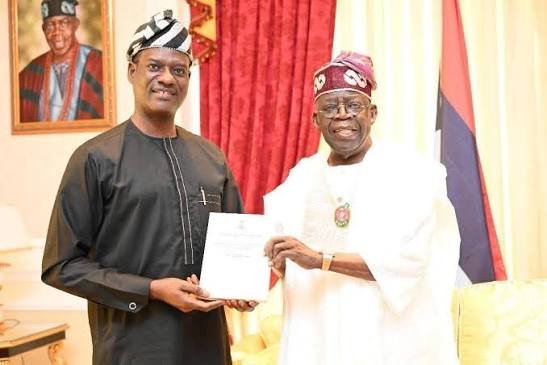
President Bola Ahmed Tinubu has nominated Mr Taiwo Oyedele as Minister of State for Finance, replacing Dr Doris Anite-Uzoka.
The nomination was disclosed on Tuesday in Abuja by the President’s Special Adviser on Information and Strategy, Bayo Onanuga.
According to the statement, Anite-Uzoka has been redeployed to the Federal Ministry of Budget and National Planning as Minister of State, marking her third portfolio in the current administration.
President Tinubu has formally conveyed Oyedele’s nomination to the Senate for confirmation in a letter addressed to Senate President Godswill Akpabio.
Until his nomination, Oyedele, a native of Ikaram in Akoko, Ondo State, served as Chairman of the Presidential Committee on Fiscal Policy and Tax Reforms, where he led efforts to overhaul Nigeria’s tax system.
Oyedele, 50, is an economist, accountant and public policy expert. He holds a Higher National Diploma in Accountancy and Finance from Yaba College of Technology, and a Bachelor of Science degree in Applied Accounting from Oxford Brookes University.
He has also completed executive education programmes at the London School of Economics, Yale University, the Gordon Institute of Business Science, and the Harvard Kennedy School.
Oyedele spent 22 years at PwC, where he joined in 2001 and rose to become Fiscal Policy Partner and Africa Tax Leader.
He is currently a professor at Babcock University and serves as a visiting scholar at the Lagos Business School.
The nomination is subject to Senate confirmation.

Nigeria will officially launch its long-awaited National Single Window (NSW) platform on March 27, marking what the Chief of Staff to the President, Femi Gbajabiamila, described as a landmark reform in the country’s trade and fiscal architecture.
Gbajabiamila made the disclosure during a high-level stakeholders’ meeting at the State House, Abuja, attended by ministers, heads of key government agencies, and senior officials.
He noted that the initiative, first introduced by President Bola Ahmed Tinubu nearly two years ago, represents a major fiscal reform designed to simplify trade processes, boost operational efficiency, and strengthen Nigeria’s global competitiveness.
“We are about to launch yet another reform by this administration — one that is transformational in nature,” he said. “As the name implies, it is a single national window, replacing multiple fragmented systems. This meeting is to assess our progress and secure collective commitment to ensure a smooth transition.”
The Chief of Staff commended the professionalism and dedication of participating institutions, including the Central Bank of Nigeria, the Nigeria Revenue Service, and the Nigeria Customs Service, among others.
Earlier, the NSW Coordinator, Mr. Tola Fakolade, urged agencies to intensify collaboration in the remaining 23 days before the platform goes live. He explained that the first phase will facilitate online processing of import permits, electronic submission of cargo manifests, and deployment of a centralised risk management system.
Fakolade disclosed that nationwide user training is already underway, while pilot testing will soon commence to guarantee a seamless rollout. He added that cargo manifests will be electronically transmitted to relevant agencies automatically, eliminating manual intervention and duplication.
“The support from all agencies is even more critical at this stage. Documents will be submitted once and shared across all relevant agencies without duplication,” he stated.
The Coordinating Minister of the Economy and Minister of Finance, Wale Edun, reaffirmed the ministry’s backing, describing the initiative as growth-enhancing and vital to economic expansion.
Similarly, the Minister of Industry, Trade and Investment, Jumoke Oduwole, described the NSW as a key pillar of the Renewed Hope Agenda. She noted that the reform is long overdue and pledged intensified engagement with traders, importers, and exporters in the weeks ahead.
Governor of the Central Bank of Nigeria, Olayemi Cardoso, also assured the Bank’s full support, stressing the importance of bridging Nigeria’s trade facilitation gap with peer economies.
Chairman of the Nigeria Revenue Service, Zacch Adedeji, called for stronger inter-agency coordination and political commitment, suggesting that the Trade Minister oversee the final 23-day implementation phase.
On his part, Comptroller-General of the Nigeria Customs Service, Bashir Adeniyi, described the project as historic and pledged sustained stakeholder engagement to ensure its success.
At the close of the meeting, the Minister of Industry, Trade and Investment was formally mandated to lead the final implementation phase ahead of the March 27 launch.
Other agencies represented at the meeting included the Standards Organisation of Nigeria, the Nigerian Maritime Administration and Safety Agency, the Nigerian Ports Authority, the National Agency for Food and Drug Administration and Control, the Federal Airports Authority of Nigeria, the Nigeria Agricultural Quarantine Service, and the National Environmental Standards and Regulations Enforcement Agency.
.
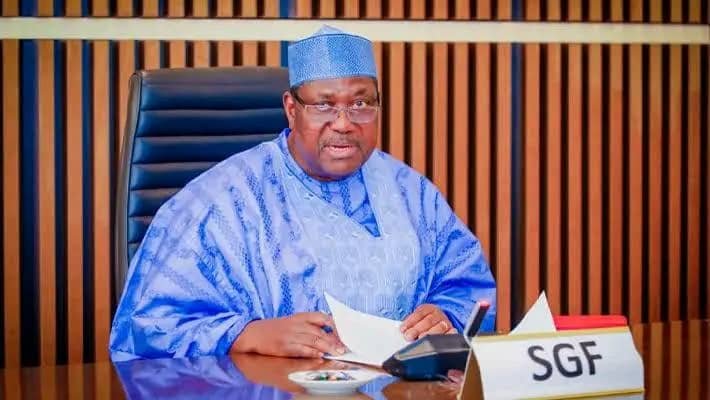
The Federal Government has directed all Ministries, Departments and Agencies (MDAs) to strictly adhere to the Medium-Term Expenditure Framework (MTEF) as part of measures to strengthen budget credibility, fiscal discipline, and sustainable economic planning.
The directive was given by the Secretary to the Government of the Federation, George Akume, during a courtesy visit by officials of the Fiscal Responsibility Commission (FRC) in Abuja.
Akume stressed that strict compliance with the MTEF is essential for maintaining a coordinated fiscal environment that supports national economic growth and development.
He explained that the framework helps align public expenditure with national development priorities while ensuring predictability and long-term budget sustainability.
He further noted that adherence to the MTEF would strengthen transparency in government spending and improve confidence in the budgeting process across all levels of administration.
Chairman of the FRC, Victor Chinmerem Muruako, commended the administration of President Bola Tinubu for its reform-driven leadership, stating that ongoing fiscal reforms are providing stronger institutional backing for the commission’s mandate.
Muruako said the reforms would enhance fiscal responsibility, accountability, and efficiency in public financial management, adding that effective implementation of the MTEF would support sustainable development planning in the country.

The Nigeria Governors’ Forum (NGF) has expressed support for reforms requiring oil and gas revenue entitlements to be paid directly into the Federation Account, saying the policy will strengthen transparency, fiscal predictability, and constitutional governance.
The position was contained in a statement released on March 2, 2026, and signed by Yunusa Tanko Abdullahi, Director of Media and Strategic Communications of the Forum.
The NGF said it has reviewed the provisions of Executive Order 9 signed by President Bola Tinubu on February 13, 2026, which seeks to align oil and gas revenue flows with constitutional requirements while clarifying regulatory roles within Nigeria’s petroleum sector.
The order mandates that government earnings under production-sharing and related agreements—including royalty oil, tax oil, profit oil, and profit gas—be channelled directly into the Federation Account.
According to the Forum, the integrity of the Federation Account is fundamental to Nigeria’s fiscal federalism since oil and gas earnings constitute a major component of national distributable income.
Chairman of the NGF and Governor of Kwara State, AbdulRahman AbdulRazaq, stated that improved clarity in revenue remittance channels would enhance economic planning across federal, state, and local governments.
“The Federation Account is the foundation of Nigeria’s intergovernmental fiscal architecture. When revenue flows are predictable and transparent, it strengthens policy planning, debt management, and infrastructure delivery,” AbdulRazaq said.
The Forum also referenced allocations data from the Federation Account Allocation Committee (FAAC), noting that gaps between gross collections and distributable revenue have sometimes complicated subnational fiscal planning.
The NGF further noted that Nigeria’s population, estimated at over 220 million people, places increasing pressure on state governments, which are primarily responsible for delivering education, primary healthcare, security support, and infrastructure services.
It reiterated its commitment to working with the Federal Government and other stakeholders to ensure that fiscal reforms strengthen institutional efficiency and improve development outcomes nationwide.