Opinion
When Blame Becomes Lazy: Looking Beyond APC in the INEC-ADC Controversy


By Barr John Apollos Maton
In my personal opinion, there is a troubling intellectual shortcut that has taken root in our political conversations one where every contentious development is immediately dumped at the doorstep of the APC and, by extension, the Tinubu administration, without the discipline of proper analysis.
Let me state this without ambiguity: I am not a fan of the APC. But that is precisely why intellectual honesty matters even more. If we are to preserve any credibility in our critique of power, we must resist the urge to weaponize every situation into proof of a preconceived narrative.
The ongoing dispute involving INEC and the ADC factions is a textbook example of how this lazy blame game is distorting reality, allowing the actual issues and actors to slip quietly into the background while outrage takes center stage.
At the heart of this matter lies a simple but highly consequential legal phrase: status quo ante bellum the state of affairs before the outbreak of hostilities. The entire controversy hinges not on conspiracy theories, but on a fundamental legal question: when did hostilities actually begin?
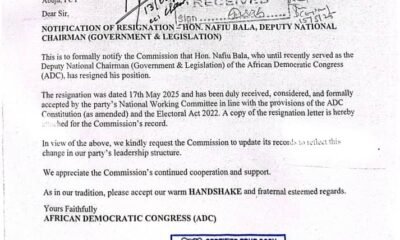
Those quick to indict INEC have conveniently adopted the position that hostilities only commenced when Nafiu Bala filed his suit in September 2025, thereby preserving the legitimacy of the David Mark-led NWC established earlier in July.
But that interpretation, while convenient, is far from conclusive.
A more rigorous and arguably more persuasive reading is that hostilities began at the point of the alleged takeover of the ADC structure an act which Bala contested and which compelled him to seek judicial intervention. In that sense, the lawsuit was not the beginning of conflict; it was a reaction to an already existing one.
This distinction is not semantic it is decisive. If the court’s directive is to maintain the state of affairs before hostilities, then logic demands that we identify the triggering act, not merely the formal legal response to it.
And if the takeover of the party structure is accepted as that trigger, then INEC’s decision to delist or refuse recognition of the David Mark-led NWC becomes less of a political ambush and more of an administrative attempt right or wrong to comply with a judicial order.
You may disagree with INEC’s interpretation, and indeed there is room for robust legal debate, but disagreement alone does not amount to proof of collusion or bad faith. To jump from contested interpretation to allegations of democratic sabotage is not analysis it is assumption dressed as certainty.
What is even more problematic is how this rush to blame APC and INEC conveniently shields the real participants in this dispute from accountability. By externalizing all fault, we ignore the internal dynamics, decisions, and power struggles within the ADC itself that gave rise to this crisis.
The burden lies on Nafiu Bala, as the plaintiff, to define and defend the nature of the alleged hostilities and he has done so by pointing to the July takeover as the injurious act. Conversely, the failure of the opposing faction to robustly contest that framing at the outset raises legitimate questions about their own legal posture.
Yet instead of interrogating these substantive issues, public discourse has largely settled for the easier route: blame the umpire, ignore the players. That is not just lazy it is dangerous.
Ultimately, this pattern of reflexive blame undermines the very democracy it claims to defend. When every institutional action is pre-labeled as partisan manipulation, we erode trust not just in the system, but in our own ability to think critically about it.
Worse still, we create an environment where opposition politics becomes complacent, insulated from self-examination, and ill-prepared for the realities of electoral competition.
If every setback is explained away as APC interference, then the hard work of internal reform, strategic clarity, and legal precision is abandoned.
And when that happens, 2027 will not be lost because of INEC or the APC it will be lost because of an opposition that mistook outrage for strategy.
#ThinkCritically #RuleOfLaw #INEC #ADC #NigerianPolitics #BeyondPartisanship #AccountabilityMatters #DemocracyFirst #StopTheLazyNarratives #FactsOverFeelings #2027Elections #PoliticalResponsibility