Education
DELTA GOVERNOR SHERIFF OBOREVWORI RECEIVES HONORARY DOCTORATE DEGREE FROM NIGERIAN MARITIME UNIVERSITY
Delta State Governor, Rt. Hon. Sheriff Oborevwori, has been awarded an honorary Doctor of Science (Honoris Causa) degree in Social and Economic Development by the Nigerian Maritime University (NMU), Okerenkoko. The award was presented during the institution’s 2nd Combined Convocation Ceremony.

Represented by the State Commissioner for Higher Education, Professor Nyerowho Tonukari, Governor Oborevwori expressed profound appreciation to the university for the recognition, describing it as a tribute to the resilience of the Delta people and the collective efforts of his administration. “I receive this recognition not merely as a personal honour but as a tribute to the resilient spirit of our people, the tireless efforts of our administration, and the shared vision we hold for a more inclusive Delta State and a prosperous Nigeria,” the governor said.
Oborevwori extended his heartfelt gratitude to the Chancellor, Vice-Chancellor, and the entire university management, noting that the award affirms the institution’s commitment to recognizing leadership, service, and contributions to societal development. “This award is especially meaningful, not only because it comes from a distinguished institution in the riverine heartland of our state but also because it affirms the enduring value of service, commitment, and belief in the transformative power of education,” he added.
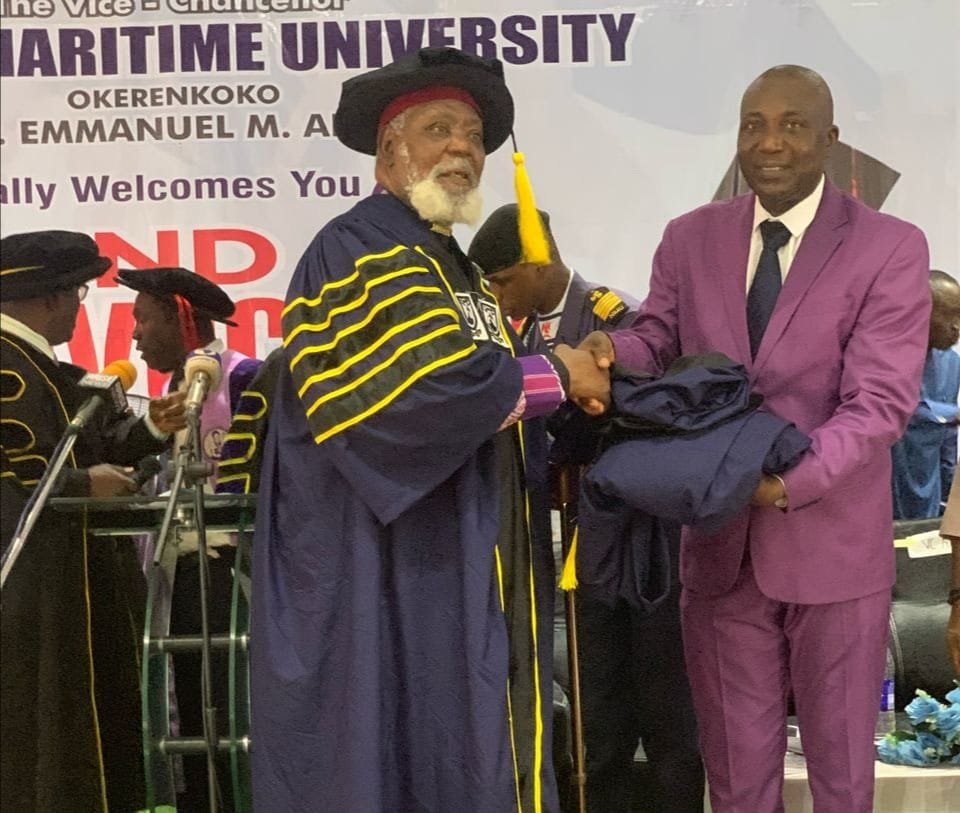
The governor reiterated his administration’s unwavering belief in education as the most enduring investment any government could offer its citizens. He praised the NMU as a beacon of hope and a driver of development in communities historically marginalized. “Since its establishment, the Nigerian Maritime University has provided world-class education in maritime studies and fostered human capital development essential to unlocking the vast potential of Nigeria’s blue economy,” he stated.
Oborevwori highlighted the strategic importance of the institution and noted the state’s continued support in partnership with the Federal Government to enhance security, improve infrastructure, and contribute to NMU’s overall development. “Our administration, guided by the M.O.R.E Agenda, has supported key projects such as the construction and donation of a faculty complex and the development of a connecting road from the host community to the university’s permanent site,” he said.
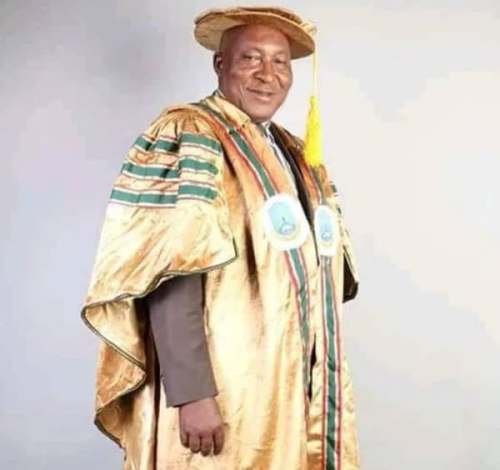
In his remarks, the Vice Chancellor of the University, Professor Emmanuel Adigio, commended Governor Oborevwori for the construction of a faculty building and the road linking Okerenkoko community to the university’s permanent site. The ceremony also honored Senator James Manager and Engr. Ebipador Ogionwo with Doctor of Science (Honoris Causa) degrees in National Development and Industrial Development, respectively.

Education
Admission Fraud: Bayero University Kano Dismisses 171 Students
Bayero University Kano (BUK) has expelled no fewer than 171 students after discovering that they gained admission using falsified academic credentials.
According to multiple reports, the university management said the affected students were identified following a thorough verification exercise conducted in collaboration with relevant examination bodies and admission authorities. The review reportedly uncovered discrepancies in documents submitted by the students during the admission process.
In a statement issued by the institution, BUK described the act as a serious breach of academic integrity and a violation of its admission guidelines. The university emphasized its zero-tolerance stance on fraud and warned that it would continue to enforce strict measures to protect the credibility of its academic system.
The affected students have been directed to withdraw from the university immediately, while their records have been updated to reflect the expulsion. Authorities also hinted that further actions could be taken where necessary, including possible legal consequences for those involved in document forgery.
The university reiterated its commitment to maintaining high academic standards and ensuring that only qualified candidates are admitted through legitimate processes.
Education stakeholders have commended the move, describing it as a step toward sanitizing Nigeria’s higher education system, where cases of admission fraud and certificate manipulation have raised growing concerns in recent years.
Education
FG to Scrap Common Entrance, Introduce Learner ID for Pupils
The Federal Government has announced plans to abolish the Junior Secondary School Common Entrance Examination and introduce a nationwide Learner Identification Number system to track pupils throughout their academic journey.
Minister of Education, Tunji Alausa, disclosed the proposal during an interactive session with journalists in Lagos, stating that the reforms are aimed at improving access to education and strengthening monitoring mechanisms across the country.
Under the proposed framework, the current common entrance examination will be phased out and replaced with a Continuous Assessment (CA) system. The minister explained that pupils would be evaluated based on their academic performance from primary one, allowing for seamless transfer of records when moving between schools.
Alausa said the reform is designed to address long-standing challenges in the transition from primary to secondary education, particularly the high number of pupils who fail to progress.
According to him, Nigeria has over 50,000 public primary schools with more than 23 million pupils, yet only slightly above three million transition to junior secondary school within the public system.
He described the gap as a reflection of limited access, noting that private schools cannot fully absorb the shortfall.
“The issue is simply lack of access,” he said, adding that the Federal Government is working with state governments to expand infrastructure and build more schools to accommodate the growing number of pupils.
To support the reform, the government plans to introduce a unique Learner Identification Number for every child from the primary school level. The number will remain with each pupil throughout their education, regardless of school transfers.
The system, the minister said, will enable authorities to track students’ progress and identify dropouts for timely intervention.
“If a child is expected to be in JSS1 and is not there, we will be able to determine the reason,” he added.
Alausa also revealed plans to revive the school feeding programme as part of efforts to boost enrolment and retention in public schools.
He noted that the programme may be placed under the supervision of the Federal Ministry of Education to improve monitoring and effectiveness.
The initiative forms part of broader efforts by the Federal Government of Nigeria to strengthen the education sector, improve retention rates, and ensure more children complete basic education.
Education
Viral School Assault: Police Arrest Igbinedion Students, Case Heads to Court
The Edo State Police Command has arrested students involved in a viral bullying incident at Igbinedion Education Centre, following widespread public outrage.
Police authorities confirmed that all individuals linked to the incident have been identified and taken into custody, with plans to charge them in a family court in line with juvenile justice and child protection laws.
The case gained national attention after disturbing videos surfaced online showing a student being physically assaulted by fellow students. In one of the clips, the victim was reportedly beaten, kicked, and humiliated while others watched and recorded the incident.
Preliminary investigations revealed that the violence stemmed from an earlier altercation between students. Authorities said a disagreement involving offensive remarks escalated into physical attacks, with a cycle of retaliation contributing to the incidents captured on video.
The Edo State Police spokesperson stated that the arrests followed a “thorough and painstaking investigation,” adding that all suspects would face legal proceedings in accordance with the law.
In response to the incident, the police have also intensified the “Operation Safe Schools” initiative across the state to address gaps in supervision and prevent similar occurrences.
The school management had earlier taken disciplinary action by expelling students directly involved, while the Edo State Ministry of Education condemned the act, describing it as unacceptable and contrary to the values of discipline and safety expected in schools.
Authorities have urged parents, guardians, and school administrators to take greater responsibility in guiding students and ensuring that grievances are handled through proper channels rather than violence.