General News
DSS Witness Details Alleged Plot Behind Owo Church Attack at Federal High Court
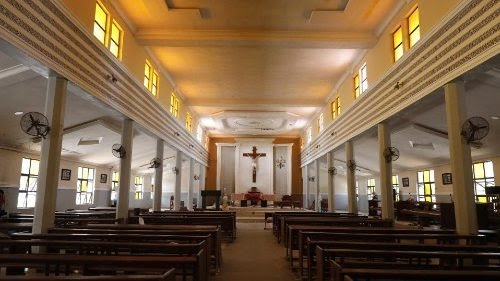
Proceedings at the Federal High Court in Abuja on Tuesday took a dramatic turn as a witness for the Department of State Services (DSS), which gave detailed testimony on how the June 5, 2022 attack on St. Francis Xavier Catholic Church was allegedly planned, funded, and executed.
The witness, identified only as SSI and testifying as the ninth prosecution witness (PW9), told the court he led the counter-terrorism investigation into the attack, which claimed over 40 lives and left more than 100 others injured.
According to the DSS operative, intelligence gathering and technical surveillance led to the arrest of five suspects in August 2022 across Kogi and Ondo states. The defendants listed before the court are:
Idris Abdulmalik Omeiza (25)
Al-Qasim Idris (20)
Jamiu Abdulmalik (26)
Abdulhaleem Idris (25)
Momoh Otuho Abubakar (47)
The prosecution alleged that the accused are members of the Islamic State West Africa Province (ISWAP), a proscribed terrorist organisation. The witness said the suspects operated as part of a cell active in parts of Kogi and Ondo states under the coordination of an individual identified as “Odoba,” who remains at large.
Alleged Planning and Weapons Procurement
PW9 testified that a meeting was allegedly held on May 30, 2022, in Ogaminana, Kogi State, where instructions were given to attack the Catholic church in Owo during Sunday Mass. He said the directive allegedly included targeting the priest.
He further told the court that:
Five AK-47 rifles, magazines, ammunition, and improvised explosive devices (IEDs) were supplied for the operation.
A vehicle was hired to transport the attackers and the weapons.
A “dry practice” session was conducted ahead of the attack.
Surveillance and logistics were finalized the night before the incident.
The witness alleged that on the morning of June 5, 2022, the attackers arrived near the church with weapons concealed in sacks. Gunfire and explosive devices were reportedly used, resulting in mass casualties.
The court heard that 40 victims later died at the Federal Medical Centre, while dozens sustained varying degrees of injuries. Medical reports, autopsy findings, and 30 photographs from the scene were tendered and admitted as evidence without objection from the defence.
On the role of the fifth defendant, Momoh Otuho Abubakar, the DSS witness said investigations revealed he operated multiple Point of Sale (POS) outlets. His account was allegedly credited with ₦800,000 in two instalments weeks before the attack.
The prosecution claimed the funds were distributed to members of the ISWAP cell, including the other defendants, and that technical evidence showed communication between him and the co-accused around the time of the incident.
The prosecution tendered what it described as a comprehensive investigation report, which the court admitted into evidence. Defence counsel requested time to examine the documents before cross-examination.
The case was adjourned to February 18 at 11 a.m. for continuation of trial.
General News
Group Threatens Legal Action Against NASS, Police Over Alleged Brutality of Protesters
The Movement for Credible Elections (MCE) has announced plans to institute legal action against the National Assembly and the Nigeria Police Force over the alleged use of tear gas and force against protesters demonstrating for electoral reforms.
In a statement issued Wednesday and signed by Olawale Okunniyi, Head of the group’s National Secretariat, the organisation condemned what it described as the “violent dispersal of unarmed protesters” who had gathered to demand transparency in the country’s electoral process.
The group said the incident occurred while lawmakers were deliberating on provisions it claims could weaken safeguards for electronic transmission of election results, warning that the development sends a troubling signal about democratic accountability.
According to the statement, deploying force against peaceful demonstrators undermines public trust in democratic institutions and creates the perception that state authorities are being used to shield controversial legislative actions from scrutiny.
MCE argued that citizens have both the right and civic duty to peacefully demand credible elections, stressing that suppressing dissent risks eroding democratic principles.
Demands
The organisation called for:
An immediate and transparent investigation into police conduct during the protest.
Public clarification from the legislature on its commitment to clearly defined safeguards for electronic transmission of results.
Open engagement between lawmakers, civil society, and citizens on electoral reform proposals.
The group warned that how institutions respond to public participation now would shape confidence in the credibility of the 2027 general elections.
MCE also urged Nigerians to remain peaceful and vigilant while it proceeds with legal steps against the legislature and police over the incident.
General News
Tinubu Signs Electoral Act 2026 Amendment Into Law
President Bola Tinubu has formally signed the Electoral Act 2026 Amendment into law.
The signing ceremony was held at the Presidential Villa in Abuja, with principal officers of the National Assembly in attendance.
President Tinubu commended lawmakers, saying he had closely followed the amendment process and praised them for a “job well done.”
The National Assembly leadership described the amendments as a significant step toward ensuring that every vote counts and enhancing the transparency of future elections.
Senate President Godswill Akpabio stated that lawmakers conducted a thorough review of the law before its approval. He highlighted that the amendments now allow for the electronic transmission of polling unit results to the results viewing portal—a longstanding demand by Nigerians.
Akpabio added that while manually signed polling unit results are retained, the new system will enable citizens to compare results at various stages, reducing the risk of post-election tampering.
House of Representatives Speaker Tajudeen Abbas noted that reducing the election notice period from 360 to 300 days is aimed at curbing voter apathy and improving participation.
Implications for Nigeria’s Elections
Analysts say the amendment is a major step toward modernizing Nigeria’s electoral system and aligning it with international best practices.
The Independent National Electoral Commission (INEC) is expected to implement the new measures ahead of the 2027 general elections, with updated guidelines to support electronic results transmission and improved monitoring.
With these reforms, Nigeria aims to enhance credibility in its elections, reduce post-election disputes, and strengthen citizens’ trust in the democratic process.
General News
Lagos Commercial Drivers Protest Against Takeover of Routes by Seyi Tinubu’s Buses, Block VGC Road
Commercial drivers in Lagos staged a protest on Wednesday along the Ajiwe–Victoria Garden City (VGC) corridor, Ajah, bringing traffic to a standstill. The drivers claim they were instructed to stop operating their existing “korope” buses and switch to newly introduced vehicles allegedly linked to Seyi Tinubu.
Eyewitnesses reported that the drivers were prevented from operating entirely, rather than just being restricted to certain routes. Many of the affected operators said they had fully paid for their current buses under long-term purchase agreements and described the directive as unfair and exploitative.
“They told us not to use korope again, even though some of us have completed payments for our buses,” an operator said, expressing frustration over the forced transition to new vehicles.
As of Wednesday morning, movement along the Ajiwe–VGC route was heavily disrupted, with protesters occupying the road and halting both commercial and private traffic.
At the time of reporting, Lagos State authorities and Seyi Tinubu had not responded to the allegations. Drivers vowed to maintain their protest until their concerns were addressed.