
International
US-Iran Conflict Grounds Thousands of Flights, Sparks Global Travel Disruption

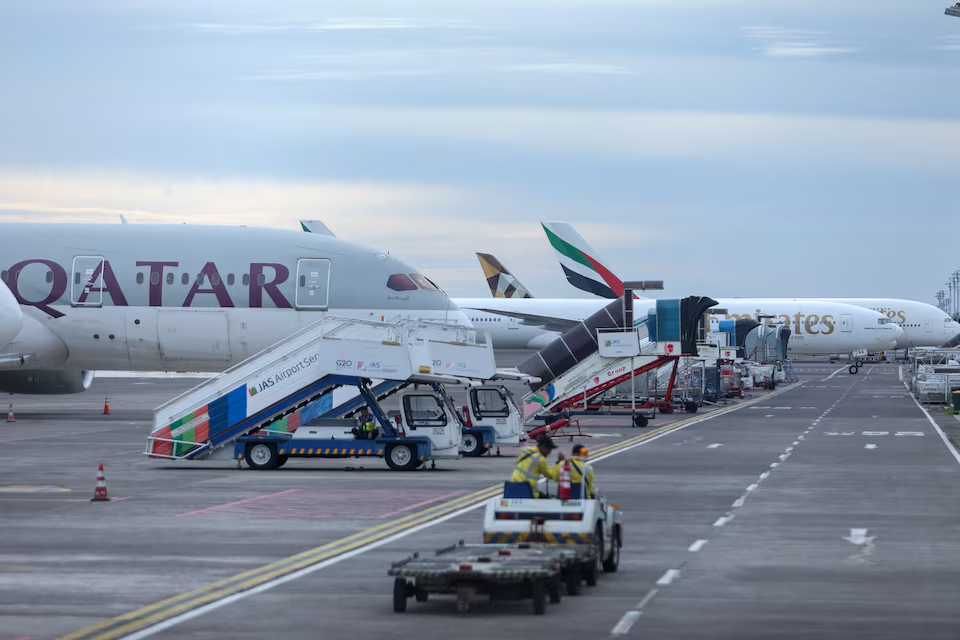
Global air travel faced severe disruption on Sunday as escalating hostilities between the United States and Iran forced the closure of key Middle Eastern airspace, stranding thousands of passengers and triggering widespread flight cancellations.

Major transit hubs including Dubai International Airport, one of the world’s busiest international gateways, remained shut for a second consecutive day following U.S. and Israeli air strikes that reportedly killed Iran’s Supreme Leader, Ali Khamenei. Airports in Abu Dhabi, Doha and Kuwait were also either closed or operating under severe restrictions after retaliatory Iranian missile attacks targeted parts of the Gulf.
Loud explosions were reported near Dubai and over Doha as Iranian forces launched counterstrikes, marking a dramatic escalation of tensions across the region.
Airlines Suspend Operations
Emirates Airline announced the suspension of all operations to and from Dubai until at least Monday, citing safety concerns. Qatar Airways also halted its services, while Germany’s Lufthansa extended its flight suspension to the region by another week.
Airspace over Iran, Iraq, Kuwait, Israel, Bahrain, the United Arab Emirates and Qatar remained largely empty, according to flight tracking data. A pilot bulletin extended the closure of Iranian airspace until at least March 3, though aviation sources warned the disruption could last longer depending on developments on the ground.
Flight analytics firm Cirium estimated that approximately 4,000 flights had been scheduled to land in the region on Sunday alone, underscoring the scale of the disruption.
Passengers Stranded Worldwide
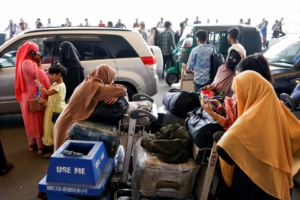
The ripple effects were felt far beyond the Middle East. Tens of thousands of travellers across Asia and Europe were left stranded as airlines cancelled or rerouted flights to avoid restricted airspace.
At Frankfurt Airport, passengers attempting to connect through Dubai scrambled to rebook cancelled flights. Long queues were also reported at I Gusti Ngurah Rai International Airport and Hazrat Shahjalal International Airport, where departure boards displayed a growing list of cancellations.
In Nepal, Tribhuvan International Airport recorded numerous flight suspensions linked to the Middle East closures.
Industry analysts described the situation as one of the most significant aviation shocks in recent years. Dubai and Doha serve as critical east-west transit corridors, funnelling long-haul traffic between Europe and Asia through tightly scheduled connecting networks. With those hubs idle, aircraft and crews were left out of position, compounding logistical challenges for global carriers.
Broader Economic Impact
The Gulf region is also a key hub for international air cargo, raising concerns about supply chain disruptions and added pressure on global trade routes already strained by maritime insecurity.
Airlines have been forced to reroute flights through narrower air corridors, increasing flight times and fuel costs. The closure of Iranian and Iraqi airspace has further complicated operations, particularly after carriers had already adjusted routes to avoid Russian and Ukrainian airspace following the war in Ukraine.
Aviation experts warned that any further escalation, including potential airspace closures linked to rising tensions between Pakistan and Afghanistan, could severely impact travel between Europe and Asia.
Air India joined several global carriers in cancelling Sunday departures from Delhi, Mumbai and Amritsar to major European and North American cities, highlighting the widening geographic reach of the crisis.
Uncertain Outlook
Airline executives said pilots and crew members were now scattered worldwide due to abrupt cancellations, complicating efforts to restore normal operations once airspace reopens.
Analysts cautioned that the risk of prolonged disruption remains high, depending on the trajectory of the conflict.
With Middle Eastern airspace serving as a critical artery for global aviation, the ongoing crisis has exposed the vulnerability of international travel networks to geopolitical shocks leaving passengers, airlines and global supply chains bracing for further uncertainty.