General News
Nigeria Customs Service Moves to Boost Revenue Transparency, Efficiency with AI Training Program

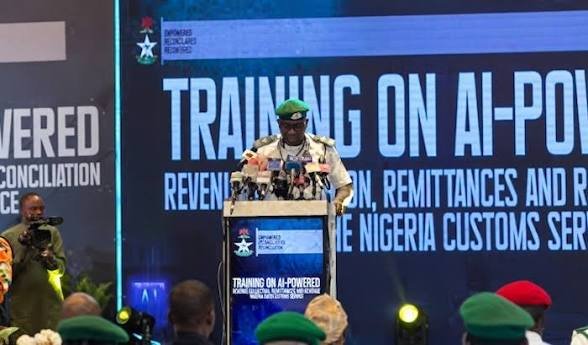
The Nigeria Customs Service has launched a major initiative to deploy artificial intelligence across its operations, aiming to boost revenue collection, enhance transparency, and curb persistent leakages in the country’s public finance system. The announcement came during the opening of a three-day training programme on AI-driven revenue generation, remittance, and reconciliation held in Abuja on Monday.
Speaking at the event, the Comptroller-General of Customs, Adewale Adeniyi, said the Service is deliberately redefining its engagement with the legislature, moving away from a reactive posture to a more proactive partnership. He explained that while legislative summons have historically defined interactions between the Service and lawmakers, the new approach is anchored on partnership and shared responsibility.
“We all know that in a presidential system of government, the power to oversee the executive lies squarely with the parliament, and this is exercised through committees such as the Public Accounts Committee in both chambers. What we have been used to over the years are summons asking us to explain our revenue, our processes, and our operations,” Adeniyi said.
He stressed that regardless of whether engagements come through summons or invitations, the ultimate goal remains accountability and fiscal discipline. “These summons are binding under the Constitution, and we have no option but to comply. Sometimes, if you are invited for a particular time and you arrive late, you may even be threatened with enforcement. But today, we are deliberately flipping that narrative. It is now the Customs that has invited the distinguished committees to engage with us, and we are glad that they responded enthusiastically. Whether it is by summons or by invitation, the objective remains the same: we are united in ensuring transparency in public accounts, achieving fiscal discipline, and bringing inefficiencies in revenue generation to account,” he added.
Adeniyi explained that AI would deepen existing technological systems within the Service, enabling better detection of anomalies in trade patterns and helping to plug loopholes in revenue processes. He noted that the World Customs Organisation has introduced artificial intelligence into the harmonised system, enabling better classification of goods through machine learning.
“Over the last 20 years, technology has evolved and has played a very critical role in our operations. Today, we have risk management systems that help us manage the huge volume of trade that we handle, and through these systems, we are able to analyse patterns and trends in international trade. We have also deployed AI in our scanning systems, where AI-enabled scanners can guide image analysts to predict the nature of items being imported,” he said.
The Customs boss emphasized that revenue generation involves multiple stakeholders beyond the Service, urging others in the fiscal ecosystem to adopt similar innovations. “This is very important in blocking leakages and ensuring compliance. However, revenue generation, remittance, and reconciliation involve a long value chain that includes banks, platform providers, auditors, the Revenue Mobilisation Allocation and Fiscal Commission, the Federation Account Allocation Committee, and the National Assembly. We are only one part of that chain, and while we are taking this leap forward, we encourage other stakeholders to adopt similar innovations so that collectively we can maximise the benefits of AI,” Adeniyi stated.
The Deputy Comptroller-General in charge of Finance, Administration and Technical Services, Kikelomo Adeola, described the training as a major milestone in the Service’s reform agenda. She noted that artificial intelligence is no longer a concept of the future but a present-day tool that offers unprecedented opportunities to optimise revenue processes, minimise leakages, improve remittance accuracy, and ensure seamless reconciliation.
“Artificial intelligence is no longer a concept of the future. It is a present-day tool that offers unprecedented opportunities to optimise revenue processes, minimise leakages, improve remittance accuracy, and ensure seamless reconciliation. From automated data analysis to predictive intelligence and real-time reconciliation systems, AI gives us the capability to transform how we manage and safeguard public funds. The presence of our oversight committees and key fiscal institutions here today underscores a shared commitment to ensuring that every naira due to the Federation Account is properly accounted for,” Adeola said.
The Chairman of the House of Representatives Public Accounts Committee, Bamidele Salam, commended the Customs Service for embracing reforms and innovation, describing the agency as one of the most progressive government institutions. He dismissed the notion that parliamentary oversight was primarily punitive, explaining that its core objective is to strengthen governance and ensure compliance with established laws.
“Contrary to public perception, legislative oversight was not designed to witch-hunt agencies but to strengthen governance systems. Whenever we invite ministries, departments, or agencies, the default thinking is that parliament is on a fault-finding mission, that we are simply looking for errors in the books. But that is not correct. What we are truly interested in is the functionality of the Nigerian state and the degree of compliance with the laws that we have all agreed to abide by,” Salam said.
He recalled past engagements with Customs based on audit queries, noting that the frequency of infractions had reduced significantly in recent years. “When I assumed office as chairman, we reviewed Auditor-General’s reports that raised several issues concerning the Nigeria Customs Service, and we had robust engagements with the Comptroller-General. What is important is that we use those processes not just to identify problems but to improve systems. I must say that in the last three years, the Nigeria Customs Service has distinguished itself as reform-minded and open to innovation, which is very commendable,” he added.
Salam further linked the AI initiative to Nigeria’s broader fiscal realities, noting that the country’s growing budget size requires stronger revenue performance from agencies like Customs. “As a country, we have passed a national budget running into trillions of naira, and the money must come from somewhere. One of the key agencies we rely on is the Nigeria Customs Service. While the Service has done well in previous years, what we are doing now will ensure even better performance in the years ahead. Artificial intelligence is no longer new; it is already transforming sectors globally, from healthcare to logistics. Bringing this into Customs operations is long overdue, and there is no better time than now. However, we must also understand that AI is a tool created by humans, and its effectiveness depends on the commitment of those who use it. Training is important, but discipline, dedication, and accountability will ultimately determine whether we achieve the desired results of blocking leakages and improving transparency,” he said.
Also speaking, a representative of the Revenue Mobilisation Allocation and Fiscal Commission, Hajiya Ibrahim Mambo, commended the Customs Service for the initiative, describing it as both timely and essential in strengthening fiscal governance. “This initiative is both timely and essential as artificial intelligence continues to enhance efficiency, transparency, and decision-making in public service. We commend the Nigeria Customs Service for taking this step and for bringing together critical stakeholders in revenue oversight and fiscal governance. As a Commission, we remain committed to promoting innovation, capacity development, and improved fiscal governance. We encourage participants to take full advantage of this training and ensure that the knowledge gained is translated into practical improvements in our revenue systems,” she said.
The renewed push by Customs to deploy AI comes amid growing pressure on revenue-generating agencies to boost collections and block leakages, as Nigeria grapples with rising fiscal deficits and expanding budgetary demands. Observers say that if effectively implemented, the integration of artificial intelligence into Customs operations could significantly strengthen non-oil revenue performance and boost confidence in the country’s public financial management system.