General News
EU-SDGN Observers Report Impressive Turnout, BVAS Glitches, And 323 Electoral Offences In Osun Election

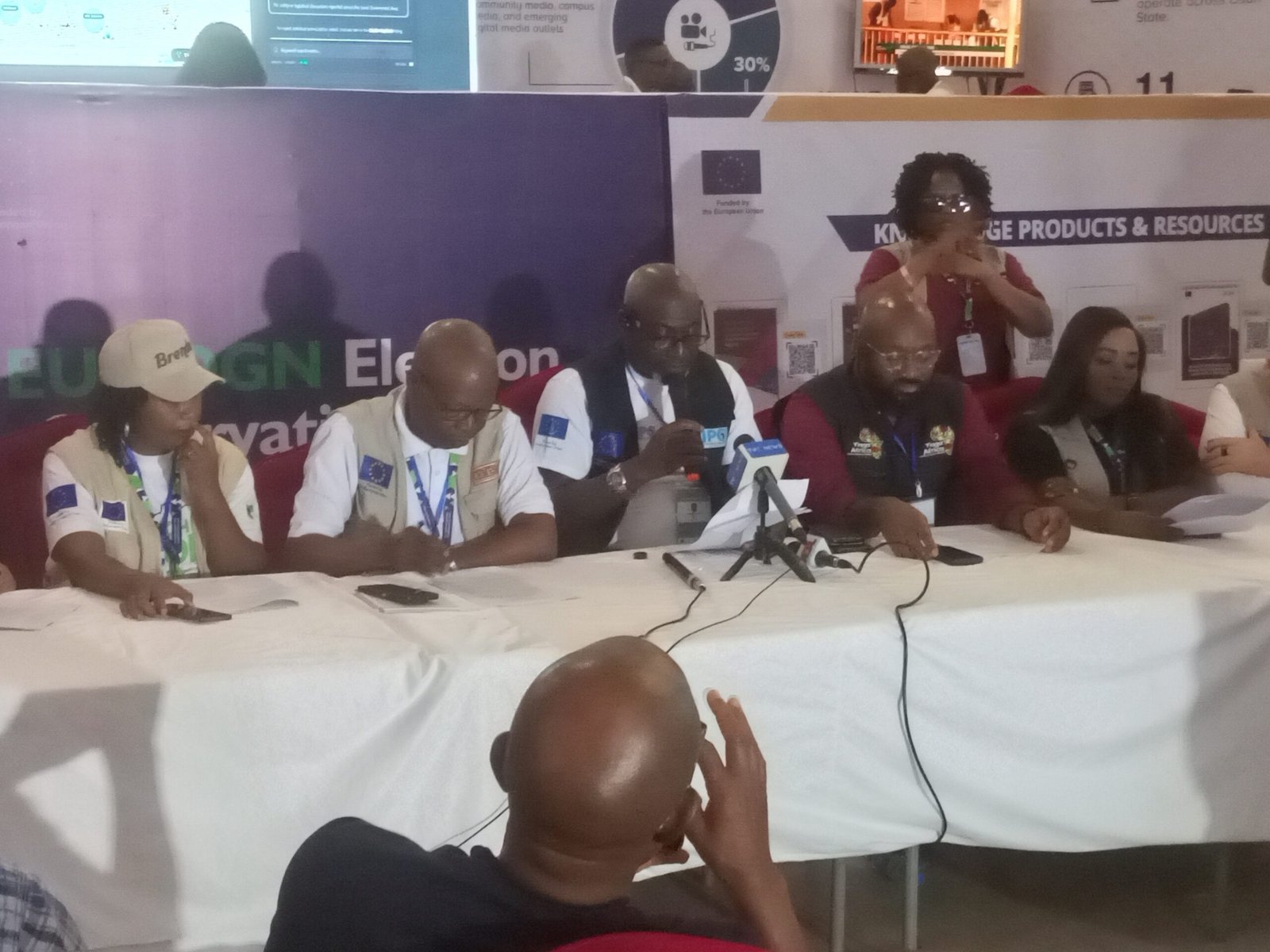
The European Union Support to Democratic Governance in Nigeria Election Observation Hub has reported an impressive voter turnout, widespread technical challenges with accreditation devices, and over 300 cases of electoral offences in the ongoing Osun State governorship election.
In a preliminary statement issued at 2.00 pm on Saturday, the Hub, comprising the Centre for Media and Society, the International Press Centre, the Nigerian Women Trust Fund, TAF Africa, The Kukah Centre, and Yiaga Africa, deployed 823 accredited observers across the 30 local government areas of the state to monitor the process.
In a statement, the Executive Director of the Centre for Media and Society noted that the assessment covered the opening of polls, accreditation, voting, and the election security environment as observed up to 12 noon.
The Hub confirmed that polling officials with complete sensitive and non-sensitive materials were present in 726 out of the 823 observed polling units, with 608 units or 83.7 percent fully set up between 7.30 and 8.00 am.
However, 58 Bimodal Voter Accreditation System devices malfunctioned out of the 726 polling units observed, though 41 of those were rectified and accreditation subsequently resumed.
The Hub’s observers reported that voter turnout was impressive and that the process was mostly peaceful and orderly, with effective crowd control measures deployed by election officials and security personnel.
On election security, the statement indicated that an average of three security personnel were deployed in observed polling units, with most exhibiting professional conduct.
However, cases of voter intimidation by security agents were reported at specific locations, including PU 29-10-10-005 at Igbon DC School in Ejigbo, and at PUs 29-26-01-002 and 29-30-06-015 at an open space opposite No 22, Oke Ola Street, Okanla Area, Osogbo.
The Centre for Media and Society further noted that the voting process was largely inclusive, with women constituting about 59 percent of voter turnout in observed polling units and more than 70 percent of persons with disabilities turning out to vote in the 12 designated PwD polling units.
Women also made up 36 percent of polling officials and played significant roles as polling agents.
As at 12 noon, the Hub recorded 38 security incidents, including 25 cases of thuggery, 12 attacks on electoral officials, and 9 cases of voter intimidation by security personnel.
The International Press Centre also reported 323 cases of electoral offences and irregularities, including 103 cases of vote trading, 12 cases of multiple voting, 28 cases of inducement of polling and security officials, 38 cases of campaigning at polling units, 14 cases of voter impersonation, 7 cases of misconduct by election officials, 31 cases of obstruction of voters, and 85 cases of exposure of ballot papers.
The Nigerian Women Trust Fund observed that the election environment was generally conducive for journalists and observers, with no major incident of impeded access reported.
The Hub’s fact checkers detected and fact-checked about eleven false claims relating to alleged payment of INEC officials, arrests by the police, and underage voting, among others.
TAF Africa reiterated the need for INEC to deploy RATECH and backup BVAS immediately to areas where devices failed to capture biometrics, and to monitor priority voting and assistive devices for elderly, pregnant, and PwD voters to ensure compliance.
The Kukah Centre called on security agencies to maintain professionalism, remain neutral, and keep a visible but restrained presence at polling units and collation centres while supporting the EFCC and ICPC plain-clothes officers working to catch vote-trading.
Yiaga Africa urged political parties and candidates to abstain from vote buying, discourage polling agents from vote-trading, and commit to challenging grievances through the tribunal rather than resorting to protest or self-help.
The Hub also advised the media to refrain from announcing unofficial results, stick to real-time fact-checking, and promptly report any attack or denial of access using dedicated lines and apps.
Voters were encouraged to vote independently, decline inducement, and report vote-buying to INEC staff or security on the spot.
The Centre for Media and Society further recommended that INEC get election personnel and materials to polling units yet to open or reschedule where polling had not commenced by 12 pm, and that security agencies maintain ICCES collaboration, coordination, and synergy throughout the day.
The International Press Centre reiterated its call on all political parties and candidates to await the official outcome of the election and pursue any grievances exclusively through lawful and judicial channels, in keeping with the Peace Accord signed on 30th July 2026.
The Hub also called on the people of Osun State to remain calm and patient as the process moves toward conclusion.
The statement concluded that the Osun State Governorship Election is a critical test of the new electoral legal framework and a bellwether for the 2027 General Election.
The Hub reaffirmed its commitment to an accurate, evidence-based, and impartial account of the election as it concludes.
The statement was signed by the Centre for Media and Society, the International Press Centre, the Nigerian Women Trust Fund, TAF Africa, The Kukah Centre, and Yiaga Africa.