General News
Nigeria Moves to End Imported Passports as FG Breaks Ground on $70m Abuja Factory


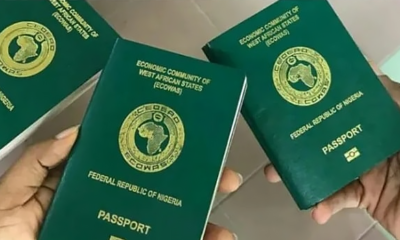
The Federal Government has commenced construction of a $70 million passport manufacturing facility in Abuja, in a major push to end the country’s reliance on imported passport booklets and establish local production of the sensitive travel documents.
The National Passport Manufacturing Centre, which is being financed entirely through private investment, is expected to produce six million passport booklets annually at its initial stage, with capacity projected to rise to 10 million.

The facility is scheduled to begin operations in May 2027.
The Nigeria Immigration Service (NIS) announced the development in a statement issued on Friday and signed by its Service Public Relations Officer, CIS Akinlabi.
The groundbreaking ceremony was led by the Minister of Interior, Olubunmi Tunji-Ojo, and the Comptroller-General of Immigration, KN Nandap, at the NIS headquarters in Abuja. Lawmakers and other government officials also attended the event.

Tunji-Ojo described the project as a landmark investment in Nigeria’s drive for self-sufficiency, noting that its private-sector financing meant the Federal Government would not incur any financial obligation.
He said the facility would complete the country’s passport production value chain, reduce dependence on imported booklets and create employment opportunities.
The minister also expressed optimism that Nigeria could eventually extend its production capacity to serve passport requirements in other Economic Community of West African States (ECOWAS) member countries and the wider African market.

Nandap said the project would strengthen the security of Nigerian passports while improving the country’s control over the supply chain for sensitive travel documents.
She noted that domestic manufacturing would also promote the development of specialised technical skills, build local expertise and improve the efficiency of immigration services.
The initiative attracted support from the National Assembly, with the Chairman of the Senate Committee on Interior, Adams Oshiomhole, describing local production as an opportunity to expand indigenous participation in manufacturing.
Oshiomhole said the project would create opportunities for Nigerian artisans and professionals while reducing dependence on foreign manufacturers.
The Chairman of the House of Representatives Committee on Interior, Abdullahi Aliyu Ahmed, also welcomed the initiative, describing it as a strategic investment in the country’s national security and industrial capacity.
He assured that the committee would continue to support the project.
The manufacturing centre represents another phase of reforms by the Immigration Service to modernise passport administration under the Tinubu administration.
In September 2025, the NIS established a Centralised Passport Personalisation Centre at its Abuja headquarters, with the capacity to produce 5,000 passports daily, a substantial improvement over the previous combined capacity of 250 to 300 passports across multiple centres.
The facility, developed in partnership with IRISMAT Technologies Limited, was intended to accelerate passport production, reduce backlogs and support the government’s target of delivering passports within one week of application.

The government had earlier introduced a contactless passport renewal platform in November 2024, allowing Nigerians in the diaspora to renew their passports remotely without visiting immigration offices.
The platform, developed by two Nigerian software companies, commenced operations in Canada on November 1, 2024.
With the $70 million manufacturing centre, the Federal Government is seeking to move beyond passport processing and personalisation to the local production of the booklets themselves, a development expected to strengthen supply security and reduce Nigeria’s dependence on external manufacturers.