General News
State Police Nears Take-Off as Senate Sends Constitutional Amendment to Tinubu

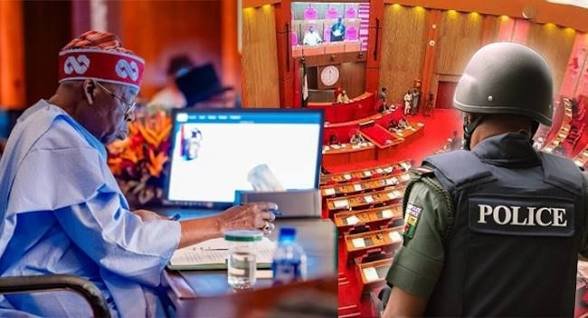
The establishment of State Police in Nigeria has moved closer to reality following the Senate’s approval of the transmission of the constitutional amendment bill to President Bola Tinubu for assent.
The decision came after all 36 State Houses of Assembly endorsed the Constitution of the Federal Republic of Nigeria (Sixth Alteration) Bill, 2026, completing the state legislative approval required for the constitutional amendment.
At plenary on Wednesday, senators unanimously adopted a motion sponsored by Senate Leader, Senator Opeyemi Bamidele, directing the Clerk to the National Assembly, Kamoru Ogunlana, to transmit the bill to the President.

The amendment, which seeks to establish State Police Services, was passed by the Senate on June 24 and the House of Representatives on July 23, 2026, before being forwarded to the state legislatures for approval in line with Section 9 of the 1999 Constitution.
Leading the debate, Senate Minority Leader, Senator Abba Moro, urged his colleagues to support the immediate transmission of the bill, describing the development as necessary in view of the country’s worsening security challenges.
He argued that decentralised policing would strengthen Nigeria’s security architecture and enable state-level security formations to complement existing federal agencies.
The Chairman of the Senate Committee on the Review of the Constitution also commended the National Assembly and President Tinubu for their contributions to the process, describing the development as a major milestone in the country’s constitutional reform efforts.

Senator Muhammad Adamole, who supported the amendment, cited terrorism, banditry, kidnapping and cultism among the security threats requiring additional policing arrangements.
However, the proposed reform attracted concerns over possible political interference and abuse of power by state authorities.
Former Edo State Governor and Senator representing Edo North, Adams Oshiomhole, warned that the establishment of State Police must be accompanied by clear legal provisions defining their powers and operational responsibilities.
He called for a separate legislation to regulate the relationship between federal and state police formations and prevent jurisdictional conflicts.
Oshiomhole acknowledged concerns that governors could use state security formations against political opponents but maintained that appropriate safeguards should be built into the operational framework.
Similarly, Senator Ekong Samson, representing Akwa Ibom South, supported the amendment while emphasising the need for an independent judiciary to protect citizens against possible abuses.

After deliberations, Senate President Godswill Akpabio subjected the two prayers in the motion to a voice vote, with lawmakers unanimously approving both.
The first prayer directs the Clerk to the National Assembly to transmit the Sixth Alteration Bill, 2026, to Tinubu for presidential assent under the Authentication Act, 2004.
The second urges the President to forward the proposed National Policing Bill to the National Assembly for consideration and passage.
The proposed legislation is expected to establish the operational framework for State Police, including the division of responsibilities between federal and state formations, their respective jurisdictions and mechanisms for resolving possible conflicts.
Akpabio said the operational legislation would be critical to ensuring an effective policing structure, adding that the National Assembly would initiate the bill if the Executive failed to forward it within a reasonable period.
He also projected that the introduction of State Police could reduce insecurity in the states by at least 70 per cent.
Bamidele described the endorsement by all 36 state assemblies as a historic development, noting that the question of decentralised policing had remained part of Nigeria’s constitutional debate for decades.
He said the focus would now shift to putting in place the necessary legislation to ensure that State Police operate within clearly defined legal boundaries and complement the Nigeria Police Force.
The bill now awaits presidential assent, after which the proposed National Policing Bill will be critical to determining how the new policing structure is established and operated.