General News
Africa’s Per Capita GDP To Rise 1.8% In 2026, But Poverty To Remain At 47.8% – World Bank

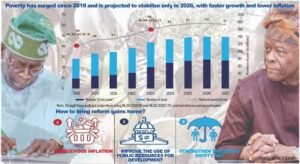
Sub-Saharan Africa’s economic growth is expected to strengthen in 2026, but the improvement may do little to ease widespread poverty, with nearly half of the region’s population projected to remain below the international poverty line.
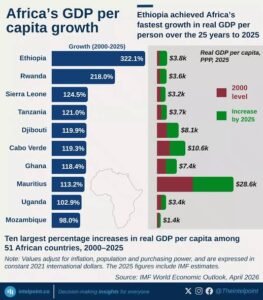
The World Bank, in its October 2026 Africa Economic Update, projected that the region’s per capita GDP would grow by 1.8 per cent in 2026, while the poverty rate is expected to stand at 47.8 per cent.
The bank also raised its overall growth forecast for Sub-Saharan Africa by 0.3 percentage points to 4.3 per cent for 2026, citing stronger-than-expected economic performance across several countries.
However, the World Bank said the increase in income per person remains too modest to result in a significant improvement in living standards.
Using the international poverty line of $3 per person per day, measured in 2021 purchasing power parity terms, the bank projected that 47.8 per cent of the region’s population would remain poor in 2026.
The rate is expected to decline only marginally to 47.1 per cent in 2027.
The World Bank attributed the weak poverty outlook to several factors, including conflict, declining development assistance, high debt-service costs and climate-related shocks.
It also noted that many poor households remain concentrated in low-productivity informal activities and subsistence agriculture, limiting the extent to which economic growth translates into higher household incomes.
The bank warned that the absolute number of people living in poverty continues to rise because population growth is outpacing the modest decline in the poverty rate.
Regional Growth Outlook Improves
The stronger regional growth projection reflects improved economic prospects in several African countries.
Zambia’s economy is projected to grow by 5.6 per cent in 2026, up from 3.8 per cent in 2025, while Angola’s growth is forecast to rise to 4.5 per cent from 3.1 per cent.
The Republic of Congo is projected to expand by 4.4 per cent, compared with 3.1 per cent in 2025.
Botswana is also expected to rebound from a 0.7 per cent contraction in 2025 to 3.4 per cent growth in 2026.
Equatorial Guinea, meanwhile, is projected to narrow its contraction from 5.8 per cent in 2025 to 1.2 per cent in 2026.
Nigeria’s Economy Expands, But Poverty Remains High
Nigeria mirrors the region’s wider challenge of economic growth failing to translate into comparable improvements in household welfare.
The World Bank raised Nigeria’s 2026 growth forecast to 4.3 per cent, from 4.0 per cent in 2025, with growth projected at 4.4 per cent in both 2027 and 2028.
However, the bank has previously warned that poverty in Nigeria has continued to worsen.
In April, it estimated that Nigeria’s poverty rate increased from 56 per cent in 2023 to 61 per cent in 2024 and 63 per cent in 2025, leaving about 140 million Nigerians below the poverty line.
The International Monetary Fund has similarly warned that despite improvements in Nigeria’s macroeconomic stability and resilience following recent reforms, poverty and food insecurity remain major challenges.
Meanwhile, official data show that economic activity continues to expand.
The National Bureau of Statistics reported that Nigeria’s real GDP grew by 4.43 per cent year-on-year in the second quarter of 2026, compared with 4.23 per cent in the corresponding period of 2025.
The latest World Bank projections therefore highlight a widening gap between headline economic growth and household welfare, with stronger GDP figures yet to translate into substantial improvements in living standards for millions of Africans.