
International
India’s Ceramic Hub Shuts Down as Iran War Disrupts Gas Supply


India’s largest ceramic manufacturing hub in Morbi, Gujarat, has been brought to a near standstill as gas shortages triggered by the ongoing Iran war choke industrial fuel supplies.
The crisis, linked to escalating tensions in the Middle East, has severely disrupted the flow of liquefied natural gas (LNG) and propane critical fuels used in ceramic production. The disruption is largely tied to instability in the Strait of Hormuz, a key global energy shipping route now affected by the conflict.
Industry officials say over 400 ceramic units in Morbi, widely regarded as the world’s second-largest ceramic tile manufacturing hub, have shut down operations due to the shortage. Many of these factories are expected to remain closed for up to three weeks, with production only resuming once gas supply stabilises.
The ceramic industry in Morbi depends heavily on continuous gas supply for firing kilns and drying tiles. With supplies cut, both propane, and natural gas-powered units have been forced to halt production, bringing economic activity in the region to a sharp slowdown.
The shutdown threatens the livelihoods of an estimated 400,000 workers directly and indirectly employed in the sector, raising concerns about job losses and economic ripple effects across Gujarat’s industrial economy.
The situation has been worsened by government measures prioritising household cooking gas over industrial use, leaving factories struggling to secure fuel. Analysts warn that prolonged disruption could lead to higher tile prices globally and strain construction supply chains.
This development highlights the far-reaching economic impact of the Iran conflict, with industries far beyond the Middle East now feeling the pressure of disrupted energy supply chains.
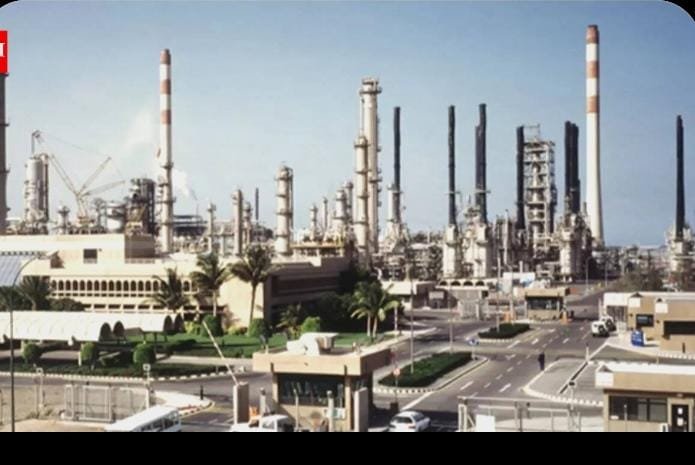
A drone has struck a major oil refinery in Yanbu, Saudi Arabia, as Iran intensifies retaliatory attacks across the Gulf following recent Israeli strikes on its energy infrastructure.
Saudi Arabia’s Ministry of Defence confirmed that the drone hit the SAMREF refinery, a key facility on the Red Sea coast capable of processing about 400,000 barrels of oil per day. Authorities said the impact caused limited damage and no casualties, though the full extent of the disruption is still being assessed.
The attack comes as part of a broader wave of Iranian missile and drone strikes targeting critical oil and gas infrastructure across the region, including facilities in Qatar, Kuwait, and the United Arab Emirates.
The escalation follows an earlier Israeli strike on Iran’s South Pars gas field; one of the world’s largest, prompting Tehran to retaliate against energy assets it considers linked to its adversaries.
Saudi air defences reportedly intercepted additional incoming threats aimed at the Yanbu port, highlighting the scale of the coordinated assault.
Despite the attack, oil loading operations at Yanbu have resumed after a temporary suspension, suggesting that the damage may not significantly affect Saudi export capacity in the short term.
However, the strike has heightened fears of wider disruption to global energy supplies. Brent crude prices have surged above $115 per barrel, reflecting growing concerns about instability in one of the world’s most critical oil-producing regions.
Analysts warn that continued attacks on energy infrastructure could trigger prolonged supply shocks, further driving up fuel prices and increasing the risk of a broader regional conflict

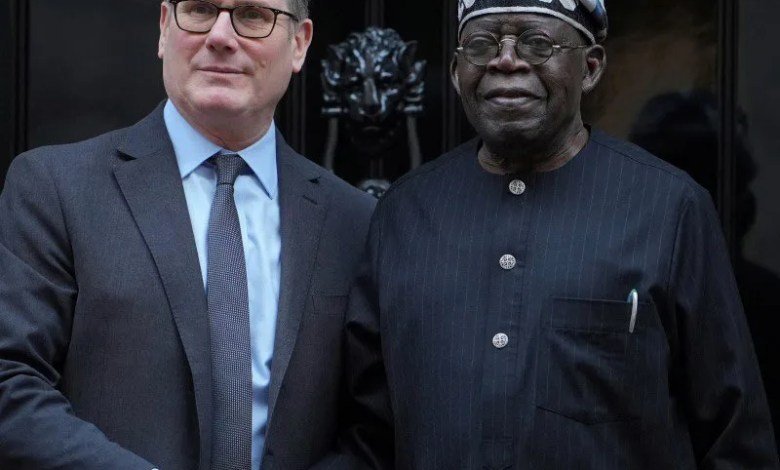
The governments of United Kingdom and Nigeria have signed a landmark £746 million agreement to modernise two of Nigeria’s major seaports, in a move expected to strengthen bilateral trade and create thousands of skilled jobs in both countries.
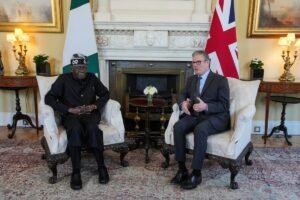
The deal, announced on Thursday, March 19, is backed by UK Export Finance (UKEF) and will fund the redevelopment of the Lagos Port Complex and Tin Can Island Port Complex in Lagos.
The financing will be delivered through UKEF’s Buyer Credit Facility, coordinated by Citibank (London branch), with the agreement involving the Nigerian Ports Authority and Nigeria’s Federal Ministry of Finance.
Officials say the project represents one of the largest recent trade and investment partnerships between both countries. At least £236 million of the total value will go to British companies through supply contracts.
A major beneficiary is British Steel, which secured a record £70 million contract to supply 120,000 tonnes of steel billets for the project. The materials will be used by construction firms Hitech Nigeria and ITB Nigeria.
UK Business and Trade Secretary, Peter Kyle, described the agreement as a significant boost for UK manufacturing and a testament to the growing economic ties between both nations.
Nigeria’s Minister of Marine and Blue Economy, Adegboyega Oyetola, said the project aligns with the federal government’s strategy to unlock the country’s maritime potential.
He noted that modernising the ports would reduce vessel turnaround time, cut cargo delays, and lower logistics costs for businesses, while improving transparency through automation and digitalisation.
According to him, the upgrades will position Nigeria as a leading maritime hub in West and Central Africa, while boosting revenue generation and easing trade operations.
Alongside the ports agreement, both countries also signed a Memorandum of Understanding (MoU) aimed at deepening long-term cooperation in trade, infrastructure, and investment.
The MoU outlines Nigeria’s priority projects that could receive future UKEF-backed financing, while opening more opportunities for UK companies to participate in Nigeria’s supply chain.
Chief Executive Officer of UKEF, Tim Reid, said the agreement demonstrates the agency’s capacity to support large-scale international projects while driving growth for UK businesses.
Also speaking, Citi’s Global Head of Export and Agency Financing, Richard Hodder, highlighted the bank’s long-standing presence in Nigeria and its role in facilitating the deal.
The agreement signals growing investor confidence in Nigeria’s infrastructure sector and reinforces the country’s commitment to expanding trade partnerships and improving its logistics backbone.
Analysts say the project could mark a turning point in Nigeria’s port efficiency and overall economic competitiveness, while strengthening its position as a key trade gateway in Africa.

The United States Department of Defense has requested an additional $200 billion in funding to support ongoing military operations related to the Iran war, according to a senior administration official.
The request, submitted to the White House, significantly exceeds previous allocations and comes on top of funds already approved under former President Donald Trump’s earlier tax and spending legislation.
While the proposal has sparked attention on Capitol Hill, it remains unclear whether the White House has formally forwarded it to Congress for approval. Lawmakers are reportedly preparing for a potential funding debate, though support for the request is uncertain.
Speaking at a press briefing, Defense Secretary Pete Hegseth did not confirm the exact figure but acknowledged that additional funding discussions are underway.
“We’re going back to Congress to ensure that we are properly funded,” Hegseth said, emphasizing the financial demands of ongoing military operations.
The proposed funding level, first reported by The Washington Post, underscores the growing cost of the conflict and could trigger intense political debate over U.S. military spending and foreign policy priorities.