
General News
INEC Mock Accreditation Exposes Voter Register Gaps, Low Turnout Across States

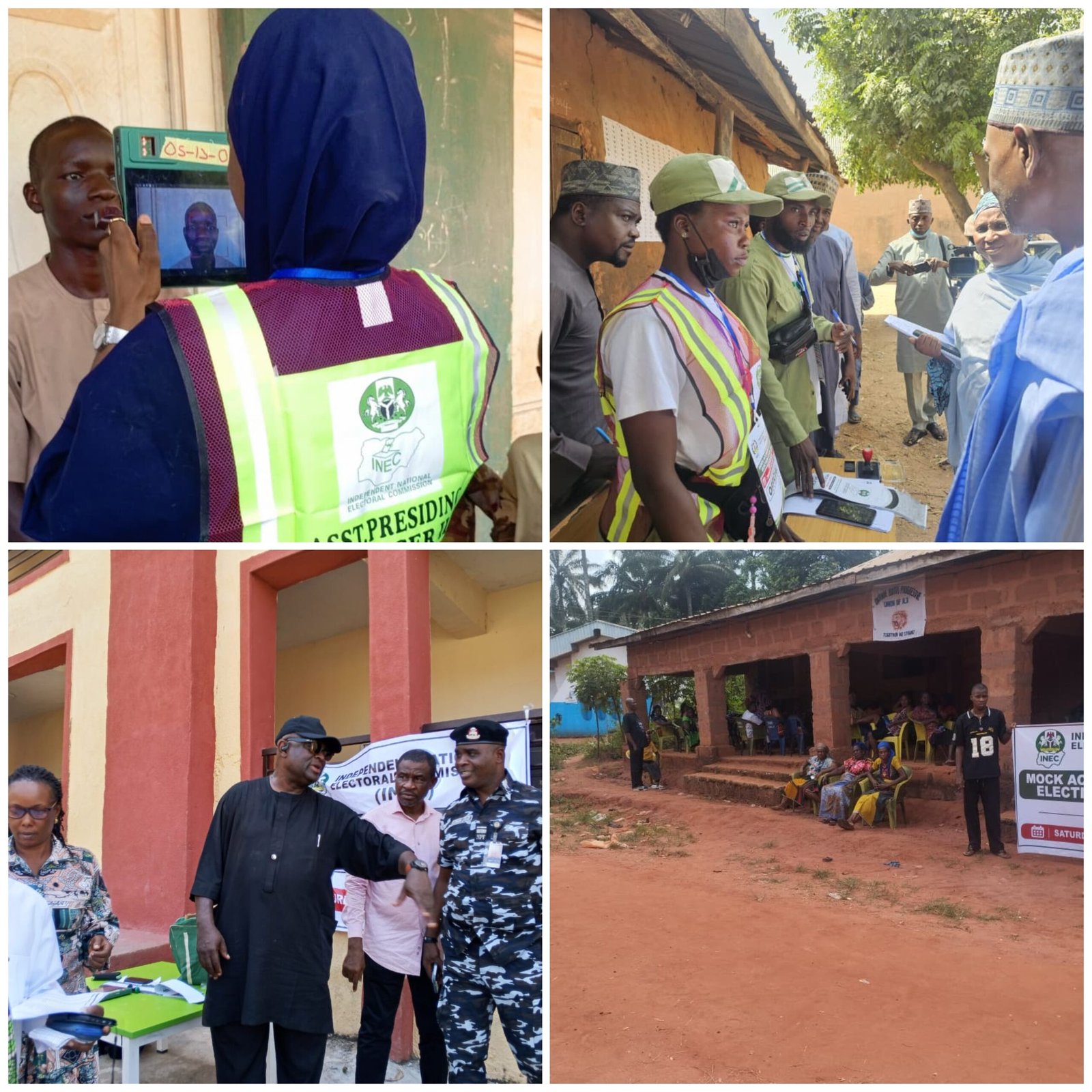
The nationwide mock accreditation exercise conducted by the Independent National Electoral Commission (INEC) on Saturday has exposed gaps in voter awareness, uneven participation and concerns over the accuracy of the voters’ register, even as the commission tested its upgraded electoral technology ahead of the 2027 general elections.
Reports from Bayelsa, Plateau, Kano and Kogi states indicated varying experiences, with some polling units recording low turnout, while others witnessed relatively smooth accreditation using the Bimodal Voter Accreditation System (BVAS).
In Bayelsa State, the exercise recorded poor participation in parts of Yenagoa, with some residents complaining that they could not locate their names on the INEC voters’ register.
At polling units monitored in Opolo and Okutukutu, affected residents blamed inadequate public sensitisation and poor information dissemination, saying many registered voters were unaware of their designated polling units.

The situation, however, was not entirely uniform across the state. At Kpansia-Epie Community Town Hall, accreditation proceeded without significant hitches. A separate report by Vanguard indicated that at least nine voters had completed accreditation at the centre by 11:15 a.m.
In Plateau State, the exercise also recorded mixed experiences. While INEC officials and ad hoc personnel were seen waiting for voters at some polling units in Jos North, participation was more evident at selected locations in Jos South.

INEC Chairman, Professor Joash Amupitan, was in Jos to inspect the exercise and assess the performance of the commission’s electoral technology.
Kano State presented a relatively encouraging picture, particularly in Paniso Ward, where voters turned out to participate in the exercise.
Although turnout remained below expectations, accreditation reportedly progressed smoothly, with BVAS fingerprint verification functioning as expected and no discrepancies reported at the polling unit monitored by Channels Television.
In Kogi State, however, low turnout was also recorded. An electoral observer, Nathaniel Abaniwo, attributed the poor participation partly to market activities, which he said might have affected voters’ availability.
A voter, Abubakar Lukman, described the exercise as peaceful and commended the cooperation of INEC officials.
The state’s Resident Electoral Commissioner, Shehu Wahab, said additional safeguards had been introduced to strengthen result management and minimise errors during electronic transmission.

The exercise covered 17,676 polling units across the country, representing two polling units in each of Nigeria’s 8,838 registration areas.
INEC said the exercise was designed to test the functionality of its upgraded BVAS devices, assess accreditation procedures and examine the electronic upload of polling unit results to the INEC Result Viewing Portal (IReV).
The commission had also introduced measures to improve the efficiency of accreditation, including reducing the maximum number of voters assigned to a BVAS machine from 1,250 to 850. Polling units with larger voter populations are expected to receive additional devices.
Ahead of the exercise, Amupitan said the commission had strengthened its electronic result validation system to prevent the upload of results containing arithmetic inconsistencies or figures reflecting over-voting.

However, concerns about preparations for the exercise had emerged before Saturday.
The Nigeria Civil Society Situation Room, which deployed observers across the country, had expressed reservations about limited public communication and stakeholder engagement.
In its preliminary statement issued ahead of the exercise, the coalition said the publication of the selected polling units on November 23, after the exercise was announced on November 12, left stakeholders with limited time to prepare.
It also reported complaints about difficulties accessing the list of selected polling units on INEC’s website, warning that the commission needed to demonstrate the reliability of its digital infrastructure ahead of the 2027 elections.
The coalition called on INEC to publish a comprehensive post-exercise assessment detailing the performance of BVAS, the electronic result upload process, technical failures and corrective measures.
The mock accreditation comes as the commission prepares for the presidential and National Assembly elections scheduled for January 16, 2027, followed by governorship and State Houses of Assembly elections on February 6.
While the relatively smooth performance reported at several polling units may provide some reassurance about the upgraded technology, the complaints from Bayelsa and the low turnout recorded in parts of the country highlight challenges that cannot be addressed by technology alone.
For INEC, the task ahead goes beyond ensuring that BVAS devices function properly. The commission must also address voter register complaints, improve public sensitisation, strengthen stakeholder engagement and ensure that voters know where and how to participate.

Ultimately, the credibility of the 2027 elections will depend not only on the successful deployment of electoral technology but also on the commission’s ability to guarantee an accessible, transparent and reliable voting process across the country.