
General News
NCN Adopts 10-Year National Food And Nutrition Policy, Moves For FEC Ratification …orders States, FCT To Set Up Nutrition Councils Within Three Months


The National Council on Nutrition (NCN) has adopted the National Policy on Food and Nutrition (NPFN) 2026–2035 and directed the Federal Ministry of Budget and Economic Planning to forward the document to the Federal Executive Council (FEC) for final ratification.

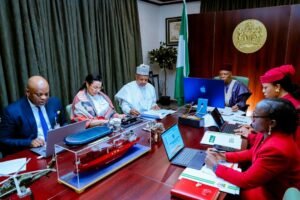
The decision was reached during the 15th meeting of the Council, held virtually and chaired by Vice President Kashim Shettima.
The policy, described as a major step toward tackling malnutrition and strengthening food security across Nigeria, followed an extensive ratification process involving key stakeholders from both the public and private sectors in the country’s nutrition space.
Vice President Shettima described the new framework as “the most consequential nutrition policy this country has produced,” stressing that it is multi-sectoral, evidence-driven, and designed to reach the grassroots.
He said the success of the policy would not be measured by discussions at the federal level, but by the impact it creates for mothers and children across the 774 local government areas by 2035.
“We will be judged not by our deliberations but by our deliveries. Not by what we decided in April 2026, but by what mothers and children in the 774 local government areas experience by 2035,” the Vice President stated.
He added that the policy does not belong to one ministry alone but to every ministry, every state, every local government, and every household involved in improving nutrition outcomes nationwide.
The Council mandated all nutrition-related Ministries, Departments, and Agencies (MDAs) to align their sectoral policies, programmes, and budgets with the provisions of the NPFN within 12 months.
It also directed all 36 states and the Federal Capital Territory (FCT) to operationalise their State Multisectoral Plans of Action for Food and Nutrition within six to nine months.
In addition, NCN approved a six-week extension for the submission of the draft National Nutrition Bill and ordered that the final draft be transmitted to the National Assembly within eight weeks.
According to the Vice President, the proposed legislation will serve as the legal backbone for Nigeria’s nutrition reform efforts by protecting funding from political uncertainties and clearly defining responsibilities across federal, state, and local governments.
On financing, the Council approved the inclusion of the Ministry of Humanitarian Affairs and Poverty Reduction, the Commissioners of Finance Forum, and the Association of Local Governments of Nigeria (ALGON) in the nutrition financing sub-committee.
Shettima praised the Coordinating Minister of Health and Social Welfare for identifying five major financing streams for nutrition interventions, including domestic funding, bilateral support, multilateral partnerships, private sector participation, and innovative financing mechanisms.
The Council also directed the Chairman of the Nigeria Governors’ Forum (NGF), working through its secretariat and in collaboration with the Office of the Vice President, to ensure the establishment and inauguration of State Councils on Nutrition in the remaining 27 states and the FCT within three months.
Currently, only nine states have functioning nutrition councils.
On private sector participation, the Vice President ordered the establishment of a co-branded private sector challenge fund for nutrition within 60 days, to be coordinated with the Dangote Foundation, the Federal Ministry of Industry, Trade and Investment, and the Federal Ministry of Innovation, Science and Technology.
Speaking on the Nutrition 774 Initiative, Shettima said the programme reflects the government’s seriousness in ending malnutrition across the country.
He explained that the initiative focuses on ensuring equal nutrition intervention coverage and improved household outcomes across all local governments.
“From Yobe to Bayelsa, from Katsina to Cross River, from Nasarawa to Ebonyi, every Nigerian child must be seen as the face of this national assignment,” he said.
Earlier, Minister of Budget and Economic Planning, Atiku Bagudu, commended the Vice President for prioritising food security and nutrition as a national development agenda.
He noted that the National Policy on Food and Nutrition 2026–2035 provides a strategic framework for food security, human capital development, and the achievement of the Renewed Hope Agenda.
Stakeholders from both the public and private sectors also expressed strong support for the policy, describing investment in child nutrition as one of the most impactful investments any nation can make.