
Judiciary
Supreme Court Bans Use of ‘Barrister’ as Prefix in Official Correspondence

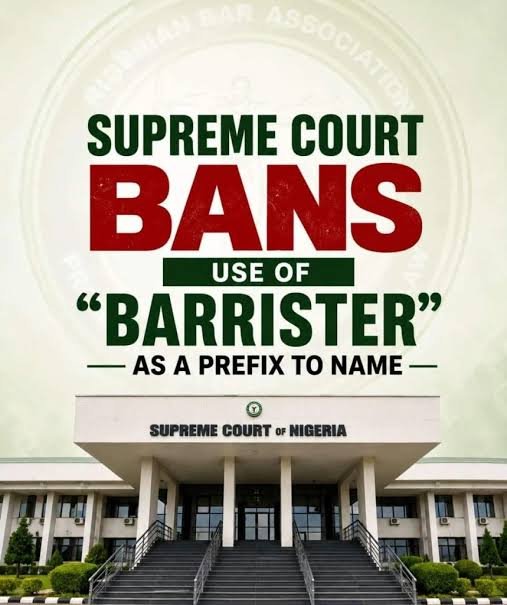
The Supreme Court of Nigeria has directed all litigation staff, legal practitioners, court registrars and lawyers attached to the apex court to discontinue the use of the title “Barrister” as a prefix to their names in all official engagements.


The directive was conveyed in an internal memorandum dated July 13, 2026, signed by the Chief Registrar of the Supreme Court, Kabir E. Akanbi, Esq., on the instruction of the Chief Justice of Nigeria.

Addressed to litigation staff, legal practitioners, court registrars and lawyers, the memo stated that the use of the title “Barrister” before names is considered inappropriate and inconsistent with the standards of professionalism expected within the Supreme Court.
“I am directed by the Honourable the Chief Justice of Nigeria to notify all Litigation Staff, Legal Practitioners, Court Registrars and Lawyers that the use of the title ‘Barrister’ as a prefix to names is inappropriate and inconsistent with the standards of professionalism expected within the Supreme Court of Nigeria,” the memorandum read.

The directive ordered all affected officers to immediately discontinue the use of the title in official correspondence, records, documents, identity materials and other official engagements connected with the Supreme Court.
The Chief Registrar also instructed Heads of Departments and Unit Heads to ensure strict compliance with the directive by all personnel under their supervision.
The memo did not state the reasons behind the policy beyond the need to uphold professional standards within the nation’s highest court.
The development has sparked discussions within legal circles, where the title “Barrister” is commonly used by legal practitioners after being called to the Nigerian Bar.

While the directive applies specifically to official communications and engagements within the Supreme Court, legal observers say it could influence broader conversations about professional titles and courtroom etiquette across Nigeria’s judiciary.
The memorandum took immediate effect from the date of its issuance.