
General News
Tinubu’s Jos Visit: Why Victims Were Received at the Airport

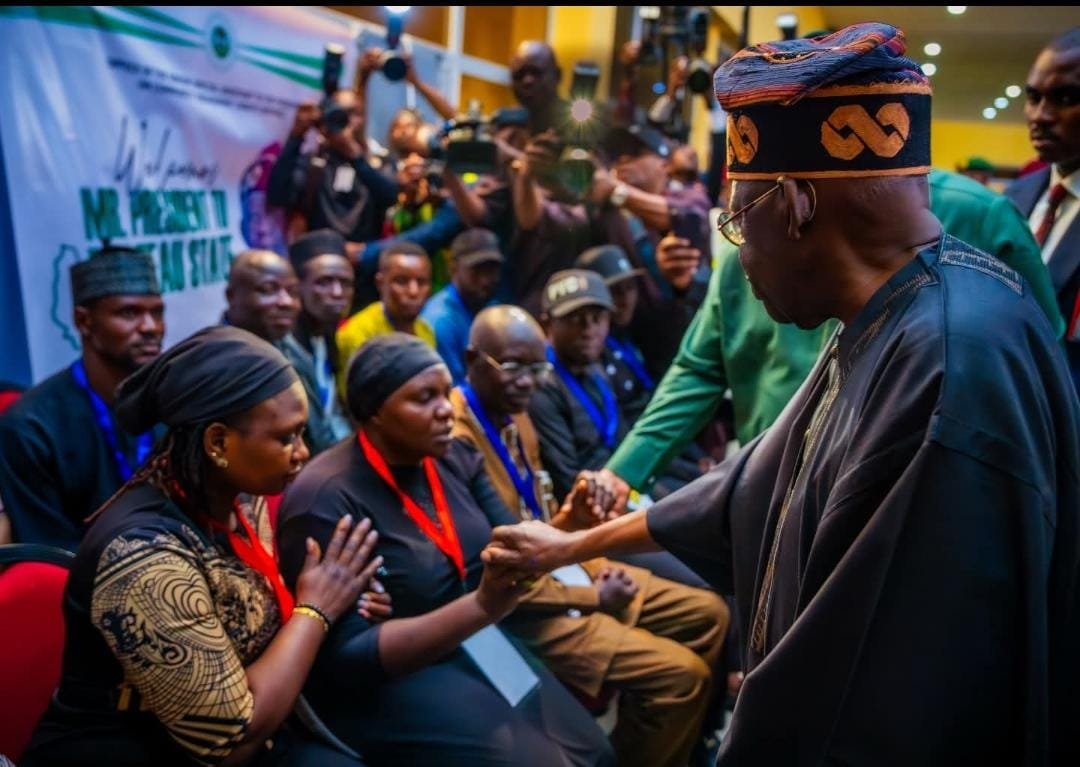
The Presidency has clarified why President Bola Ahmed Tinubu met victims of the recent Plateau attacks at the Jos Airport instead of visiting affected communities directly.
In a statement issued on Friday by presidential spokesman Bayo Onanuga, it was explained that logistical and scheduling constraints shaped the President’s actions during his visit to Plateau State.
According to the statement, Tinubu’s itinerary on Thursday initially included receiving Chadian President Mahamat Idriss Déby Itno at the Presidential Villa in Abuja, followed by a planned trip to Iperu in Ogun State. However, after a security briefing from Plateau State Governor Caleb Mutfwang, the president suspended the Ogun visit and arranged an urgent trip to Jos.
The bilateral meeting with the Chadian leader focused on strengthening security cooperation between both countries, reportedly extended longer than expected, delaying Tinubu’s departure for Plateau.
Upon arrival in Jos, further complications arose. The presidency noted that the airport runway lacks navigational aids required for night operations, making it unsafe for flights after dusk. Given the roughly 40-minute travel time from the airport to Jos city, officials determined it would be impractical for the president to visit affected communities and return in time for departure.
As a result, victims and representatives from the affected communities were transported to a hall near the airport, where the president met with them.
The meeting was attended by top security officials, including the Minister of Defence, the Chief of Army Staff, and the Inspector General of Police, who had earlier visited Rukuba; the epicentre of the violence A high-level delegation had also been deployed ahead of the President’s arrival to carry out security assessments and community engagement.
During the interaction, Tinubu expressed condolences to victims, listened to their concerns, and assured them of the Federal Government’s commitment to ending the recurring violence in Plateau State.
He also pledged concrete measures to improve security, including the deployment of 5,000 AI-enabled surveillance cameras across the state to aid monitoring and law enforcement.
The President further invited community leaders to Abuja for follow-up discussions aimed at finding a lasting solution to the long-standing conflict.
The presidency described the visit as a strategic engagement rather than a symbolic gesture, emphasizing that sustainable peace can only be achieved through inclusive dialogue with affected communities.